

Carpet Beetle Heat Treatment Explained
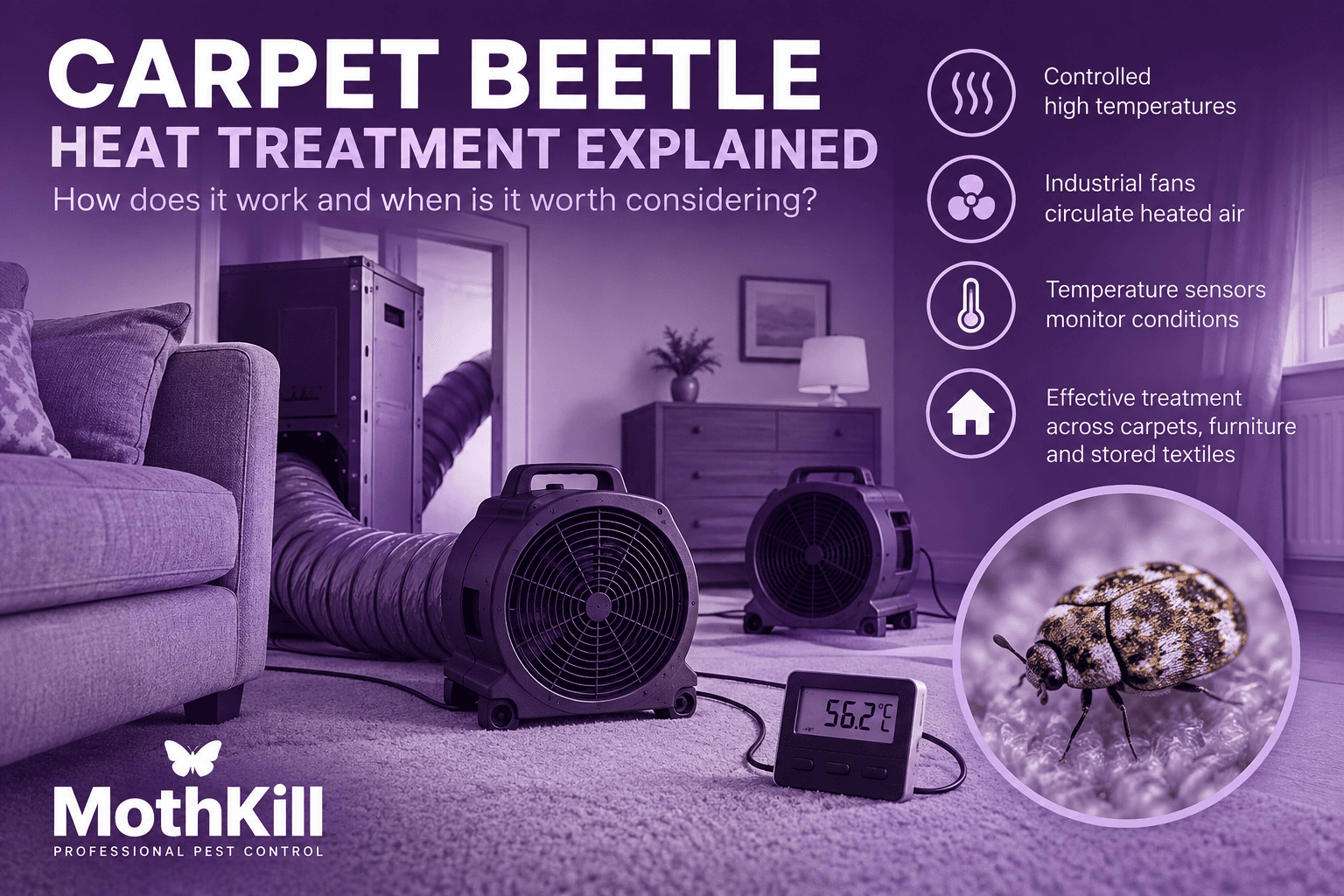
Carpet beetle heat treatment uses controlled high temperatures to target carpet beetle larvae, adults, pupae and eggs when sufficient heat reaches them for long enough.
It can be particularly useful for established infestations involving carpets, furniture, stored textiles and several areas of a property.
However, successful heat treatment involves much more than simply making a room hot.
Air circulation, temperature monitoring, exposure time and identifying slower-heating areas are all important.
This guide explains how professional carpet beetle heat treatment works, what happens during treatment, when it may be worth considering and where its limitations lie.
Why Are Carpet Beetles Difficult to Treat?
The adult beetles are often the most noticeable stage because they may appear around windows and windowsills.
The stage responsible for most textile damage, however, is the carpet beetle larva.
Larvae can remain concealed in quiet, undisturbed locations where suitable food is available.
This can include natural fibres, hair, feathers, dead insects and other animal-derived material.
🪑 Under Furniture
Quiet areas beneath beds, sofas and heavy furniture can provide food and shelter for larvae.
🧶 Carpet Edges
Larvae may be found around carpet edges, beneath furniture and in other areas that receive little regular disturbance.
👕 Stored Textiles
Stored wool, natural-fibre clothing and other susceptible materials may provide a food source.
🏠 Lofts & Cupboards
Lofts, airing cupboards and other quiet locations may harbour larvae or contain an overlooked source.
Our carpet beetle larvae guide explains what the larvae look like and where to search for them.
What Is Carpet Beetle Heat Treatment?
Professional heat treatment raises the temperature of the treatment area in a controlled manner.
Heated air is circulated throughout the property while multiple temperature sensors are used to monitor different locations.
The objective is not to achieve one impressive temperature reading beside the heater.
The important question is whether potential harbourages and slower-heating locations receive sufficient thermal exposure.
Does Heat Kill Carpet Beetles?
Yes. Carpet beetles are vulnerable to sufficiently high temperatures when exposure is adequate.
Heat can affect all major life stages:
- adult carpet beetles;
- larvae;
- pupae; and
- eggs.
But this does not mean every insect automatically dies simply because the open room becomes hot.
The thermal conditions need to reach the location where the insect is actually hiding.
Does Heat Kill Carpet Beetle Larvae?
Yes, provided the larvae themselves receive sufficient heat exposure.
This is particularly important because larvae are the stage responsible for feeding damage to susceptible materials.
They may remain hidden beneath furniture, around carpet edges, in stored textiles and in other quiet locations for extended periods.
This can make an established infestation difficult to tackle through cleaning alone.
Does Heat Kill Carpet Beetle Eggs?
Yes. Sufficient thermal exposure can kill carpet beetle eggs.
Again, the important issue is whether the eggs themselves reach effective conditions.
Eggs may be deposited in protected locations close to suitable food for emerging larvae.
A high reading in the middle of a room does not prove that every slower-heating location has reached the same conditions.
How Does Professional Carpet Beetle Heat Treatment Work?
The exact setup depends on the property, but MothKill's professional treatment process follows several important principles.
The Property Is Assessed
The infestation, property layout, likely harbourages and possible sources are considered before treatment begins.
Heat-Sensitive Items Are Identified
Items that could be affected by treatment temperatures need to be removed, protected or otherwise dealt with according to the preparation instructions.
Professional Heating Equipment Is Installed
MothKill uses professional indirect heating equipment positioned outside the property. Combustion gases remain outdoors while clean heated air is ducted into the treatment area.
Industrial Fans Circulate Heated Air
Fans help distribute heat around rooms, furniture and other areas of the treatment zone.
Multiple Temperatures Are Monitored
Sensors positioned in different locations show which areas are heating quickly and which are responding more slowly.
Effective Conditions Are Maintained
The treatment is guided by actual temperature readings and exposure rather than simply running heaters for an arbitrary period.
Why Is Airflow So Important?
Without good air circulation, heat can build up close to the heat source while protected locations remain cooler.
Industrial fans help distribute heated air:
- around beds;
- under and around accessible furniture;
- across carpeted areas;
- into room corners;
- through doorways; and
- around other potential harbourages.
Fan positioning can also be adjusted as treatment progresses.
Why Are Multiple Temperature Sensors Important?
One thermometer cannot tell you what is happening throughout an entire property.
A sensor positioned in the open room may show a high temperature while an area beneath dense furniture is considerably cooler.
Multiple sensors give the technician a better picture of how temperatures are developing throughout the treatment area.
This helps identify locations that may require:
- more treatment time;
- better airflow;
- different fan positioning; or
- closer monitoring.
What Are Cold Spots?
A cold spot is simply an area that heats more slowly than the surrounding environment.
Potential examples can include:
- beneath heavy furniture;
- inside densely packed belongings;
- around floor level;
- behind wardrobes;
- beneath beds;
- inside some furniture; and
- areas where airflow is restricted.
Finding and managing slower-heating areas is an important part of professional heat treatment.
Does Heat Penetrate Carpets?
Heat can transfer through carpets and into materials beneath them, but this should not be described as instant or unlimited penetration.
Thick carpets, underlay and insulated areas may heat at different rates.
This is why sufficient treatment time and appropriate temperature monitoring matter.
Does Heat Penetrate Furniture?
Furniture absorbs heat progressively.
The outside of a sofa, wardrobe or other item may become hot before denser or protected areas reach similar conditions.
Professional treatment therefore allows time for furniture and other contents to warm while airflow is managed around them.
Can Heat Reach Carpet Beetles Under Furniture?
It often can, particularly when heated air can be properly circulated around and beneath accessible furniture.
But it would be misleading to claim that heat automatically reaches every conceivable hiding place.
Dense materials, sealed spaces and restricted airflow can all create slower-heating locations.
Does Heat Penetrate Walls and Sealed Voids?
Heat transfers into building materials, but professional treatment should not be sold on the claim that hot air magically penetrates every sealed wall void.
A completely enclosed or heavily insulated location can behave differently from the open treatment area.
If there is evidence of a separate source in a loft, structural void or inaccessible location, that source may need to be investigated rather than simply assumed to have been treated.
What Temperature Is Used for Carpet Beetle Heat Treatment?
There is no benefit in reducing a professional treatment to one headline temperature.
The lethal effect of heat depends on both:
- temperature; and
- exposure time.
Different parts of the property also heat at different rates.
Professional treatment therefore uses multiple temperature readings to establish what is happening throughout the treatment area rather than relying solely on room-air temperature.
How Long Does Carpet Beetle Heat Treatment Take?
Professional heat treatment normally takes several hours and is generally carried out during one treatment day.
The total treatment time can depend on:
- property size;
- number of rooms;
- amount and type of furniture;
- construction and insulation;
- air circulation;
- starting temperature; and
- how quickly slower-heating locations reach the required conditions.
A fixed number of hours should not replace actual temperature monitoring.
Do You Need to Empty the House?
No.
Removing every possession can actually be counterproductive if potentially infested items are moved into untreated areas.
Many normal household belongings can remain in place.
However, heat-sensitive items need to be identified and dealt with according to the preparation instructions.
What Needs Attention Before Heat Treatment?
Depending on the property and treatment conditions, items requiring removal, protection or specific advice can include:
⚠️ Pressurised Items
Aerosols and other pressurised containers should not simply be left in the treatment area.
🕯 Wax & Sensitive Products
Candles, wax products and some cosmetics can be affected by elevated temperatures.
💊 Medicines
Medicines and other temperature-sensitive products should be dealt with according to the preparation instructions.
🪴 Plants & Pets
People, pets and plants should not remain within the heated treatment area.
🔋 Batteries & Electronics
Some batteries, electronics and related items may require specific preparation.
🪟 Heat-Sensitive Materials
Plastic blinds, rails and other temperature-sensitive materials need particular consideration.
Always follow the preparation guidance provided for your individual property.
Can Carpet Beetle Heat Treatment Damage a House?
Many normal household materials tolerate professionally controlled treatment, but the risk of heat-related damage is not zero.
Particular care can be required around:
- some UPVC components;
- plastic blinds and rails;
- laminated materials;
- MDF and bonded furniture;
- vinyl products;
- delicate adhesives;
- some decorative finishes; and
- other heat-sensitive materials.
This is another reason controlled heating and monitoring are preferable to simply trying to make a property as hot as possible.
Is Carpet Beetle Heat Treatment Chemical-Free?
Heat itself does not require an insecticide to kill carpet beetles.
A heat-only treatment can therefore be carried out without applying a residual insecticide as part of the heat process.
However, describing heat simply as “chemical-free” can be misleading if it implies that professional insecticides are inherently unsuitable.
Appropriately selected insecticides can also have a legitimate role in carpet beetle control.
Is Heat Better Than Insecticide for Carpet Beetles?
Neither method is automatically the best choice for every infestation.
| Method | Advantages | Considerations |
|---|---|---|
| Vacuuming & cleaning | Useful for removing accessible larvae, shed skins, hair, lint and food sources | May not reach concealed larvae or a widespread infestation |
| Professional insecticide | Useful for targeted treatment and may provide residual control | Correct product selection, application and treatment coverage matter |
| Professional heat | Can target multiple life stages during the treatment period without depending on insecticide susceptibility | Requires sufficient heating capacity, airflow, exposure and monitoring |
When Is Carpet Beetle Heat Treatment Worth Considering?
Professional heat treatment may be particularly worth considering when:
- larvae are being found in several rooms;
- the infestation appears established;
- carpets and furniture are extensively involved;
- activity continues despite thorough cleaning;
- stored textiles are affected;
- previous treatment has not resolved the problem; or
- a more comprehensive property treatment is required.
Find out more about MothKill's professional carpet beetle heat treatment .
When Might Heat Treatment Be Unnecessary?
Finding a single adult carpet beetle near a window does not automatically justify whole-property heat treatment.
A small and genuinely localised source may sometimes be dealt with through:
- thorough vacuuming;
- removing the larval food source;
- treating affected textiles appropriately;
- targeted professional insecticide treatment; and
- continued monitoring.
Our guide to professional carpet beetle treatment explains when professional intervention may be worth considering.
Can Carpet Beetle Heat Treatment Fail?
Yes.
No responsible pest-control treatment should be described as incapable of failure.
Possible reasons for continued carpet beetle activity include:
- a slower-heating or untreated location;
- an overlooked source;
- larvae elsewhere in the property;
- an external source;
- an old bird nest;
- untreated stored belongings;
- activity in a separate loft or void; or
- a new introduction after treatment.
An overlooked food source, old bird nest, stored natural-fibre material or separate untreated area can produce further activity.
Why Do Carpet Beetles Keep Coming Back?
One of the most important parts of carpet beetle control is identifying why larvae are present in the first place.
Possible sources include:
- wool and other animal-derived fibres;
- accumulated pet hair;
- lint and debris;
- feathers;
- dead insects;
- old bird nests;
- stored natural-fibre materials; and
- other overlooked organic material.
Read our detailed guide to why carpet beetles keep coming back .
What Happens After Carpet Beetle Heat Treatment?
After treatment, prevention and monitoring still matter.
Useful steps include:
- vacuuming regularly;
- cleaning beneath furniture;
- removing accumulated hair and lint;
- checking stored wool and natural fibres;
- investigating old bird nests where appropriate;
- monitoring windowsills for adult beetles; and
- checking for fresh larval activity.
How Do You Know Whether Carpet Beetles Are Gone?
Look for the absence of new evidence over time rather than expecting every old sign to disappear.
Old shed skins and existing textile or carpet damage remain after the insects have gone.
More useful indicators are whether you continue to find:
- live larvae;
- new shed skins;
- fresh textile damage; or
- repeated adult beetles indoors.
Carpet Beetle Heat Treatment FAQs
Does heat treatment kill carpet beetles?
Yes. Sufficient thermal exposure can kill adult carpet beetles, larvae, pupae and eggs. The important issue is ensuring that effective conditions reach the locations where the insects are hiding.
Does heat treatment kill carpet beetle eggs?
Yes, when the eggs themselves reach lethal thermal conditions for sufficient time.
Does heat treatment kill carpet beetle larvae?
Yes. Larvae are vulnerable to sufficient thermal exposure, but treatment must account for the sheltered locations in which larvae may be hiding.
Does heat treatment reach larvae under carpets?
Heat can transfer through carpet and underlay, although different materials and locations heat at different rates. Professional monitoring helps assess slower-heating areas.
Is one carpet beetle heat treatment enough?
A properly completed treatment may control an infestation during one treatment process, but recurrence cannot responsibly be ruled out in every situation. An overlooked, external or untreated source can result in further activity.
Is heat treatment better than spraying?
Both methods can be effective. Heat can target several life stages during the treatment period, while appropriately selected professional insecticides can provide useful targeted and residual control.
Do I need heat treatment if I find one carpet beetle?
Not necessarily. A single adult beetle does not automatically mean there is a serious indoor infestation. Look for larvae, shed skins, repeated adult activity and textile damage before deciding on the appropriate treatment.
Can I stay in the property during heat treatment?
No. People and pets should remain outside the heated treatment area during professional heat treatment and follow the technician's instructions regarding re-entry.
Can heat treatment damage furniture?
Many household items tolerate controlled treatment, but some materials can be heat-sensitive. Particular attention may be required for laminated or bonded furniture, plastics, adhesives and other temperature-sensitive items.
Carpet Beetle Heat Treatment: The Bottom Line
Professional heat treatment can be a powerful option for an established carpet beetle infestation, particularly when larvae are hidden across carpets, furniture, stored textiles and several areas of a property.
But its effectiveness depends on much more than reaching a high room temperature.
Heating capacity, good airflow, multiple temperature sensors, sufficient exposure time and careful management of slower-heating locations are fundamental parts of the process.
Heat is not automatically necessary for every carpet beetle sighting, and professional insecticide treatment can also be appropriate.
The right approach depends on the scale of the infestation, where the larvae are located and whether the underlying source has been identified.
Carpet Beetles in Several Rooms?
MothKill provides professional carpet beetle heat treatment for established infestations. Tell us what you are finding, how many rooms are affected and your property location and we can advise on the most appropriate next step.