Clothes Moth Heat Treatment
Professional whole-property clothes moth heat treatment using high-output heating equipment, industrial air circulation and temperature monitoring to deliver controlled heat throughout the treatment area.

Professional Heat Treatment in Action
High-output heating equipment and industrial air movement are used to distribute heat through the treatment area, including furniture, carpets and other potential moth harbourages.

Temperature Monitoring Throughout Treatment
Temperatures are monitored at multiple points during the treatment so we can track how heat is progressing through different areas of the property.
Heat Reaches Beyond the Surface
Clothes moth larvae can remain hidden in carpets, underneath furniture, around edges, inside cupboards and amongst natural fibres. Professional heat treatment is designed to raise temperatures throughout the treatment area rather than relying solely on a surface-applied insecticide.
- Targets adult clothes moths, larvae and eggs
- Heat penetrates potential hidden harbourages
- Professional heaters and industrial circulation fans
- Multiple temperatures monitored during treatment
- No insecticide spray required for the heat process
- Suitable for qualifying whole-property treatments
Need Help with a Clothes Moth Infestation?
Tell us your postcode, property size and where you are seeing moth activity or damage and we can advise on the most appropriate treatment option.
See How Professional Heat Treatment Works
Explore our interactive property demonstration. Select a room, adjust the simulated heat and discover why controlled heating, air circulation and temperature monitoring are important.
Interactive illustration only. Equipment placement, temperatures and airflow are simplified for demonstration.
Why Heat Monitoring Matters
Professional heat treatment uses industrial heating equipment and circulation fans to distribute heat. Technicians monitor temperatures and assess whether heat is reaching the places where pests may be hiding. Room-air readings alone cannot confirm successful treatment.
This simulator is educational. Readings are fictional and do not represent a live treatment, guaranteed pest mortality or a validated treatment schedule.
How Clothes Moth Heat Treatment Works
Clothes moth larvae can remain hidden deep within carpets, furniture, wardrobes and other undisturbed areas. Professional heat treatment is designed to raise temperatures throughout those areas while the treatment is continuously monitored.
Inspection & Preparation
We assess the affected property, likely harbourages and contents before positioning the heating and air-circulation equipment.
Controlled Heating
Professional heaters and industrial fans progressively raise and circulate heat through the treatment area rather than simply heating the surface.
Monitor & Maintain
Sensors are used at multiple points so temperatures can be monitored and the treatment adjusted where necessary.
Designed to Reach Hidden Moth Harbourages
The damaging stage of a clothes moth infestation is the larva. Larvae can feed in quiet, protected areas where conventional surface treatments may be difficult to apply effectively.
- Targets adult moths, larvae and eggs
- Heat circulates through treated rooms and contents
- Reaches carpets, furniture and potential harbourages
- No insecticide spray required for the heat process
- Professional equipment and industrial air movement
- Temperature monitoring throughout treatment
It's Not Just About Making the Room Hot
Successful heat treatment depends on achieving appropriate temperatures in the places insects may actually be hiding. Air temperature alone does not tell the whole story.
Think You Have Clothes Moths?
Tell us what you've found, your property size and postcode. We can discuss whether professional heat treatment is suitable for the infestation and property.


Clothes Moth Heat Treatment FAQs
Find answers to common questions about professional clothes moth heat treatment, including preparation, temperatures, safety, treatment time and what to expect afterwards.
Heat Treatment & Results
How professional clothes moth heat treatment works and what it targets.
How Clothes Moth Heat Treatment Works
Does heat treatment get rid of clothes moths?
Yes. Professional heat treatment can be highly effective against clothes moth infestations when the correct temperatures reach the affected areas.
Unlike a surface treatment, heated air can circulate around furniture, carpets and other potential harbourages. At MothKill, we use professional heating equipment, powerful air-moving fans and multiple temperature sensors to monitor conditions throughout treatment.
Does heat treatment kill clothes moth eggs?
Yes. When sufficiently high temperatures reach the insects and remain there for long enough, heat can kill clothes moth eggs, larvae, pupae and adult moths.
This is one of the major advantages of heat treatment because eggs and larvae can hide deep within carpets, furniture, wardrobes and other difficult-to-access areas.
Does heat treatment kill clothes moth larvae?
Clothes moth larvae cause most of the damage to carpets, clothing and other natural fibres. Correctly performed heat treatment can kill larvae as well as eggs and adult moths.
Larvae often hide underneath furniture, around carpet edges and in dark, undisturbed areas. Therefore, good heat distribution and careful temperature monitoring are important.
How does clothes moth heat treatment work?
Professional heating equipment gradually raises temperatures throughout the treatment area. Industrial fans then circulate the heated air around rooms, furniture and potential moth harbourages.
We position multiple temperature sensors throughout the property. This allows us to monitor conditions and identify cooler areas that need additional heat or airflow.
The objective is not simply to make the room hot. Instead, the heat needs to reach the places where moth eggs and larvae are actually hiding.
It Isn't Just About Making a Room Hot
Successful treatment depends on heat reaching carpets, furniture, wardrobes, cracks, edges and other potential harbourages. We use powerful air circulation and multiple temperature sensors throughout the treatment.
Temperature, Treatment Time & Carpets
What temperature is needed to kill clothes moths?
Clothes moths and their developing stages are vulnerable to sustained high temperatures. During professional treatment, room temperatures may reach approximately 50–60°C or higher in selected areas.
However, air temperature alone does not determine whether treatment has succeeded. Effective temperatures need to reach carpets, furniture and other potential harbourages and remain there for sufficient time.
How long does clothes moth heat treatment take?
Most professional clothes moth heat treatments take several hours and can occupy much of the day.
The exact treatment time depends on the size and layout of the property, its contents and how quickly the required temperatures develop throughout the affected areas.
For this reason, we monitor temperatures throughout treatment rather than relying on a fixed treatment time alone.
Why is heat treatment effective for clothes moths in carpets?
Clothes moth larvae often hide in dark, undisturbed areas. Common locations include underneath furniture, along carpet edges, beneath beds and around skirting boards.
Heated air can circulate throughout the room and around furniture. As a result, heat treatment can target areas that may be difficult to reach with surface treatments alone.
Do I need to remove my carpets?
Normally, no. Carpets can usually remain in place and form part of the treatment area.
However, badly damaged or heavily infested carpet may sometimes need replacing for cosmetic reasons even after the infestation itself has been controlled.
Preparing Your Home
What stays, what moves and what may need protecting before treatment.
Clothing, Wardrobes & Carpets
Do I need to empty wardrobes before clothes moth heat treatment?
Wardrobes and cupboards need preparation so heated air can circulate effectively.
Depending on their contents, clothing may need to be loosened, separated, removed or treated separately. Tightly packed wardrobes and drawers can create insulated areas that take considerably longer to reach effective temperatures.
We provide detailed preparation instructions before treatment.
Do I need to wash all my clothes before treatment?
Not necessarily. The correct approach depends on the garments and how we plan to treat the property.
Suitable clothing can be washed or tumble dried according to the manufacturer's care instructions. Delicate items may require dry cleaning or another appropriate treatment.
Most importantly, keep treated and untreated clothing separate. Doing so reduces the risk of accidentally reintroducing moth eggs or larvae after treatment.
Items That May Need Removing or Protecting
What items need to be removed before heat treatment?
Some belongings can become damaged or unsafe when exposed to prolonged high temperatures. Therefore, certain items may need removing or protecting before treatment.
Other items can include cosmetics, perfumes, some electronics, heat-sensitive plastics and food or drink that heat may damage.
You will receive preparation instructions before treatment. If you are unsure about a particular item, ask us before removing it.
Safety & Your Property
Important information about furniture, plastics, UPVC and other materials.
Furniture, Plastics & Decorating
Can clothes moth heat treatment damage furniture?
Most normal household furniture tolerates professional heat treatment well. However, some materials can be sensitive to prolonged high temperatures.
Laminated and MDF furniture can contain adhesives that may soften. In some cases, laminate or edging may lift or separate.
Please discuss delicate, antique or particularly valuable furniture with us before treatment.
Can heat treatment damage plastic items?
Some plastics can soften, distort or warp at elevated temperatures.
Where practical, remove plastic blinds, curtain rails, lightweight mouldings and other heat-sensitive plastic items before treatment.
Can heat treatment affect wallpaper?
It can. Elevated temperatures can soften some wallpaper adhesives, particularly where wallpaper is old, poorly applied or already lifting.
Occasionally, this can cause bubbling, curling or lifting around the edges.
Can heat treatment affect paintwork?
Good-quality paintwork normally tolerates treatment. However, old, damaged or poorly applied paint can occasionally bubble, crack or peel when exposed to prolonged heat.
Are UPVC windows and doors safe during heat treatment?
UPVC and associated fittings can be sensitive to excessive temperatures.
We monitor temperatures and take precautions around vulnerable windows, doors and fittings. Material quality, age, existing condition and proximity to hot airflow can all affect how UPVC responds.
During the Heat Treatment
Are there diesel fumes inside my home?
No. MothKill uses indirect diesel heating equipment. The heater remains outside the property, while its combustion gases exhaust outdoors.
We duct clean heated air into the property. Diesel exhaust fumes are not pumped into your home.
Can I stay in my home during clothes moth heat treatment?
People and pets should not remain in heated treatment areas while treatment takes place.
Temperatures become uncomfortable, while surfaces, ducting and other items can become very hot. We will advise you when the treatment has finished and when it is appropriate to return.
Is clothes moth heat treatment safe?
Professional heat treatment is a controlled process that uses specialist equipment and temperature monitoring.
Nevertheless, treatment involves unusually high temperatures. Preparation is therefore important. We ask customers to remove or protect heat-sensitive and potentially hazardous items before treatment.
Heat Treatment & Insecticides
Do you use insecticides with clothes moth heat treatment?
Heat is the primary control method during a heat treatment. Therefore, it can significantly reduce reliance on insecticides.
Depending on the infestation and treatment plan, we may also recommend targeted professional insecticide, insecticidal dust or monitoring traps as part of an integrated approach.
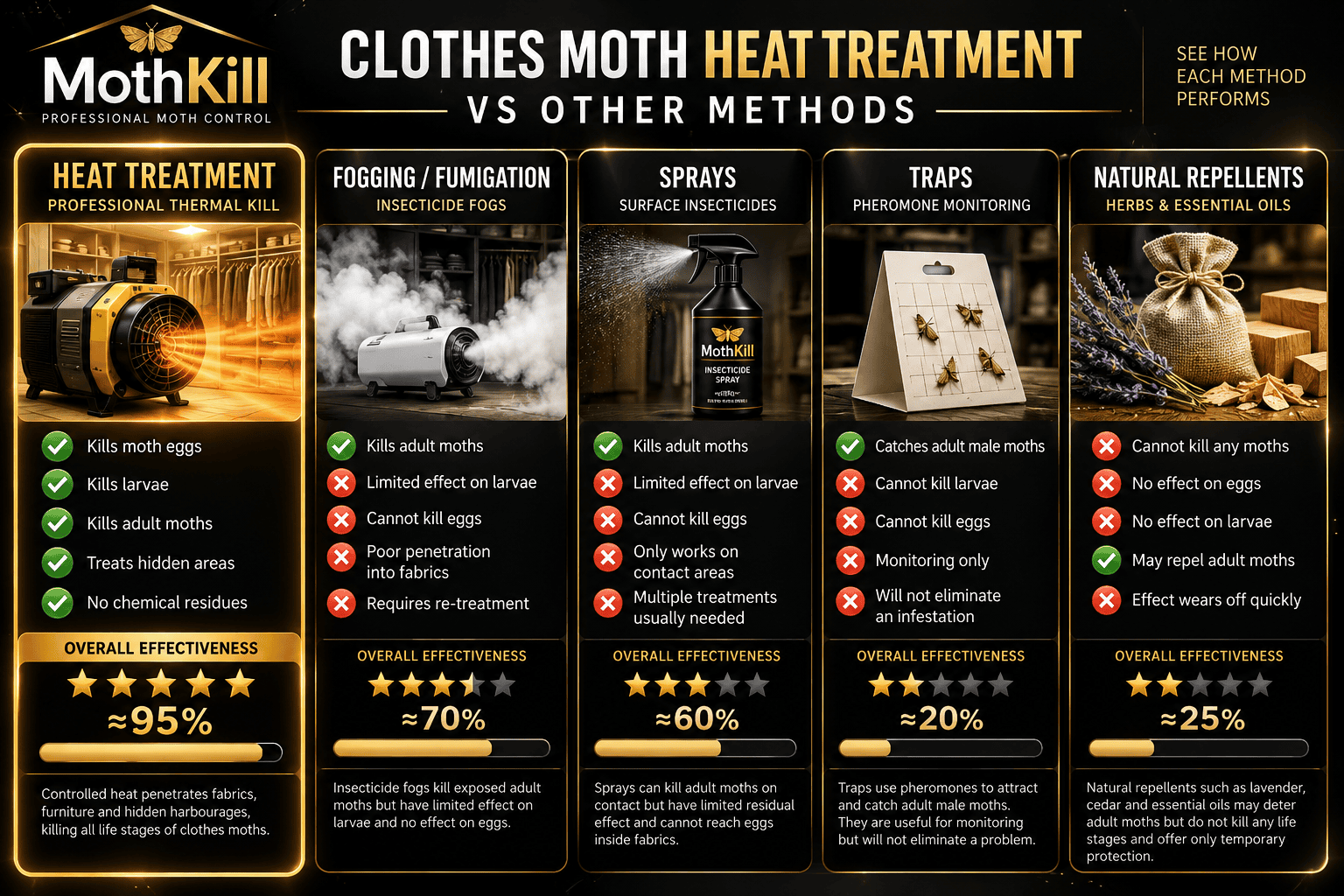
Is heat treatment better than spraying for clothes moths?
Both methods have their place. However, heat treatment has an important advantage: sufficiently high temperatures can kill clothes moths across their life cycle, including eggs and larvae, without relying solely on a surface-applied insecticide.
Another advantage is that heated air can reach many areas around carpets, furniture and other belongings that can be difficult to treat individually.
For some infestations, combining different control methods can provide the most appropriate treatment plan.
After Treatment & Prevention
What to expect afterwards and how to reduce the risk of moths returning.
Treatment Results & Reinfestation
Can clothes moth heat treatment fail?
Heat treatment can be extremely effective, but no responsible pest treatment should be described as incapable of failure.
Problems can occur when rooms are poorly prepared, wardrobes or belongings are packed too tightly, heavy clutter creates insulated areas or moth activity exists in parts of the property that have not been treated.
Correct preparation, good air circulation and careful temperature monitoring greatly improve treatment success.
Can clothes moths come back after heat treatment?
Yes. Even after successful treatment, infested clothing, rugs, furniture or other natural-fibre items can potentially reintroduce clothes moths into a property.
For that reason, ongoing vacuuming and monitoring are sensible. It is also worth checking second-hand textiles and furniture before bringing them into your home.
Why am I still seeing moths after treatment?
Seeing an occasional moth shortly after treatment does not automatically mean that a full infestation remains.
Correct identification is important because not every small moth found indoors is a clothes moth. Monitoring traps can help establish whether clothes moth activity is continuing.
If you continue seeing suspected clothes moths after treatment, contact us so we can assess the situation.
Monitoring & Prevention
Should I use pheromone moth traps after treatment?
Yes. Clothes moth pheromone traps can be useful for monitoring adult male moth activity after treatment.
However, traps should not normally be the sole method used to control an established infestation because they do not remove hidden eggs and larvae.
What can I do to stop clothes moths returning?
Regular vacuuming is one of the most useful preventative measures. Pay particular attention to carpet edges, underneath furniture, inside wardrobes and other dark, undisturbed areas.
In addition, inspect natural-fibre clothing and textiles regularly. Store vulnerable garments clean and appropriately protected, and check second-hand rugs, furniture and clothing before bringing them into your home.
Pheromone monitoring traps can also help detect renewed adult moth activity early.
Warranty
Complete-Property Treatment Protection
MothKill provides a 6-month warranty when the complete property is professionally heat treated, subject to our terms, preparation requirements and treatment conditions. We cannot normally provide the same warranty when only selected rooms are treated because moth eggs or larvae may already be present elsewhere in the property.
Why Choose MothKill?
Why choose MothKill for clothes moth heat treatment?
MothKill specialises in professional treatment for clothes moths and other textile pests.
We use powerful indirect heating equipment, industrial air circulation and multiple temperature sensors during our heat treatments.
Our aim is not simply to make a room hot. Instead, we focus on achieving effective temperatures in carpets, furniture and other areas where clothes moth eggs and larvae may be hiding.
Qualifying complete-property treatments also include our 6-month warranty, subject to our terms and preparation requirements.
Worried About Clothes Moths?
Tell us about the problem and your property. We can discuss the infestation, explain the treatment options and provide a no-obligation quote.
Professional clothes moth heat treatment • MothKill