Clothes Moth Fumigation
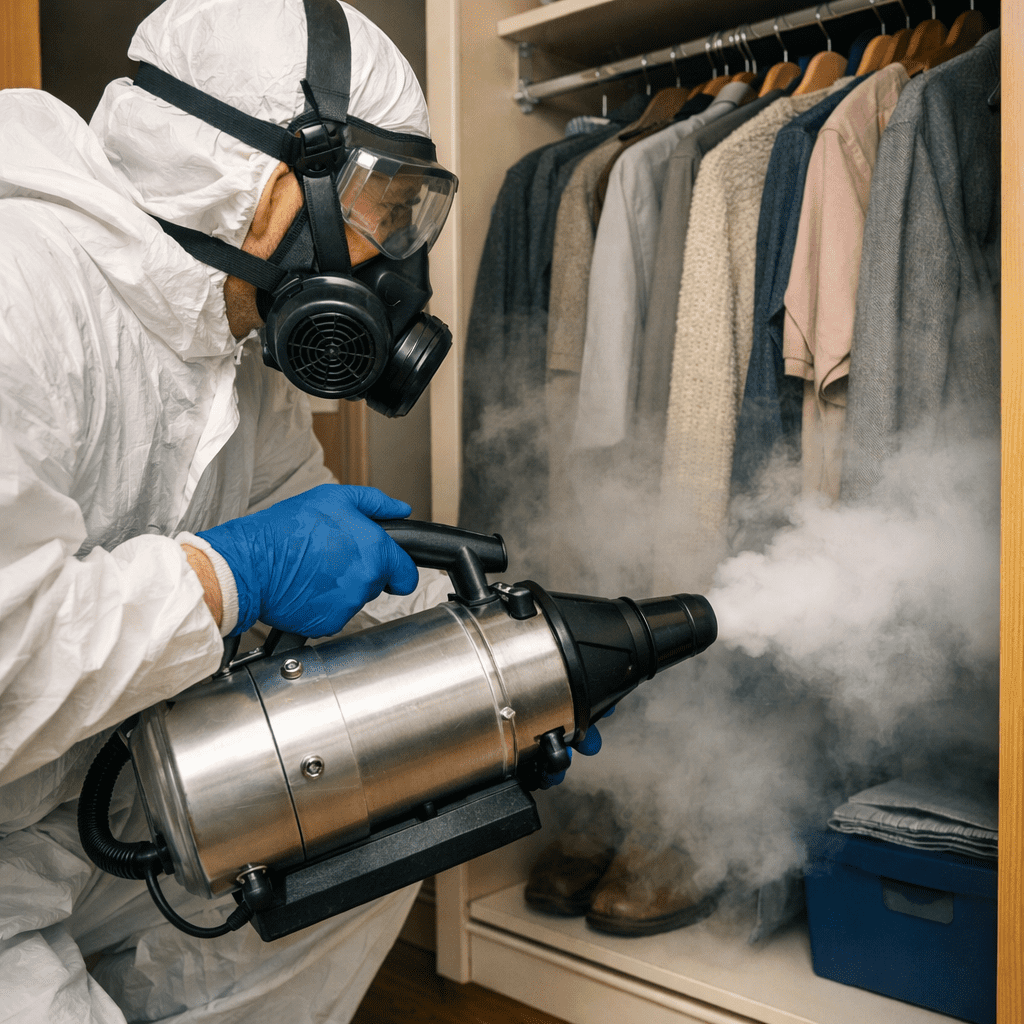
If you are searching for clothes moth fumigation, you are probably looking for a treatment capable of dealing with an infestation throughout your home rather than simply killing the adult moths you can see.
However, the word “fumigation” is often used loosely. True professional fumigation, residual insecticide spraying, ULV treatment, smoke generators and heat treatment are different pest-control methods.
Understanding the difference matters because clothes moth larvae and eggs can be hidden beneath furniture, around carpet edges, inside wardrobes and among vulnerable textiles.
This guide explains what clothes moth fumigation actually means, how the main treatment methods differ and which approaches may be appropriate for an established infestation.
What Is Clothes Moth Fumigation?
True fumigation involves the use of a pesticidal gas within an appropriately controlled and sealed environment.
That is different from spraying a residual insecticide around a room, applying a ULV mist or using an insecticidal smoke product.
In everyday conversation, however, people often use “fumigation” as a general term for almost any pest-control treatment involving a spray, fog, smoke or airborne product.
Fumigation, Fogging, Spraying and Heat: What's the Difference?
True Fumigation
Uses a pesticidal gas within a controlled environment. This is not the same as ordinary household insecticide spraying or fogging.
Residual Insecticide
An authorised insecticide is applied to appropriate surfaces and harbourage areas according to its label, providing treatment where insects may contact treated surfaces.
ULV Treatment
Ultra-low-volume equipment creates fine droplets of an appropriate insecticide formulation. It can form part of some professional treatment programmes but is not true fumigation.
Heat Treatment
Uses elevated temperatures rather than pesticidal gas. Effective treatment depends on controlled heating, airflow, exposure time and temperature monitoring.
Is Spraying a House the Same as Fumigation?
No.
A professional residual insecticide treatment normally involves applying an authorised product to appropriate surfaces and harbourage areas in accordance with its label.
Depending on the product, an active residue may remain on treated surfaces for a period after application.
Clothes moth larvae or adults encountering those treated surfaces may then be exposed to the active ingredient.
That is a different process from true fumigation.
Is ULV Fogging the Same as Fumigation?
No.
Ultra-low-volume equipment produces very small droplets of an appropriate insecticide formulation.
The droplets can disperse through an area and ULV treatment may contribute to some professional pest-control programmes.
However, airborne droplets should not be assumed to reach every clothes moth egg or larva hidden beneath furniture, within carpets or among stored materials.
Are Moth Smoke Bombs Fumigation?
Smoke generators and similar products are sometimes casually described as fumigation products.
They release an insecticidal product into a treatment area, but this is not equivalent to specialist structural fumigation using a pesticidal gas.
The effectiveness of any pesticide treatment depends on factors including the authorised product, active ingredient, formulation, target pest, application method and whether the treatment reaches the relevant insects.
Why Are Clothes Moths Difficult to Treat?
The adult moths flying around a property are only one stage of the infestation.
The characteristic damage to wool carpets and vulnerable clothing is caused by the larval stage.
Larvae can remain concealed in dark, protected and relatively undisturbed locations. Killing the visible adult moths therefore does not necessarily remove the underlying infestation.
Where Can Clothes Moth Larvae Be Hiding?
This hidden larval activity is one reason an apparently simple moth problem can continue even after numerous adult moths have been killed.
Why Clothes Moth Eggs Matter
Clothes moth eggs are tiny and can be extremely difficult to locate individually.
After hatching, larvae begin feeding on suitable materials and can remain concealed while developing.
An established infestation can therefore contain eggs, larvae, pupae and adults at the same time.
Our guide to the clothes moth larvae life cycle explains these stages in more detail.
Does Clothes Moth Fumigation Kill Eggs?
There is no sensible yes-or-no answer unless you know exactly what treatment is being called “fumigation”.
Different insecticides, formulations and application methods can have different effects on different life stages.
You should not assume that because a room has been sprayed, fogged or treated with an insecticidal smoke product, every hidden egg has automatically been killed.
The actual product, application method and treatment coverage determine what can reasonably be expected.
Does Insecticide Spray Work Against Clothes Moths?
Yes. Authorised insecticides can play an important role in professional clothes moth control when they are selected and applied correctly.
Residual treatment may be particularly useful on suitable surfaces and around harbourage areas where larvae or adults are likely to travel.
However, insecticide should be part of a considered treatment programme.
Does Fogging Work for Clothes Moths?
Fogging can potentially contribute to a professional treatment programme, depending on the authorised product and circumstances.
Its limitations need to be understood.
Fine droplets may disperse around a room, but concealed larvae can be protected by furniture, carpet construction, stored materials and other physical barriers.
Fogging should therefore not be viewed as a replacement for inspection, cleaning, source identification and appropriate targeted treatment.
What About Insecticidal Dust?
Appropriate insecticidal dust can be useful in suitable cracks, voids and other locations where its authorised use permits.
Dust is different from a space treatment because it can remain within an appropriate harbourage after application.
It should be applied carefully and according to its label rather than unnecessarily scattered over exposed living surfaces.
Can You Fumigate a Wardrobe for Clothes Moths?
A more useful question is whether the wardrobe contains active larvae, eggs or infested clothing.
If clothes are affected, suitable garments may need individual attention through methods such as washing, dry cleaning, controlled freezing or another appropriate treatment.
The wardrobe itself should also be inspected and cleaned.
Introducing an airborne or strong-smelling product does not remove the need to find and deal with affected textiles.
Do I Need to Remove My Clothes Before Moth Treatment?
It depends on the treatment being carried out.
Preparation for an insecticide treatment can differ significantly from preparation for professional heat treatment.
Some clothing may need to be removed, washed, dry cleaned or otherwise treated, while other items may remain in place depending on the treatment plan.
Follow the preparation instructions supplied for the specific treatment rather than using generic advice from another treatment method.
Should I Vacuum Before Clothes Moth Treatment?
Vacuuming can be one of the most useful parts of clothes moth management.
It can physically remove accessible larvae, some eggs, debris, hair, lint and other material from affected areas.
Pay particular attention to:
- carpet edges;
- beneath accessible furniture;
- under beds;
- beneath wardrobes;
- inside empty cupboards; and
- areas where hair and lint accumulate.
Where residual insecticide treatment is planned, follow your pest controller's instructions about when vacuuming should take place in relation to treatment.
How Long Does Clothes Moth Fumigation Take?
It depends entirely on what treatment is actually being described.
Residual insecticide application, ULV treatment, smoke products, true fumigation and professional heat treatment all involve different procedures and timescales.
Before treatment, ask:
- what treatment method is being used;
- which authorised product is being applied, where relevant;
- how long the treatment is expected to take;
- how long the property needs to remain vacant;
- whether follow-up treatment is expected; and
- what preparation is required.
Will One Clothes Moth Treatment Be Enough?
Sometimes, but not always.
The answer depends on the treatment method, extent of the infestation, treatment coverage and whether all important breeding areas have been identified.
Some residual insecticide programmes involve follow-up treatment because developing insects may continue to emerge and because residual treatment works differently from a whole-area thermal process.
Heat treatment is carried out differently and aims to expose the relevant life stages within the treatment area to effective temperatures.
Is Heat Treatment the Same as Fumigation?
No.
Professional heat treatment controls insects through elevated temperature rather than pesticidal gas.
Heating equipment raises temperatures within the treatment area while fans help distribute heated air.
Temperature sensors are used to monitor different locations.
When effective thermal conditions reach clothes moth eggs, larvae, pupae and adults for sufficient time, those life stages can be killed.
Read our guide to how clothes moth heat treatment works for more information.
Why Consider Heat for an Established Clothes Moth Infestation?
Heat treatment can be particularly useful when activity is established throughout carpets, furniture or several rooms.
It does not depend on applying insecticide directly to every individual moth or larva.
However, heat treatment has its own requirements and limitations. Preparation matters, heat-sensitive belongings need consideration, airflow needs to be managed and temperatures need to be monitored throughout treatment.
Learn more about professional clothes moth heat treatment .
Is Heat Always Better Than Insecticide?
No.
Good clothes moth control should not be reduced to “heat good, insecticide bad” or the opposite.
A small and genuinely localised infestation may not justify whole-property heat treatment.
Professional insecticides can provide useful targeted and residual control when they are used appropriately.
For a widespread infestation, heat may provide a practical way of treating a much larger environment.
Some treatment programmes may also use more than one method.
Which Clothes Moth Treatment Is Best?
There is no single treatment method that is automatically the right choice for every property.
| Situation | Methods That May Be Considered |
|---|---|
| Small, localised activity | Source removal, thorough vacuuming, treatment of affected textiles and monitoring. |
| Infested clothing | Appropriate laundering, dry cleaning, controlled freezing or another suitable item-specific method. |
| Localised professional treatment | Appropriate residual insecticide and/or dust treatment where authorised and suitable. |
| Established multi-room infestation | Professional heat treatment, insecticide treatment or an integrated approach depending on the property. |
How Do I Know Whether My Clothes Moth Infestation Is Serious?
Do not judge the size of the infestation solely by the number of adult moths you see flying.
More useful evidence includes:
- living larvae;
- fresh damage to vulnerable clothing;
- damage to wool carpets;
- larvae beneath several pieces of furniture;
- activity in multiple rooms;
- continued pheromone-trap catches; and
- repeated activity despite thorough cleaning.
Can Pheromone Traps Replace Fumigation?
No.
Clothes moth pheromone traps are primarily useful for monitoring.
They can help identify adult male moth activity and provide useful information about whether activity is continuing.
They do not directly kill eggs and larvae hidden in carpets, furniture and textiles.
Read our guide to what clothes moth pheromone traps do for more information.
Can I Fumigate Clothes Moths Myself?
Consumers should use only pest-control products authorised for their intended use and follow the product label exactly.
Do not improvise with pesticides, mix products or assume that applying more product will produce a better result.
If activity is widespread, identifying the source and extent of the infestation is generally more useful than repeatedly applying different DIY products without understanding where the larvae are developing.
Why Do Clothes Moths Sometimes Return After Treatment?
Continued activity after treatment can have several explanations.
Missed Breeding Area
Larvae may remain beneath furniture, among stored textiles or in another protected location that was not identified.
Partial Treatment
Treating one room may not resolve activity if the infestation is also established elsewhere in the property.
Life Cycle
Depending on the treatment method, developing insects may continue to appear and planned follow-up treatment may form part of the programme.
Reintroduction
Clothes moths can potentially be reintroduced through vulnerable textiles, rugs, furniture or other infested items.
Monitoring after treatment can help establish whether activity is genuinely continuing and whether further investigation is required.
How Can I Reduce the Risk of Clothes Moths Returning?
Once an infestation has been brought under control:
- vacuum beneath furniture regularly;
- clean around carpet edges;
- store vulnerable clothing clean;
- inspect wool and cashmere periodically;
- check second-hand rugs and furniture;
- reduce accumulations of hair and lint; and
- monitor previously affected areas for renewed activity.
Frequently Asked Questions
Does clothes moth fumigation work?
It depends on what is actually meant by “fumigation”. True fumigation, residual insecticide spraying, ULV treatment, smoke products and heat treatment are different methods. Ask exactly what treatment is being proposed and what it is intended to achieve.
Is fogging the same as fumigation?
No. ULV fogging produces fine droplets of an appropriate insecticide formulation, whereas true fumigation uses a pesticidal gas within a controlled environment.
Does spraying kill clothes moth eggs?
Do not assume that every insecticide or spray application kills every life stage. Effectiveness depends on the authorised product, application method and whether treatment reaches the relevant insects.
Is heat treatment a type of fumigation?
No. Heat treatment uses elevated temperatures to control clothes moths rather than a pesticidal gas.
Do I have to leave the house during moth treatment?
It depends on the treatment. Follow the technician's product-specific safety and re-entry instructions for insecticide applications. People and pets should not remain within areas undergoing professional heat treatment.
How many clothes moth treatments will I need?
It depends on the infestation and treatment method. Some insecticide programmes involve follow-up treatments. Heat treatment uses a different process and treatment programme.
Does needing another treatment mean the first treatment failed?
Not necessarily. Some treatment programmes are deliberately designed around more than one visit because of pest biology, treatment method, residual activity, monitoring and the possibility of hidden breeding areas.
What is the best treatment for a severe clothes moth infestation?
There is no single best method for every property. The extent of activity, affected materials, hidden breeding areas and property layout should be considered before choosing professional insecticide treatment, heat treatment or an integrated approach.
Clothes Moth Fumigation: Final Thoughts
If you are looking for “clothes moth fumigation”, first establish what treatment is actually being offered.
Fumigation, fogging, residual spraying and heat treatment are not interchangeable terms.
For a small infestation, careful cleaning, source removal and treatment of affected items may be sufficient.
For widespread activity involving carpets, furniture or several rooms, professional insecticide treatment, heat treatment or an integrated approach may be more appropriate.
Most importantly, a treatment strategy needs to address the hidden larvae and breeding areas rather than concentrating only on the adult moths you can see.
Dealing With an Established Clothes Moth Infestation?
If clothes moth activity is affecting carpets, furniture or several rooms, MothKill can help you determine whether professional heat treatment or another treatment approach is appropriate.