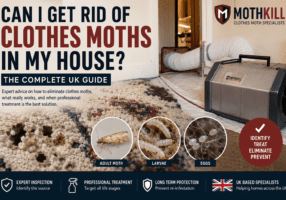
Clothes moth larvae on walls and ceiling

Finding clothes moth larvae crawling on a wall or even across the ceiling can be confusing. Clothes moth larvae feed on natural fibres, so why would they be halfway up a painted wall where there is apparently nothing for them to eat?
The answer is usually that the wall is not the source of the infestation. A larva may have moved away from the material it has been feeding on and travelled to a quieter location before pupating. The important question therefore isn't simply how to remove the larva from the wall. It is where did it come from?
Quick answer: Clothes moth larvae seen on walls or ceilings may have travelled away from an infested carpet, rug, upholstered item, stored clothing or another source containing suitable natural fibres. Removing the visible larva deals with that individual insect — it does not necessarily deal with the infestation.
Why Are Clothes Moth Larvae Crawling on My Walls?
Clothes moth larvae do the damaging and feeding. Adult clothes moths do not eat your carpet or clothing.
The larvae feed on suitable materials containing animal-derived fibres and substances, particularly wool, fur, feathers and other keratin-containing material. Depending on the species and conditions, lint, hair and other organic debris can also contribute to suitable harbourages.
Once a larva has developed sufficiently, it may move away from its feeding site looking for a protected place in which to pupate. That movement is one reason larvae or their cases can sometimes be discovered somewhere that appears completely unrelated to the damaged material.
They Can Wander
The place where you spot a larva is not necessarily the place where it has been feeding.
They Prefer Hidden Areas
Carpet edges, underneath furniture, wardrobes and other undisturbed areas can allow an infestation to develop unnoticed.
Look for the Source
Repeated larvae on a wall should prompt an inspection of the room rather than repeated removal of the insects you can see.
The Wall May Be a Clue, Not the Problem
This is where clothes moth investigations can go wrong. The obvious insect attracts all the attention, while the actual breeding and feeding area remains untouched.
In practice, if I find larvae away from an obvious source, I start looking at the surrounding room as a whole. A wall sighting gives me a reason to investigate — it doesn't automatically tell me where treatment needs to be concentrated.
Where Should You Look for the Source?
Start close to the area where the larvae are being found, but don't stop there. Clothes moth activity is often strongest in places that receive very little disturbance.
- Along the edges of wool and wool-blend carpets
- Under sofas, beds, wardrobes and heavy furniture
- Behind furniture that has not been moved for a long time
- Inside wardrobes and drawers containing natural-fibre clothing
- Under rugs and around their edges
- Stored woollen clothing, blankets and textiles
- Upholstered furniture containing suitable natural materials
- Dark corners and undisturbed areas around skirting boards
- Accumulations of hair, lint and organic debris in protected areas
What Do Clothes Moth Larvae on Walls Look Like?
Correct identification matters because not every small larva, case or caterpillar-like insect found indoors is a clothes moth.
The common clothes moth, Tineola bisselliella, has pale larvae with a darker head. Another important household species is the case-bearing clothes moth, whose larva carries a portable silken case. These cases can be particularly noticeable when they appear on walls.
| What you find | What it may indicate | What to check next |
|---|---|---|
| Pale caterpillar-like larva | Possible clothes moth larva | Natural-fibre materials nearby |
| Small portable case on wall | Possible case-bearing clothes moth larva | Carpets, textiles and hidden feeding areas |
| Silken material around carpet edges | Possible larval activity | Inspect beneath and around the carpet edge |
| Irregular damage to wool | Active or previous textile pest feeding | Inspect surrounding undisturbed material |
| Adult moths plus larvae | Possible established infestation | Carry out a wider inspection of the property |
If you're unsure what you're looking at, see our guide to clothes moth larvae and their lifecycle.
Why Are Clothes Moth Larvae on the Ceiling?
A larva found at ceiling level can seem particularly strange. There is usually little or nothing on a normal painted ceiling for a clothes moth larva to feed upon.
Its presence there can therefore be a sign of movement rather than feeding. It may have travelled up a wall before settling in a protected edge, crack, corner or junction.
If the infestation is actually developing in a wool carpet beneath a bed, treating a visible larva at ceiling height misses the important part of the problem. Successful control depends on finding and dealing with the breeding and feeding sites.
What Should You Do When You Find Clothes Moth Larvae on a Wall?
Why Simply Killing the Larvae You See Often Fails
This is one of the biggest mistakes people make with clothes moths.
You see a larva, kill it and assume the problem has gone. Another appears several days later, so you kill that one too. This can continue while eggs and larvae remain hidden elsewhere.
Effective control needs to consider the whole lifecycle and the areas in which the insects are actually developing.
This is also why randomly spraying accessible surfaces can give disappointing results. A treatment is only as good as the inspection behind it.
Could the Larvae Be Coming From the Carpet?
Yes. Wool carpets can provide an excellent food source for clothes moth larvae, and the most heavily affected areas are not always obvious.
Activity can occur around carpet edges and underneath furniture where there is little foot traffic or vacuuming. Damage underneath a bed or wardrobe can develop for some time before the homeowner notices adult moths or wandering larvae elsewhere in the room.
If you have a wool carpet and repeatedly find clothes moth larvae on nearby walls, the carpet should be high on the inspection list.
Could They Be Coming From a Wardrobe?
They can. A wardrobe containing wool, cashmere, fur, feathers or other susceptible materials can support an infestation, particularly where items have been stored undisturbed.
Look beyond obvious holes in clothing. Check folds, seams, the backs and bottoms of drawers, corners of wardrobes and items that have not been worn recently.
Our guide to Tineola bisselliella explains more about the common clothes moth and the materials its larvae attack.
Do Pheromone Traps Solve the Problem?
Pheromone traps can be useful as a monitoring tool. They can help establish whether adult male clothes moths are present and provide information about ongoing activity.
They should not, however, be confused with complete infestation control. Catching adult males does not automatically remove larvae and eggs hidden within susceptible materials.
When Is Professional Clothes Moth Treatment Worth Considering?
Professional help becomes particularly useful when larvae continue appearing, textile damage is increasing, several rooms show activity or the source cannot be identified.
The inspection is important. Treating one visible location without understanding how far the infestation extends can leave other active areas untouched.
MothKill provides professional clothes moth treatment and specialist clothes moth heat treatment for established infestations.
Still Finding Clothes Moth Larvae?
If larvae keep appearing on your walls or ceilings, the next job is to find where they are coming from. MothKill specialises in identifying and treating clothes moth infestations in UK homes.
ENQUIRE ABOUT TREATMENT VIEW MOTH TREATMENTFrequently Asked Questions
Why do I keep finding clothes moth larvae on my walls?
Repeated sightings may mean larvae are moving away from a nearby feeding or harbourage area. Inspect carpets, rugs, furniture, wardrobes and stored natural-fibre textiles rather than concentrating only on the wall.
Can clothes moth larvae climb walls?
Larvae can move away from feeding sites and may be found on vertical surfaces. Finding one on a wall does not mean the wall itself is providing food.
Why are clothes moth larvae on my ceiling?
A larva at ceiling level may have travelled from another part of the room while seeking a protected place. Inspect the surrounding room carefully for the actual source.
Are clothes moth larvae damaging my wall?
Ordinary painted walls are not the material clothes moth larvae are normally seeking as food. The greater concern is susceptible natural-fibre material elsewhere in the property.
Should I spray clothes moth larvae on the wall?
Killing an individual visible larva does not necessarily control an infestation. Finding the source and dealing with the wider lifecycle is more important than treating only the surface where a larva happens to appear.
Does seeing one clothes moth larva mean I have an infestation?
One sighting alone does not tell you the size of a problem. Check for further larvae, adult moths, cases, webbing and textile damage. Repeated activity is a stronger reason for a detailed inspection.