
The Home Infestation Handbook
A practical, evidence-led guide to bed bugs, clothes moths, carpet beetles, rats and mice — written from real pest-control experience rather than recycled internet advice.
 THE PRACTICAL GUIDE TO HOME INFESTATIONS
Pest Problems Are Confusing Enough Already
Search online for advice about bed bugs, clothes moths, carpet beetles, rats or mice and you can quickly find hundreds of different answers.
Some advice is useful. Some is outdated. Some only solves part of the problem. And some can waste money, spread an infestation or make the situation considerably harder to deal with.
The Home Infestation Handbook is being written to cut through that confusion.
Killing a Pest Is Not Always the Same as Solving an Infestation
You can kill a bed bug and still have bed bugs. Catch a mouse and still have mice. Poison a rat and never discover how rats are entering the building.
Successful pest control is about understanding what is happening, identifying the cause, choosing the right method and knowing when the problem has actually been solved.
That principle runs throughout this book.
Five Major Household Pest Problems
The handbook focuses on five pest problems that can be difficult, expensive and frustrating to eliminate when the underlying cause is misunderstood.
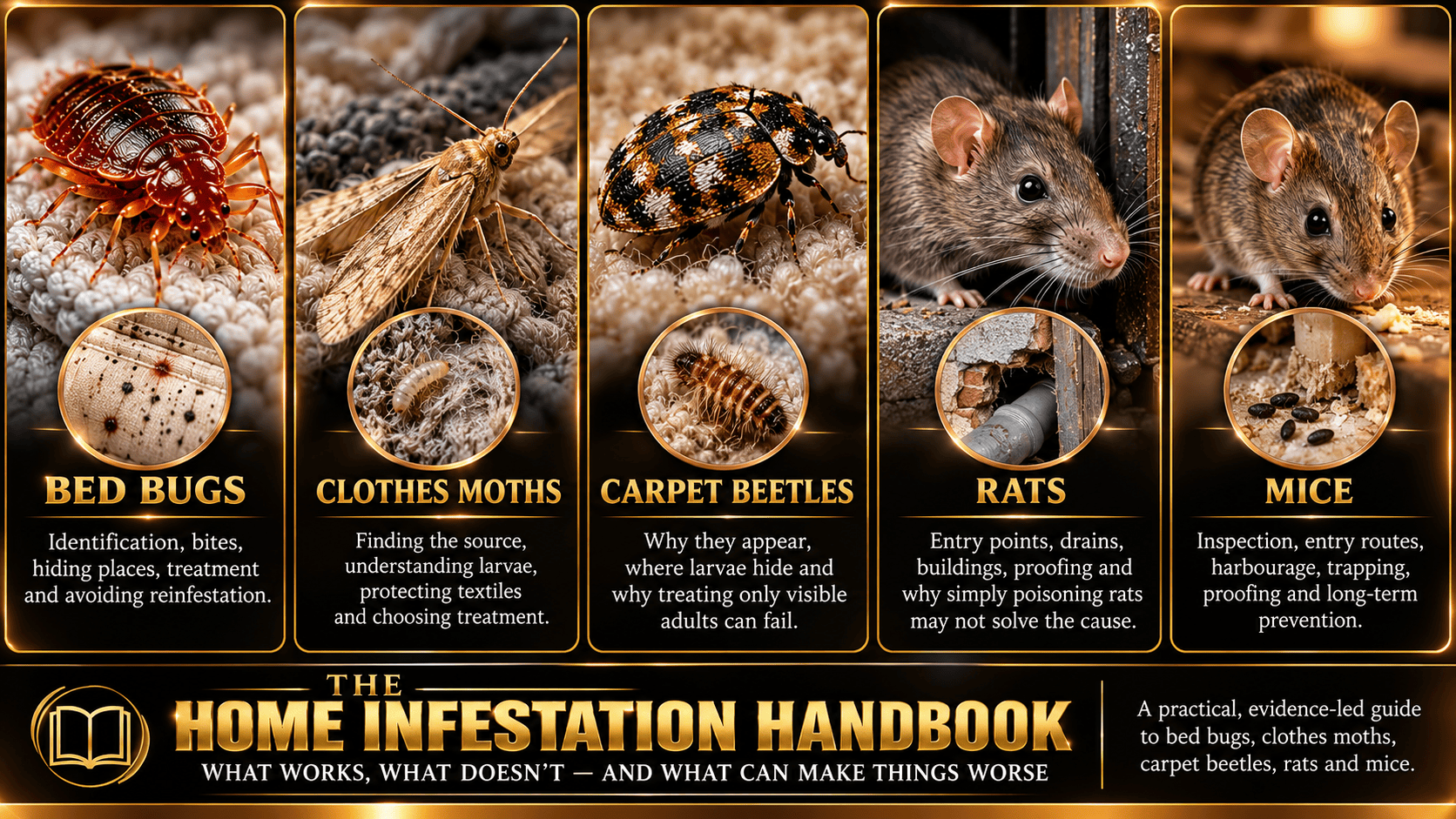
Bed bugs • Clothes moths • Carpet beetles • Rats • Mice
What's Inside The Home Infestation Handbook?
This isn't intended to be an encyclopaedia full of technical language. It's designed to help you understand what is happening and make better decisions when a pest problem appears in your home.
Identify What You're Actually Dealing With
Learn how to recognise the pest, its evidence and the clues that distinguish one infestation from another.
Understand Why It Is There
Finding the pest is only part of the job. Understand harbourage, food sources, entry routes and the conditions allowing an infestation to continue.
Know What DIY Methods Can Really Do
Some DIY techniques genuinely help. Others kill a few pests but leave the underlying infestation untouched.
Avoid Expensive Mistakes
From unnecessary furniture disposal to treating the wrong areas, simple mistakes can make a pest problem considerably more expensive.
Understand Professional Treatment
Learn what pest controllers are actually trying to achieve, how different treatments work and where their limitations lie.
Know When the Problem Is Really Solved
Understand the difference between reduced activity, temporary control and genuine elimination of the underlying infestation.
DIY Pest Control: What Actually Works?
One of the major themes of the handbook tackles the pest-control advice people find online every day.
Home remedies, sprays, powders, traps, steam, heat, repellents, essential oils, ultrasonic devices and countless other methods are recommended across websites, forums, videos and social media.
But there is a much more important question:
Does the method eliminate the infestation — or does it simply kill the pest you can see?
DIY techniques that can genuinely help when they are used correctly and in the right circumstances.
Methods that may kill or remove some pests but are often mistaken for complete eradication.
Popular ideas with little useful evidence behind them or methods unlikely to solve an established infestation.
Approaches that may spread pests, delay effective treatment, create unnecessary risks or waste significant amounts of money.
Inside Heat Treatment: What Really Happens When Pests Are Treated With Heat?
Heat treatment is often described very simply: raise the temperature and kill the pests. In practice, successful structural heat treatment is far more involved.
Drawing on my own experience carrying out professional heat treatments, The Home Infestation Handbook takes readers behind the scenes to explain how heat is actually used against household pests — and why simply making a room hot is not enough.
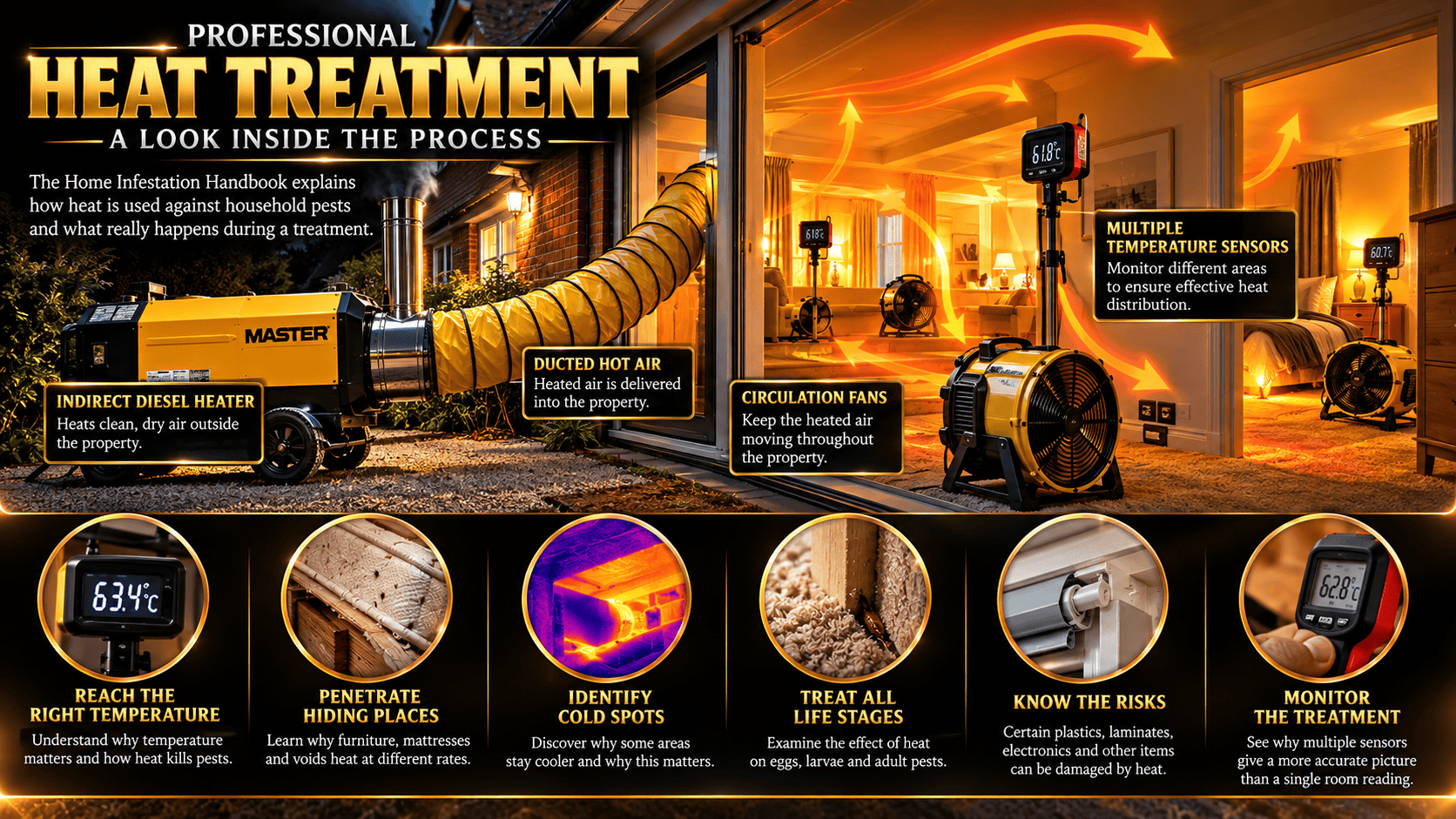
How Heat Kills Pests
Understand why temperature matters, how heat affects insects and their life stages, and why achieving the correct conditions throughout the treatment area is crucial.
Air Temperature Isn't Everything
A thermometer showing a high room temperature does not prove that every hiding place has reached an effective temperature. Furniture, mattresses, flooring, wall edges and insulated areas can heat at very different rates.
Cold Spots & Hidden Harbourages
Readers will learn why professionals monitor difficult areas and why pests hidden deep inside furniture, cracks, voids and belongings can present a very different challenge from pests exposed on a surface.
Heat Distribution
Discover why airflow, equipment positioning, room layout and movement of heated air matter. Producing heat is only one part of creating an effective treatment environment.
Monitoring the Treatment
The book explains the role of temperature sensors and why temperatures should be monitored at multiple locations rather than relying on a single reading from the room.
What Can Be Damaged by Heat?
Heat treatment also requires judgement. Certain plastics, laminated materials, electronics, medicines, pressurised containers and other heat-sensitive belongings may need special consideration or removal.
Not a Laboratory Explanation — A Look at Heat Treatment in Real Homes
Rooms are not laboratories. They contain beds, wardrobes, drawers, soft furnishings, flooring, belongings and countless places where temperatures can behave differently.
This section uses practical treatment experience to explain the difference between heating a room and creating the conditions required for an effective pest heat treatment.
Questions the Heat Treatment Section Will Explore
- How does heat actually kill bed bugs and other insect pests?
- Why can some parts of a room heat much faster than others?
- What are cold spots and why do they matter?
- Why are multiple temperature sensors useful?
- How does airflow affect a treatment?
- Can pests move away from heat?
- Can heat penetrate mattresses and furniture?
- Does heat kill eggs as well as adult insects?
- What belongings may be vulnerable to high temperatures?
- Why can DIY heating be very different from professional structural heat treatment?
Getting a room hot is relatively easy.
Knowing whether the pest's hiding places have received an effective heat exposure is the difficult part.
The handbook explains that difference.
Who Is This Book For?
You don't need to be a pest controller to understand pest control.
Homeowners
Understand what's happening before spending money on products, replacing belongings or booking professional treatment.
Tenants
Learn what evidence to look for, what information matters and how to understand the problem before deciding what happens next.
Landlords & Property Managers
A practical reference for recognising common infestations and understanding the treatment options being proposed.
Anyone Facing an Infestation
Especially people overwhelmed by contradictory online advice and unsure what they should actually do next.

10 Pest-Control Mistakes That Can Make an Infestation Worse
Join the pre-launch list and receive the free guide when it becomes available, plus an email when The Home Infestation Handbook is released.
Be the First to Know When the Book Launches
The Home Infestation Handbook is currently being written. Join the pre-launch list for publication updates, launch information and the free pest-control mistakes guide when it becomes available.
Your details will only be used for relevant book and launch updates. You can unsubscribe at any time.
Frequently Asked Questions
When will The Home Infestation Handbook be released?
The book is currently in development. Join the pre-launch list to receive an update when the publication date is confirmed.
Is the book only about UK pest control?
No. The Home Infestation Handbook is being written for an international audience. Where laws, products or pest-control practices differ between countries, those differences will be identified where relevant.
Is this a DIY pest-control book?
Partly. The book explains DIY methods that can genuinely help, methods with limitations and situations where professional treatment may be the more appropriate option.
Which pests are covered?
The main sections cover bed bugs, clothes moths, carpet beetles, rats and mice, alongside broader guidance about inspection, identification, treatment and prevention.
Does the book cover professional heat treatment?
Yes. A dedicated in-depth section explains how structural heat treatment works, why airflow and temperature monitoring matter, how hidden cold spots can affect treatment and why heating a room is not the same as confirming effective heat exposure throughout pest harbourages.
Will the book explain other professional treatments?
Yes. The aim is to explain what different treatments are designed to achieve, their limitations and why one treatment method may be more appropriate than another.
Who is Richard Collings?
Richard Collings is a pest-control practitioner and heat-treatment specialist with practical experience investigating and treating household pest infestations.