Clothes Moth Larvae Life Cycle Explained
Clothes moth larvae are the stage of the clothes moth life cycle responsible for damage to wool, carpets, cashmere, fur, feathers and other animal-based natural fibres.
Seeing an adult moth may alert you to a problem, but the moth flying around your home is not eating your clothes. The damage happens earlier, while the insect is developing as a larva.
Understanding the clothes moth life cycle can therefore help you find an infestation, recognise fresh activity and choose an appropriate treatment.
This guide explains the four stages of the clothes moth life cycle, what clothes moth larvae look like, where they hide and why infestations can continue even when few adult moths are visible.
What Is the Clothes Moth Life Cycle?
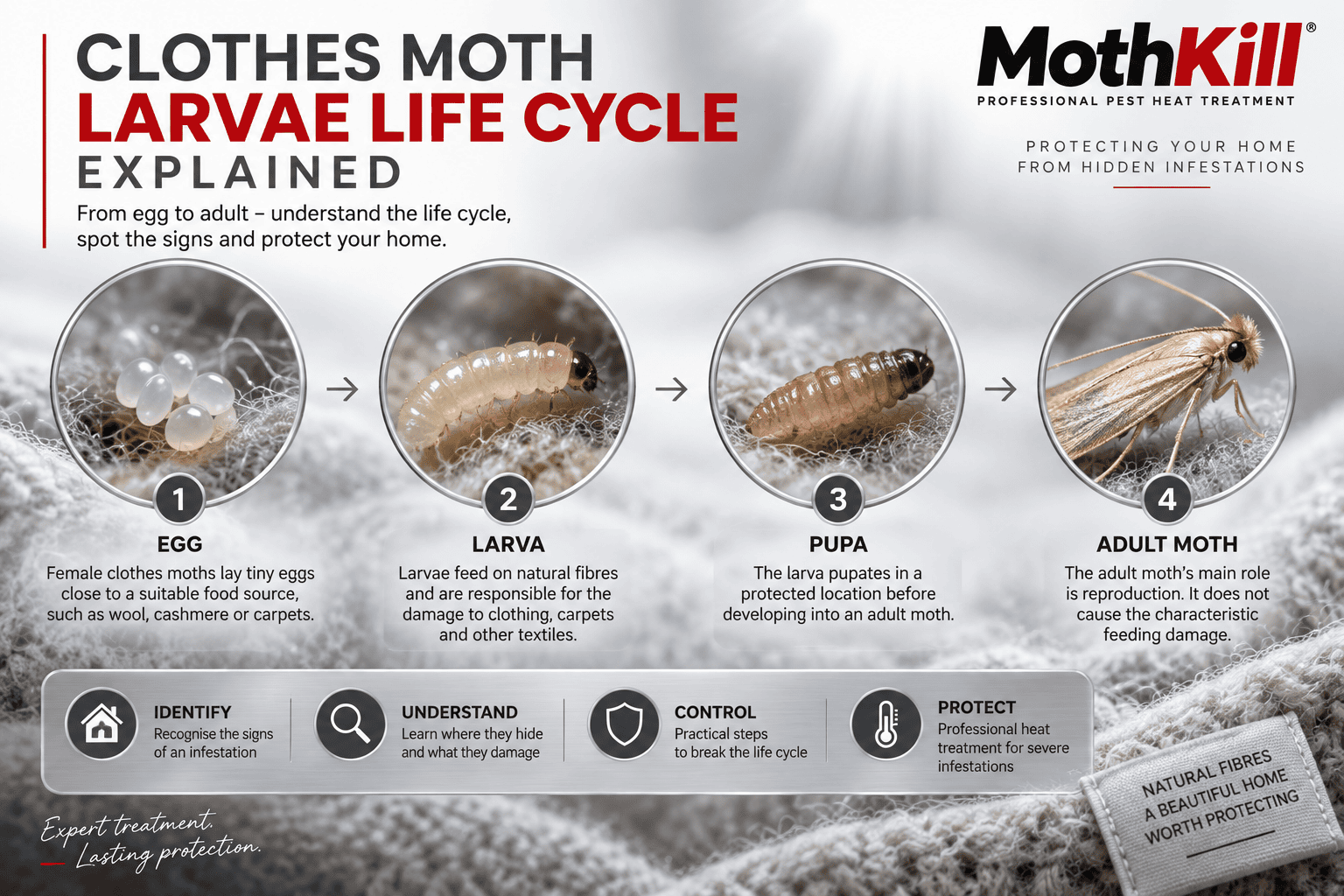
Clothes moths undergo complete metamorphosis. Their life cycle has four stages:
- Egg
- Larva
- Pupa
- Adult moth
The amount of time required to complete this cycle varies considerably. Temperature, food availability, humidity and other environmental conditions can all affect development.
In warm indoor environments with suitable food, development can be considerably faster than in cooler or less favourable conditions.
Stage 1: Clothes Moth Eggs
The life cycle begins when an adult female lays eggs close to a suitable food source for the emerging larvae.
That might include:
- wool carpets and rugs;
- woollen clothing;
- cashmere;
- fur;
- feathers;
- felt;
- animal hair;
- upholstery containing suitable natural fibres; and
- lint and debris containing natural fibres.
The eggs are extremely small and can be difficult to spot without close inspection.
Rather than being deposited somewhere obvious, they can be concealed among fibres, seams, folds and other protected areas.
For more detail about development times, see our guide to how long clothes moth eggs take to hatch in UK homes.
Stage 2: Clothes Moth Larvae
Once an egg hatches, the larval stage begins.
This is the stage that causes the characteristic textile damage associated with clothes moth infestations.
Clothes moth larvae need protein for development. They are particularly associated with animal-derived materials containing keratin.
This is why infestations are commonly discovered in wool carpets, woollen clothing, cashmere garments, rugs, feathers and similar materials.
What Do Clothes Moth Larvae Look Like?
Clothes moth larvae are small, pale caterpillar-like insects with a darker head.
Because they tend to remain concealed in or close to their food source, homeowners often discover the evidence they leave behind before finding a live larva.
Possible signs include:
- irregular holes or thinning in natural-fibre clothing;
- bare or damaged areas of wool carpet;
- silken webbing;
- small cases or tubes associated with case-bearing clothes moths;
- cast larval skins;
- debris around carpet edges or beneath furniture; and
- adult moth activity nearby.
Where Do Clothes Moth Larvae Hide?
Larvae favour areas where they can feed relatively undisturbed.
Common locations include:
- beneath beds and wardrobes;
- under sofas and other heavy furniture;
- along carpet edges;
- inside wardrobes and drawers;
- among stored clothing;
- inside rolled or stored rugs;
- around upholstery;
- beneath furniture that is rarely moved; and
- other dark, quiet areas containing suitable fibres.
This behaviour helps explain why an infestation can become established before the homeowner notices adult moths.
Why Do Clothes Moth Larvae Damage Carpets and Clothing?
The larvae feed on suitable natural materials as they develop.
Damage can be particularly noticeable on wool and other animal-derived fibres.
Carpet infestations are often concentrated underneath furniture and around edges because these areas can remain dark and undisturbed for long periods.
Clothing stored without regular movement can provide similarly favourable conditions.
Perspiration, food residues, skin cells and other organic soiling on textiles may also make particular items more attractive to larvae.
Do Adult Clothes Moths Eat Clothes?
No. Adult clothes moths do not cause the characteristic feeding damage to carpets and clothing.
Their main role is reproduction.
This distinction matters because killing the adult moths you see does not necessarily remove eggs, larvae or pupae already hidden elsewhere in the property.
That is also why pheromone traps can be useful for monitoring moth activity but should not automatically be regarded as a complete treatment for an established infestation.
Stage 3: The Pupal Stage
After completing its larval development, the insect enters the pupal stage.
During this stage it undergoes the transformation from larva to adult moth.
Pupae can be concealed in protected areas close to feeding sites, including around carpet edges, furniture and stored textiles.
Eventually an adult moth emerges and the reproductive cycle can begin again.
Stage 4: Adult Clothes Moths
Adult clothes moths are small and relatively inconspicuous.
Unlike many outdoor moth species, clothes moths are not typically the large insects seen repeatedly flying around bright lights.
They often favour darker, quieter areas of the home.
Finding adult clothes moths can indicate activity, but the number of adults you see does not necessarily reveal the size of the hidden larval population.
How Long Does the Clothes Moth Larval Stage Last?
There is no single fixed duration.
Larval development depends heavily on environmental conditions, particularly temperature and food availability.
Under favourable conditions development can progress relatively quickly. Under less favourable conditions, the larval period can continue for considerably longer.
This variable development is one reason clothes moth infestations can seem unpredictable.
A homeowner may see several adult moths, then apparently nothing for a period, followed by further activity later.
Why Do Clothes Moths Keep Appearing?
Repeated sightings do not necessarily mean new moths are continuously entering the house.
An established indoor population can contain insects at several different life stages simultaneously.
While one group is emerging as adults, other eggs may still be developing and larvae may remain hidden in carpets, furniture or stored textiles.
This is why simply killing visible adult moths often fails to resolve an established infestation.
Can Vacuuming Remove Clothes Moth Larvae and Eggs?
Thorough vacuuming is one of the most useful practical measures for managing clothes moths.
Pay particular attention to:
- carpet edges;
- beneath beds;
- under wardrobes;
- under sofas;
- around skirting boards;
- inside accessible furniture voids; and
- other areas that are rarely disturbed.
Vacuuming can physically remove larvae, eggs, debris and potential food material from accessible areas.
However, it may not reach every insect within an established or widespread infestation.
Can Washing or Freezing Kill Clothes Moth Larvae?
Suitable individual garments and textiles can sometimes be treated using heat or freezing.
Always follow the item's care instructions. High temperatures can shrink or damage wool and other delicate materials.
Freezing can also be useful for suitable items when the correct temperature and exposure conditions are achieved.
These approaches are particularly useful for individual belongings, but treating a jumper does not address larvae living beneath a wool carpet or elsewhere in the property.
Do Pheromone Traps Kill Clothes Moth Larvae?
No. Clothes moth pheromone traps primarily attract adult male moths of the target species.
They can be very useful for monitoring activity and helping establish whether clothes moths are present.
However, a trap does not directly kill larvae feeding in carpets, clothing or furniture.
Our guide to what clothes moth pheromone traps do explains their role in more detail.
Does Heat Treatment Kill Clothes Moth Larvae?
Yes. Clothes moth larvae are vulnerable to sufficiently high temperatures, as are the other stages of the life cycle.
During professional treatment, however, the important issue is not simply the temperature of the air beside a heater.
Effective conditions need to reach the places where larvae and eggs may actually be concealed.
This is why professional heat treatment uses controlled heating, powerful air circulation and temperature monitoring throughout the treatment area.
For established infestations affecting carpets, furniture or multiple areas of a property, you can read more about our professional clothes moth heat treatment.
Can Clothes Moth Heat Treatment Fail?
No pest-control treatment should be described as incapable of failure.
Heat treatment can be highly effective when correctly planned and monitored, but results depend on factors including preparation, airflow, property layout, access and whether all relevant infestation areas are treated.
Dense belongings and heavy clutter can create insulated areas, while treating only part of an infested property can leave activity elsewhere.
This is why MothKill focuses on heat distribution and multiple temperature readings rather than relying on a single room-temperature measurement.
How Do You Break the Clothes Moth Life Cycle?
Successful control means dealing with more than the adult moths you can see.
A practical approach may involve:
- confirming that the pest really is a clothes moth;
- finding affected textiles and breeding areas;
- thorough vacuuming and cleaning;
- treating or laundering suitable affected belongings;
- using pheromone traps for monitoring;
- checking stored and second-hand natural-fibre items; and
- using professional treatment where an infestation is established or widespread.
The correct approach depends on the extent and location of the infestation.
Frequently Asked Questions About Clothes Moth Larvae
Are clothes moth larvae the things that eat clothes?
Yes. The larval stage feeds on suitable natural materials. Adult clothes moths do not cause the characteristic feeding damage to clothing and carpets.
Can you see clothes moth larvae?
Yes. They are small and easily overlooked, particularly when concealed among fibres, beneath furniture or around carpet edges.
What colour are clothes moth larvae?
They are generally pale or cream coloured with a darker head.
Do clothes moth larvae live in carpets?
They can. Wool carpets provide a suitable food source, particularly in dark, undisturbed areas beneath furniture and around room edges.
Do clothes moth larvae turn into moths?
Yes. A larva eventually pupates and develops into an adult moth, completing the egg–larva–pupa–adult life cycle.
Does killing adult moths stop an infestation?
Not necessarily. Eggs, larvae and pupae may already be present elsewhere in the property, which is why established infestations need to be approached as a complete life-cycle problem.
Clothes Moth Larvae Life Cycle: Final Thoughts
Understanding the clothes moth life cycle explains why these infestations can be so persistent.
The adult moth is the stage homeowners are most likely to notice, but the larvae are responsible for the textile damage.
Finding and dealing with those hidden developing stages is therefore much more important than simply killing moths flying around a room.
If you are finding larvae, fresh carpet damage or recurring adult clothes moths in several areas of your home, learn more about MothKill's professional clothes moth heat treatment and whether whole-property treatment may be appropriate.