How to Identify Clothes Moths

How to Identify Clothes Moths: A Complete UK Homeowner’s Guide
Introduction: Why Clothes Moths Are So Often Misidentified
Few household pests cause as much frustration as clothes moths. They work quietly, often unnoticed for months, until one day you discover holes in wool jumpers, thinning carpets, or damaged upholstery.
In the UK, clothes moths are frequently misidentified, leading homeowners to waste time and money treating the wrong pest — or treating the right pest incorrectly.
The key problem is simple:
-
Not all moths in your home are clothes moths
-
Not all holes in clothing are caused by moths
-
Killing adult moths alone rarely solves the problem
Correct identification is the foundation of effective control. This guide will show you exactly how to identify clothes moths, from adult insects to larvae and damage patterns — using evidence-based UK guidance and trusted sources.
What Are Clothes Moths?
Clothes moths are small insects whose larvae feed on animal-based natural fibres containing keratin. Common materials at risk include:
-
Wool
-
Cashmere
-
Silk
-
Alpaca
-
Feathers
-
Fur
-
Felt
According to the Natural History Museum, clothes moths rarely feed on synthetic fabrics unless they are stained with sweat, food, or body oils.
This is why rarely worn or long-stored garments are often hit hardest.
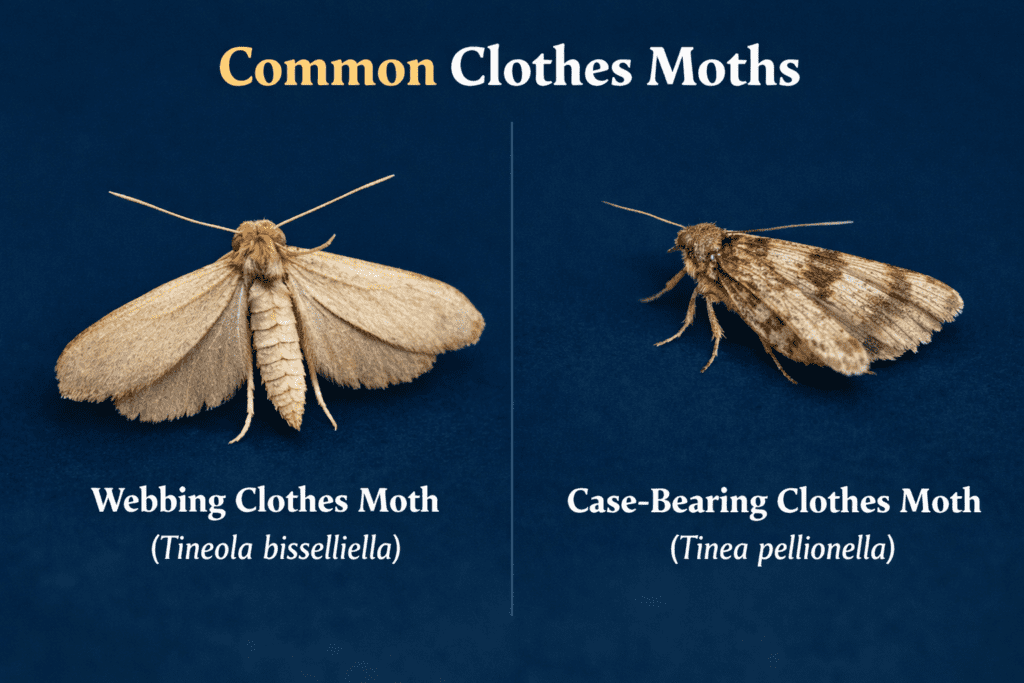
The Two Clothes Moth Species Found in UK Homes
Webbing Clothes Moth (Tineola bisselliella)
-
The most common species in UK homes
-
Pale gold or straw-coloured
-
Larvae leave fine silk webbing in fabrics
Case-Bearing Clothes Moth (Tinea pellionella)
-
Slightly darker, sometimes spotted wings
-
Larvae carry a tube-like silken case
-
Often found in carpets, rugs, and upholstery
Both species cause similar damage and require the same careful identification.
What Do Adult Clothes Moths Look Like?
Size & Colour
Adult clothes moths are:
-
Small (6–8 mm long)
-
Beige, buff, or pale gold
-
Plain in appearance, with no strong patterns
Distinctive Features
A subtle but useful clue is the slightly fluffy head, noted by the Natural History Museum as a distinguishing feature.
Behaviour (One of the Best Clues)
Clothes moths:
-
Avoid light
-
Prefer dark, undisturbed areas
-
Rarely fly toward windows
-
Flutter weakly rather than flying strongly
If moths are repeatedly seen around lights or windows, especially in kitchens, they are unlikely to be clothes moths.
Why Adult Moths Aren’t the Real Problem
A common mistake is focusing on adult moths.
🔴 Adult clothes moths do not eat clothes.
Their only purpose is to mate and lay eggs. The real damage is caused by larvae, which can remain hidden for months while feeding on textiles.
The British Pest Control Association confirms that eliminating larvae is essential for long-term control.
What Do Clothes Moth Larvae Look Like?
Clothes moth larvae resemble small caterpillars.
Key Characteristics
-
Creamy white or pale yellow body
-
Brown head capsule
-
Up to 10 mm long
-
Slow-moving and often curled
Webbing & Casings
-
Webbing clothes moth larvae leave silk threads in fabrics
-
Case-bearing larvae carry a fibre-covered silken tube
Larvae are usually found deep within folds, seams, under carpets, or along skirting boards.
Common Signs of Clothes Moth Damage
1. Irregular Holes in Clothing
Moth holes are:
-
Uneven in shape
-
Often clustered
-
Common in hidden areas (armpits, hems, collars)
2. Thinning or Surface Grazing
Larvae may scrape fibres without punching holes, leaving:
-
Bald patches
-
Weak or fuzzy fabric
3. Silk Webbing
Fine, cobweb-like threads in wardrobes, drawers, or carpet edges are a strong indicator of larvae.
4. Larval Casings
Small, rice-grain-sized tubes or shed skins confirm active or recent infestation.
Where Clothes Moths Hide in UK Homes
Clothes moths prefer dark, undisturbed locations, including:
-
Back corners of wardrobes
-
Drawers with rarely worn clothing
-
Under rugs and carpets
-
Upholstered furniture seams
-
Stored blankets and suitcases
The National Trust, which protects historic textiles, notes that regular disturbance and inspection are key to early detection.
Clothes Moths vs Carpet Beetles (Very Common UK Confusion)
Many UK households assume moths are responsible when carpet beetles are the real cause.
| Feature | Clothes Moths | Carpet Beetles |
|---|---|---|
| Adult | Small beige moth | Round, patterned beetle |
| Larvae | Smooth, pale | Brown and hairy |
| Damage | Irregular holes, thinning | Holes + shed skins |
| Behaviour | Avoid light | Often near windows |
If you see hairy larvae or striped shed skins, the problem is likely carpet beetles, not moths.
Are Pantry Moths Clothes Moths?
No.
Pantry moths:
-
Are larger
-
Have two-toned wings
-
Fly toward light
-
Infest food cupboards
If moths are appearing in kitchens rather than wardrobes, clothing is usually not at risk.
Understanding the Clothes Moth Life Cycle
The life cycle consists of four stages:
-
Eggs – laid directly on fabric
-
Larvae – feeding stage (damage occurs here)
-
Pupae – cocoons in dark corners
-
Adult moths – mate and lay eggs
In cool UK homes, larvae can remain active for many months, which explains why damage often appears suddenly.
How to Confirm a Clothes Moth Infestation
To confirm identification:
-
Inspect natural-fibre items carefully
-
Look for larvae, webbing, or casings
-
Check dark, undisturbed areas
-
Use pheromone traps to monitor activity
UK-specific identification guides and pheromone monitoring traps are available from MothKill, which specialises in clothes moths rather than food pests.
MothKill also provides educational resources to help homeowners identify moth species correctly before treatment.
Trusted UK Sources for Clothes Moth Identification
For independent, non-commercial guidance, consult:
-
Natural History Museum – species identification
-
British Pest Control Association – professional standards
-
National Trust – textile care advice
-
Local council pest control services
These sources complement practical guidance found at https://mothkill.co.uk, ensuring identification is accurate before action is taken.
Final Thoughts: Correct Identification Protects Your Home
Clothes moths are subtle, persistent, and often misunderstood. But once you know what to look for — the moths, the larvae, the damage, and the hiding places — they become far easier to identify and manage.
Key Takeaways
-
Larvae cause the damage, not adult moths
-
Clothes moths avoid light and prefer darkness
-
Damage targets natural fibres
-
Carpet beetles are the most common misidentification
-
UK-based guidance leads to better outcomes
Accurate identification is the first and most important step in protecting your clothing, carpets, and furnishings.