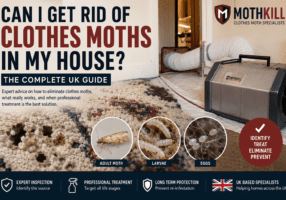
How Long Do Clothes Moth Eggs Take to Hatch in the UK


Clothes moths are one of the most common and frustrating household pests across the UK. By the time most people notice holes in clothing or damage to carpets, the infestation is already well underway. That’s because the real problem begins with the eggs, not the adult moths.
So, how long do clothes moth eggs take to hatch in the UK?
In typical indoor UK conditions, clothes moth eggs usually hatch within 4 to 10 days. In cooler or less favourable environments, hatching can take up to three weeks.
According to the Natural History Museum (UK), the common clothes moth (Tineola bisselliella) develops more quickly in warm indoor conditions, which is why centrally heated homes are particularly vulnerable year-round.
Why Hatch Time Varies in UK Homes
Not all infestations develop at the same speed. Several environmental factors influence how quickly eggs hatch.
Temperature
Warmth accelerates development. Eggs laid in wardrobes, cupboards, and bedrooms where temperatures remain consistently warm are likely to hatch within a week. Cooler environments (spare rooms, lofts, unheated storage areas) slow the process.
Humidity
Clothes moths thrive in slightly humid conditions. Homes with poor ventilation, damp corners, or packed wardrobes provide ideal conditions for faster egg development.
Location
Female moths deliberately lay eggs in dark, undisturbed areas close to natural fibres, such as:
-
Inside wardrobes
-
Under carpet edges
-
In drawers and storage boxes
-
Beneath furniture
-
Inside folded or rarely worn clothing
The Natural History Museum confirms that eggs are usually laid directly onto materials the larvae can feed on.
What Happens After the Eggs Hatch?
Once eggs hatch, they release larvae, which are responsible for all the damage.
These larvae feed on natural fibres including:
-
Wool
-
Cashmere
-
Silk
-
Fur
-
Feathers
-
Felt
-
Carpet edges and underlay
This stage can last several months, depending on conditions. That’s why infestations can quietly worsen long before you notice visible signs.
If this sounds familiar, you might also find it helpful to read:
-
Why moth infestations keep returning in homes
https://www.mothkill.co.uk/blog-posts/why-moths-keep-returning/ -
How long before a pest problem becomes a serious infestation
https://www.mothkill.co.uk/blog-posts/how-long-before-your-home-is-overrun/
How to Spot Clothes Moth Eggs
Clothes moth eggs are extremely small — around 0.5 mm — making them difficult to see with the naked eye. They are typically:
-
White or cream coloured
-
Oval shaped
-
Laid directly onto fabrics or hidden in crevices
Most people don’t notice eggs at all. Instead, the first warning signs tend to be:
-
Small irregular holes in clothing
-
Damage to carpets along edges
-
Fine powder (larval droppings)
-
Silken tubes or webbing in corners

How to Stop Eggs From Becoming an Infestation
If you suspect moth activity, timing matters. Acting before eggs hatch (or immediately after) can dramatically reduce damage.
Wash at high temperatures
Washing items at 50–60°C kills eggs and larvae effectively.
Freeze delicate items
Items that can’t be washed can be sealed in bags and frozen at -18°C for at least 72 hours.
Vacuum thoroughly
Vacuum wardrobes, skirting boards, carpet edges, drawers, and under furniture. Dispose of the vacuum contents immediately.
Monitor adult moth activity
Pheromone traps help identify whether adult moths are still present and breeding.
If you’ve dealt with other pests before, you’ll recognise how timing affects success — similar to the principles discussed in:
-
How long bed bugs survive without feeding
https://www.mothkill.co.uk/blog-posts/how-long-can-bed-bugs-live-without-food/
Early intervention always makes treatment easier.
Are Clothes Moths Active All Year in the UK?
Yes. While outdoor moth activity peaks in spring and summer, indoor infestations can remain active all year round in heated properties. This means eggs can hatch even in winter if indoor temperatures remain stable.
The Natural History Museum confirms that clothes moths are commonly active inside homes throughout the year, particularly in modern centrally heated buildings.
Trusted Informational Sources
For readers who want deeper scientific background, these are reliable, non-commercial sources:
-
Natural History Museum (UK) – Clothes moth identification and lifecycle
https://www.nhm.ac.uk/take-part/identify-nature/common-insect-pest-species-in-homes/clothes-moths-identification-guide.html -
Wikipedia – Tineola bisselliella lifecycle and development
https://en.wikipedia.org/wiki/Tineola_bisselliella -
University of California IPM (academic reference on moth development)
https://ipm.ucanr.edu/home-and-landscape/clothes-moths/
These support your content without sending traffic to competitors.
Key Takeaways
-
Clothes moth eggs typically hatch in 4–10 days in warm UK homes
-
In cooler conditions, hatching can take up to three weeks
-
Larvae cause the damage, not adult moths
-
Early cleaning, washing, freezing, and monitoring can stop infestations before they spread
-
Centrally heated homes allow moths to stay active all year