Why You Should Consider Heat Treatment for a Moth Infestation

Is clothes moth heat treatment worth it? It can be when an infestation has become established across carpets, furniture or several rooms and repeatedly treating individual belongings is no longer practical.
That does not mean every clothes moth sighting requires professional heat treatment.
A small, localised problem may be manageable with careful inspection, cleaning, monitoring and appropriate treatment of affected belongings.
A widespread infestation is different. Eggs and larvae may be concealed beneath furniture, around carpet edges, inside stored textiles and in other difficult-to-reach locations.
This guide explains when professional clothes moth heat treatment may be worth considering, what its main advantages are, its limitations and when a simpler approach may be sufficient.
Is Clothes Moth Heat Treatment Worth It?
For a widespread or persistent infestation, it can be.
Professional heat treatment becomes particularly useful when the problem is not confined to one easily treated garment, rug or small area.
It may be worth considering when:
- moths are appearing in several rooms;
- larvae are damaging wool carpets;
- activity exists beneath beds, sofas or wardrobes;
- DIY treatment has repeatedly failed to control the problem;
- you cannot identify every breeding area;
- valuable natural-fibre furnishings are at risk; or
- the infestation has become too widespread to treat item by item.
For a small and clearly localised infestation, whole-property heat treatment may be unnecessary.
Why Are Established Clothes Moth Infestations Difficult to Treat?
The adult moths you see flying around a room are only one part of the infestation.
The textile damage is caused by the larvae.
Clothes moth larvae favour relatively dark, sheltered and undisturbed locations where suitable material is available.
Potential locations include:
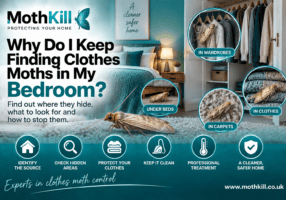
Beneath Furniture
Beds, wardrobes and sofas can create sheltered areas that remain undisturbed for long periods.
Carpet Edges
Natural-fibre carpets can provide suitable material, particularly around edges and areas that receive little disturbance.
Stored Clothing
Wool, cashmere and other vulnerable animal-derived fibres can provide a food source for developing larvae.
Rugs and Furnishings
Natural-fibre rugs, upholstery and other textile furnishings may also support larval activity.
An infestation can therefore remain active even when only a few adult moths are being seen.
The Real Problem Is the Clothes Moth Life Cycle
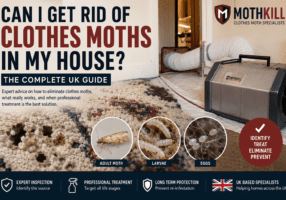
Clothes moths develop through four main stages:
- egg;
- larva;
- pupa; and
- adult moth.
An established infestation may contain several of these stages at the same time.
Killing adult moths does not automatically deal with eggs or developing larvae elsewhere in the property.
Our guide to the clothes moth larvae life cycle explains why activity can continue even after the number of visible adult moths falls.
What Is the Main Advantage of Clothes Moth Heat Treatment?
The major advantage is that professional heat treatment can treat a much larger environment rather than relying solely on treating individual visible insects or belongings.
Clothes moth eggs, larvae, pupae and adults are vulnerable to sufficiently high temperatures when the necessary thermal conditions actually reach them.
Professional treatment is therefore designed to establish effective conditions throughout the treatment area, including locations where developing insects may be concealed.
Can Heat Treatment Reach Hidden Clothes Moth Larvae?
Targeting concealed larvae is one of the reasons heat treatment can be useful for an established infestation.
This is particularly relevant when wool carpets are affected.
You may notice damage along an exposed carpet edge while larval activity also exists beneath a bed, wardrobe or other furniture.
Treating only the visible damaged patch may therefore leave another part of the infestation untouched.
Professional heat treatment aims to establish suitable thermal conditions throughout the treatment area rather than concentrating solely on visible damage.
Does Heat Treatment Kill Clothes Moth Eggs?
Clothes moth eggs are vulnerable to heat.
They can be killed when sufficient thermal conditions reach them for an appropriate period.
This is important because locating every individual egg inside a furnished property would be unrealistic.
However, the temperature of the room air alone does not prove that an egg inside a protected location has experienced the same conditions.
Airflow, exposure time and temperature monitoring therefore matter.
Why Airflow Matters
Temperatures are not naturally uniform throughout a furnished property.
Areas beneath furniture, behind large objects, around room edges and inside dense belongings may warm at different rates.
MothKill uses industrial fans to help circulate heated air through the treatment environment.
Airflow may also need to be adjusted as the treatment progresses.
Heat distribution matters just as much as producing heat in the first place.
Why Temperature Monitoring Matters
A temperature reading beside a heater tells you little about conditions at the opposite side of a furnished room.
This is why professional heat treatment benefits from monitoring at multiple locations.
MothKill uses multiple temperature sensors so that conditions can be monitored throughout the treatment.
If one area is heating more slowly than expected, the technician can investigate whether airflow, equipment positioning or additional heating time needs to be considered.
Is Heat Treatment Faster Than Repeated DIY Treatment?
For a widespread infestation, it can be.
DIY control can involve repeated vacuuming, inspection, laundering or dry-cleaning suitable items, treating individual belongings and continuing to monitor activity.
Those approaches can be entirely appropriate when a problem is small and localised.
But when clothes moths are established throughout several rooms, repeatedly treating one small area at a time can become impractical.
A professional heat treatment allows a much larger treatment area to be addressed during a controlled treatment visit.
Can Heat Treatment Save an Infested Wool Carpet?
Potentially, yes.
Finding clothes moth larvae in a wool carpet does not automatically mean the carpet must be thrown away.
Professional treatment can often take place with the carpet remaining in position.
However, heat treatment cannot reverse damage that larvae have already caused. The carpet's condition and whether it remains serviceable should therefore be assessed separately.
Do You Have to Throw Away Infested Furniture?
Not automatically.
Furniture should first be inspected to understand whether it is contributing to the infestation and whether it can be treated appropriately.
Throwing away a bed, sofa or other item without addressing activity elsewhere may achieve very little if larvae remain beneath carpets or in other furnishings.
Unnecessary disposal can also make an already expensive pest problem even more costly.
Can Clothes Stay in the Property During Heat Treatment?
Suitable clothing and belongings can often remain within the treatment area, although preparation is important.
Densely packed clothes can restrict airflow and may take longer to heat.
Belongings may therefore need to be arranged according to the preparation instructions supplied for the treatment.
Heat-sensitive items should be identified beforehand and removed or otherwise managed as appropriate.
See our preparation guidance for insect heat treatment .
Is Clothes Moth Heat Treatment Chemical-Free?
The heat process itself kills through elevated temperature rather than an insecticidal active ingredient.
However, that does not mean insecticides have no legitimate role in clothes moth control.
Depending on the infestation, authorised insecticides, cleaning, physical removal, monitoring and other control measures can also be useful.
The appropriate method should be chosen according to the problem rather than assuming one treatment is automatically superior in every situation.
Heat Treatment vs Other Clothes Moth Treatments
| Method | Where It Can Be Useful | Main Limitation |
|---|---|---|
| Professional Heat Treatment | Widespread or established infestations involving rooms, carpets, furniture and multiple harbourages. | Requires preparation, controlled heating, airflow and temperature monitoring. |
| Authorised Insecticides | Targeted and residual control on appropriate surfaces and locations. | Correct product selection, application and treatment coverage are important. |
| Vacuuming | Removing accessible larvae, debris, lint and other material from affected areas. | Does not reliably reach every concealed life stage by itself. |
| Washing / Dry Cleaning | Treating suitable individual garments and textiles. | Cannot be used for fitted carpets, furniture and many household items. |
| Controlled Freezing | Suitable individual items where appropriate freezing conditions can be achieved. | Impractical for large furnishings and whole rooms. |
| Pheromone Traps | Detecting and monitoring adult male clothes moth activity. | They do not directly control hidden eggs and larvae. |
Are Pheromone Traps Enough to Get Rid of Clothes Moths?
Pheromone traps are useful monitoring tools, but they perform a different job from treatment.
They generally attract adult male clothes moths.
This can help indicate activity and provide useful information before and after treatment.
However, trapping adult males does not directly remove larvae feeding beneath furniture, inside carpets or among stored textiles.
Read our guide to what clothes moth pheromone traps actually do .
What About Washing, Dry Cleaning and Freezing?
These can be extremely useful for suitable individual items.
If a problem is genuinely confined to one garment or removable textile, treating that item and carefully inspecting the surrounding area may be enough.
The difficulty comes when activity involves fixed carpets, furniture or several rooms.
You cannot put a fitted wool carpet, upholstered sofa or entire bedroom into a washing machine or domestic freezer.
That is where treating the wider environment becomes more attractive.
When Is Clothes Moth Heat Treatment Probably Unnecessary?
Heat May Be Unnecessary When...
- you have found one isolated moth with no other evidence;
- the problem is confined to one removable item;
- inspection finds no larvae or damage elsewhere;
- the source can be identified and treated easily; or
- monitoring shows no continuing activity.
Heat Becomes More Attractive When...
- several rooms show activity;
- larvae are beneath furniture;
- wool carpets are affected;
- DIY treatment repeatedly fails;
- the source cannot be isolated;
- the infestation has become widespread; or
- valuable furnishings remain at risk.
Good pest control should match the treatment to the infestation.
How Does Professional Clothes Moth Heat Treatment Work?
Professional treatment involves considerably more than placing heaters in a property.
Assess the Infestation
The affected rooms, carpets, furniture, textiles and likely breeding areas need to be considered before treatment.
Prepare Heat-Sensitive Items
Belongings that may be unsuitable for the treatment environment are identified and managed before heating begins.
Install Professional Heating Equipment
MothKill's indirect diesel heating equipment remains outside. Combustion gases remain outdoors while clean heated air is ducted into the treatment area.
Circulate the Heated Air
Industrial fans help distribute heated air through the treatment environment and around furnishings.
Monitor Temperatures
Multiple temperature sensors provide information from different locations as the property heats.
Adjust and Maintain Conditions
Airflow and treatment conditions can be adjusted where necessary, and effective thermal conditions are maintained for the required period.
For a more technical explanation, read how clothes moth heat treatment works .
How Long Does Clothes Moth Heat Treatment Take?
Professional heat treatment generally takes several hours, but there is no single treatment time appropriate for every property.
Duration can depend on:
- property size;
- number of rooms;
- starting temperature;
- furniture and belongings;
- airflow;
- construction;
- outside conditions; and
- how quickly harder-to-heat locations reach suitable conditions.
The treatment should therefore be guided by monitored conditions rather than simply by the clock.
Can Clothes Moth Heat Treatment Fail?
Yes. No responsible pest-control treatment should be described as incapable of failure.
Factors that can affect a heat treatment include:
- inadequate preparation;
- restricted airflow;
- slow-heating or cooler locations;
- insufficient thermal exposure;
- treatment coverage;
- activity in untreated rooms or areas; and
- later reintroduction.
This is why establishing the likely extent of the infestation before treatment and monitoring conditions during treatment are important.
Will Clothes Moths Come Back After Heat Treatment?
Reintroduction is possible after any successful pest treatment.
For example, an infested second-hand rug, woollen garment or piece of furniture could introduce clothes moths into a property again.
That is different from surviving activity caused by incomplete treatment.
Continued inspection and monitoring can therefore remain useful after the original infestation has been controlled.
How Can You Reduce the Risk of Another Clothes Moth Infestation?
Once an infestation has been controlled:
- vacuum beneath beds and furniture regularly;
- clean carpet edges and other undisturbed areas;
- store vulnerable clothing clean;
- inspect wool, cashmere and other vulnerable textiles periodically;
- check second-hand rugs and furniture before bringing them indoors;
- reduce accumulations of hair, lint and textile debris;
- avoid leaving vulnerable natural-fibre clothing undisturbed for very long periods; and
- continue monitoring previously affected areas.
Frequently Asked Questions
Is heat treatment worth it for clothes moths?
It can be particularly worthwhile for established infestations affecting several rooms, wool carpets, furniture or difficult-to-reach areas. A small localised infestation may not justify whole-property heat treatment.
Does heat treatment kill clothes moth larvae?
Clothes moth larvae are vulnerable to sufficiently high temperatures when effective thermal conditions reach their hiding places for an appropriate period.
Does heat treatment kill clothes moth eggs?
Yes, eggs are vulnerable to heat when sufficient thermal conditions actually reach them for sufficient time. This is important because individual eggs can be extremely difficult to locate inside an established infestation.
Can clothes moth heat treatment save my wool carpet?
Potentially. Finding larvae in a wool carpet does not automatically mean the carpet needs to be discarded. Treatment cannot repair damage that has already occurred, so the carpet's remaining condition should also be considered.
Is heat treatment better than moth spray?
It depends on the infestation. Heat can be particularly useful for widespread activity involving numerous harbourages, while appropriately selected authorised insecticides can provide useful targeted or residual control. Some treatment strategies may combine methods.
Are pheromone traps enough to eliminate clothes moths?
Not normally when an established infestation is present. Pheromone traps are primarily useful for detecting and monitoring adult male clothes moth activity; they do not directly treat hidden larvae and eggs.
Can I treat clothes moths myself?
A small localised problem may sometimes be manageable through careful inspection, cleaning, treatment of affected textiles and monitoring. A widespread infestation involving carpets, furniture or several rooms is much more difficult to address item by item.
How long does clothes moth heat treatment take?
Treatment generally takes several hours, but the exact duration depends on the property, contents, airflow and how quickly important areas reach the required thermal conditions.
Can clothes moths return after treatment?
Yes. Even after an infestation has been successfully controlled, clothes moths can potentially be introduced again with infested clothing, rugs, furniture or other suitable materials.
So, Is Clothes Moth Heat Treatment Worth the Cost?
The answer depends largely on the scale and location of the infestation.
If the problem is limited to one removable item and inspection finds no evidence elsewhere, professional heat treatment may be more treatment than the situation requires.
But the calculation changes when larvae are established beneath wool carpets, under furniture or throughout several rooms.
At that point, repeatedly treating individual belongings and visible patches can become both time-consuming and impractical.
The main advantage of professional heat treatment is the ability to treat a much larger environment and target multiple clothes moth life stages during the same controlled treatment.
That makes it particularly useful for established infestations where the problem is no longer confined to one easily treated source.
Considering Clothes Moth Heat Treatment?
If clothes moths are affecting carpets, furniture or several rooms, MothKill can assess whether professional heat treatment is appropriate for your property.