Clothes Moth Larvae
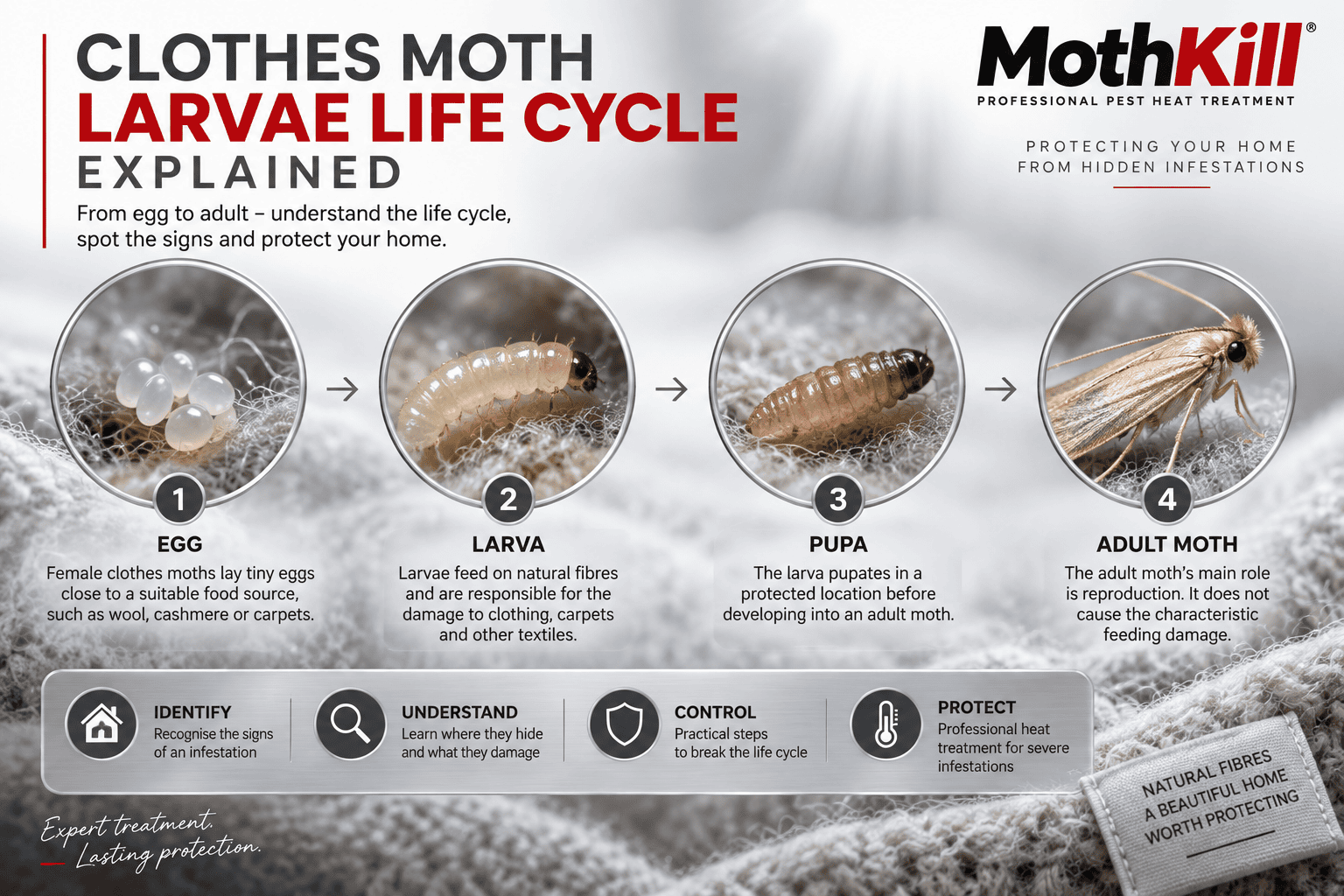
Clothes moth larvae are the stage responsible for the holes, thinning and damaged patches people discover in wool clothing, carpets, rugs and other susceptible textiles.
Adult clothes moths may be the insects you notice first, but they are not the ones eating your clothes. The larvae feed while developing, often hidden in dark and relatively undisturbed areas where damage can continue unnoticed.
This guide explains what clothes moth larvae look like, where to find them, what they eat and what you can do if you discover them in your home.
🦋 What Are Clothes Moth Larvae?
Clothes moth larvae are the immature feeding stage between the egg and pupa.
After eggs hatch, the larvae feed on suitable materials while growing and developing.
This is the stage responsible for textile damage.
Adult clothes moths are primarily concerned with reproduction rather than eating your jumper or carpet.
What Do Clothes Moth Larvae Look Like?
Appearance varies with species and stage of development, but clothes moth larvae are generally small, pale caterpillar-like insects.
For a broader identification guide, see: How to Identify Clothes Moths .
Common Clothes Moth vs Case-Bearing Clothes Moth Larvae
Common Clothes Moth
Tineola bisselliella larvae can produce silken webbing, tubes or mats around the material on which they are feeding.
Case-Bearing Clothes Moth
Tinea pellionella larvae construct a portable silken case incorporating fibres from their surroundings and move around while carrying it.
These cases and silken materials can be useful identification clues when investigating textile damage.
What Do Clothes Moth Larvae Eat?
Clothes moth larvae are adapted to utilise animal-derived materials.
Commonly susceptible materials include:
- wool;
- cashmere;
- animal hair and fur;
- feathers and down;
- sheepskin;
- some silk textiles;
- natural-bristle materials; and
- other animal-derived fibres.
Wool is particularly vulnerable because it contains keratin proteins that the larvae are adapted to utilise.
Learn more: Why Do Clothes Moths Eat Wool?
Do Clothes Moth Larvae Eat Cotton?
Pure cotton is plant-derived cellulose and is not the preferred food source that wool and other animal-derived fibres are.
However, damage associated with clothes moth activity can appear on cotton-containing items when:
- the fabric is blended with wool or another animal fibre;
- organic residues are present;
- the garment is stored alongside infested textiles; or
- fibres become incorporated into larval webbing or cases.
Read: Do Clothes Moths Eat Cotton?
Does Dirty Clothing Attract Clothes Moth Larvae?
Worn or stained animal-fibre textiles can provide additional organic material such as perspiration, skin debris or food residues.
That can make some textiles particularly suitable for developing larvae.
However, clothes moth infestation is not evidence of a dirty home.
Clean wool, cashmere and other suitable animal-derived materials can still be attacked.
The Clothes Moth Life Cycle
Understanding the lifecycle explains why killing adult moths alone does not necessarily eliminate an infestation.
Egg
Adult females deposit small eggs in or near locations that can provide suitable food for the developing larvae.
Larva
After hatching, the larva feeds and develops. This is the stage responsible for textile damage.
Pupa
After completing larval development, the insect pupates before transforming into an adult moth.
Adult Moth
The adult emerges and the reproductive cycle begins again.
The time spent at each stage varies according to species and environmental conditions, including temperature and food availability.
See: Clothes Moth Larvae Life Cycle Explained .
Where Do Clothes Moth Larvae Hide?
Larvae can be difficult to discover because infestations often develop in relatively dark, protected and undisturbed locations.
Check:
- the back and bottom of wardrobes;
- folds of stored wool clothing;
- drawers;
- carpet edges;
- beneath heavy furniture;
- under rugs;
- around skirting edges;
- stored blankets and textiles;
- spare bedrooms;
- lofts and storage areas; and
- other locations containing suitable natural-fibre material.
See: The Most Common Places Clothes Moths Hide .
Signs of Clothes Moth Larvae
You may find the larvae themselves, but often the first evidence is the damage or material they leave behind.
Look for:
- irregular holes in susceptible garments;
- thinning or threadbare areas;
- carpet damage, particularly beneath furniture or around edges;
- silken webbing;
- feeding tubes;
- portable larval cases;
- cast skins;
- small granular debris or frass; and
- adult clothes moth activity nearby.
Carpet beetle larvae can also damage natural-fibre textiles, and clothing can develop holes for many non-pest reasons. Finding larvae, cases, webbing or correctly identified adult moths provides much stronger evidence.
Clothes Moth Larvae or Carpet Beetle Larvae?
This is one of the most useful distinctions to make.
Clothes Moth Larvae
Generally pale and caterpillar-like. Depending on species, you may see silken webbing, tubes or a portable fibrous case.
Carpet Beetle Larvae
Typically brownish and noticeably hairy or bristly. Their cast larval skins are also commonly discovered around infestations.
If you've found a small hairy larva, compare it with our guide to Carpet Beetle Larvae .
Are Clothes Moth Larvae Dangerous to People?
Clothes moth larvae are primarily a textile and property pest.
They do not feed on human blood and are not responsible for bites in the way bed bugs or fleas are.
The principal problem is damage to clothing, carpets, rugs and other susceptible materials.
If somebody is experiencing unexplained bites or a persistent skin reaction, don't assume clothes moth larvae are responsible simply because moths are present in the home.
How to Get Rid of Clothes Moth Larvae
Effective control starts by establishing where the infestation is located and which materials are affected.
There isn't one DIY technique that is appropriate for every textile or every property.
1. Inspect the Full Area
Don't stop after finding one damaged jumper.
Inspect:
- other animal-fibre clothing;
- wardrobe floors and corners;
- adjacent carpets;
- rugs;
- under nearby furniture;
- stored blankets;
- soft furnishings containing susceptible material; and
- other quiet areas where natural fibres are present.
Finding the true extent of the infestation is often more important than killing the individual larva you happen to see.
2. Vacuum Thoroughly
Vacuuming is one of the most useful physical-control measures available.
Pay particular attention to:
- carpet edges;
- under furniture;
- wardrobe floors;
- skirting edges;
- under rugs;
- cracks where lint and hair accumulate; and
- other undisturbed locations.
Vacuuming can physically remove accessible larvae, eggs, debris and food material.
It may not eliminate an established infestation by itself where insects remain in inaccessible locations, but it is an important part of control and prevention.
3. Treat Affected Clothing Appropriately
Washable garments can be laundered according to their care labels.
Delicate or valuable wool, cashmere and silk items may require professional dry cleaning rather than high-temperature domestic washing.
The treatment method should be chosen around the textile rather than risking damage to an expensive garment simply to kill the pest.
4. Can Freezing Kill Clothes Moth Larvae?
Controlled freezing can be used for some suitable items where washing or heating is inappropriate.
Effectiveness depends on factors including the temperature reached, duration, item construction and treatment procedure.
For valuable textiles, specialist conservation or fabric-care advice may be appropriate rather than relying on a casual home-freezing recipe.
5. Do Clothes Moth Sprays Kill Larvae?
Appropriate insecticide products can kill susceptible clothes moth stages when the insects receive sufficient exposure.
But product performance depends on:
- the active ingredient;
- formulation;
- where the larvae are hiding;
- application;
- exposure; and
- the product label.
Do not spray clothing, bedding or other materials unless the product is specifically labelled for that use.
Professional insecticides can form part of an integrated clothes moth treatment, particularly where larvae are associated with carpets, edges and other harbourages.
Read: Does Clothes Moth Spray Kill Eggs?
6. Do Pheromone Traps Kill Clothes Moth Larvae?
No.
Clothes moth pheromone traps are primarily monitoring tools and commonly target adult male moths.
They can help:
- confirm moth activity;
- show where activity is occurring;
- monitor changes over time; and
- monitor after treatment.
But they do not directly remove the larvae already feeding on textiles.
A trap with no moths on it does not necessarily prove there are no larvae elsewhere in the property.
Read: What Do Clothes Moth Pheromone Traps Do?
7. Professional Clothes Moth Heat Treatment
For established or widespread infestations, professional heat treatment can treat a much larger area than item-by-item cleaning.
Heat can kill clothes moth:
- eggs;
- larvae;
- pupae; and
- adults
when sufficient thermal exposure reaches them.
The important part is not simply making a room hot.
Different parts of a property, furniture and belongings can heat at different rates. Professional treatment therefore involves heating capacity, airflow, exposure time and temperature monitoring.
🔥 How MothKill Heat Treatment Works
MothKill uses professional heating equipment together with industrial circulation fans and multiple temperature sensors.
- The main indirect diesel heater remains outside.
- Combustion gases remain outdoors.
- Clean heated air is ducted into the treatment area.
- Industrial fans distribute heated air.
- Multiple sensors monitor temperatures at different locations.
- Slower-heating areas can be identified and managed during treatment.
People and pets do not remain in the heated treatment area.
Learn more about Clothes Moth Heat Treatment .
Why Heat Treatment Can Be Useful for Clothes Moth Larvae
A major advantage of heat is that its effectiveness does not depend on the insect contacting a pesticide residue.
Where sufficient thermal exposure reaches them, heat can affect all stages of the clothes moth lifecycle.
However, heat should not be described as automatically reaching every hidden location or guaranteeing eradication regardless of circumstances.
Treatment effectiveness still depends on:
- preparation;
- heating capacity;
- airflow;
- temperature distribution;
- monitoring;
- exposure time; and
- treating the full extent of the infestation.
Can Clothes Moth Larvae Survive Heat Treatment?
They can survive if sufficient lethal thermal exposure does not reach the location where they are sheltering.
This is why one high air-temperature reading is not enough to demonstrate complete treatment coverage.
Multiple sensors and controlled airflow help identify and address locations that heat more slowly.
Will Heat Treatment Damage Clothes or Furniture?
Heat should not be assumed to be harmless to every household item.
Some belongings may require removal or special preparation, including certain:
- plastics;
- adhesives;
- laminated or MDF furniture;
- blinds;
- wax products;
- medicines;
- aerosols;
- batteries; and
- delicate or specialist items.
Preparation is therefore an important part of professional heat treatment.
How to Prevent Clothes Moth Larvae Returning
Once an infestation has been controlled, prevention should focus on making susceptible textiles easier to inspect and reducing undisturbed feeding opportunities.
Clean Before Storage
Clean vulnerable garments according to their care instructions before putting them into long-term storage.
Store Valuable Textiles Properly
Clean woollens and other vulnerable items can be kept in well-sealed storage where appropriate.
Vacuum Hidden Areas
Don't concentrate solely on visible carpet. Vacuum edges, beneath furniture and other areas where lint and hair accumulate.
Inspect Periodically
Check stored woollens, blankets, rugs and carpets periodically rather than leaving them undisturbed for long periods.
Use Pheromone Traps for Monitoring
Correctly positioned traps can provide useful information about continuing or returning adult moth activity.
Do Cedar and Lavender Kill Clothes Moth Larvae?
No. Cedar, lavender and similar scented products should not be relied upon to eliminate an established infestation.
Some scented products may have a limited deterrent role, but they do not replace inspection, cleaning and treatment where larvae are already feeding.
What About Mothballs?
Mothballs are pesticide products, not simply household fragrances.
Only use legally available products exactly according to their label instructions.
Do not scatter pesticide products casually around bedrooms, wardrobes or living spaces.
Common Clothes Moth Larvae Mistakes
❌ Killing Only Adult Moths
The larvae causing the textile damage can remain even after visible adults have been removed.
❌ Treating Only One Garment
A damaged jumper may be evidence of a wider problem involving other clothing, carpets or stored textiles.
❌ Relying Only on Traps
Pheromone traps can be excellent monitoring tools but do not directly kill feeding larvae.
❌ Assuming Every Hole Is Moths
Carpet beetles and ordinary wear can also damage textiles. Identification matters.
❌ Ignoring Carpet Edges
Activity can remain unnoticed beneath furniture and around undisturbed carpet edges.
❌ Stopping Monitoring Too Soon
Continue inspecting susceptible materials after treatment rather than assuming the problem has ended immediately.
When Should You Call a Professional?
Consider professional clothes moth control when:
- larvae are appearing in several areas;
- new textile damage continues;
- carpets are affected;
- valuable textiles are at risk;
- you cannot identify the source;
- DIY treatment has not resolved the problem; or
- moths repeatedly return after cleaning.
The objective should be to identify and treat the full infestation rather than repeatedly dealing with individual adult moths.
Clothes Moth Larvae FAQs
What do clothes moth larvae look like?
They are generally small, pale caterpillar-like larvae, often with a darker head. Depending on the species, you may also find silken webbing, feeding tubes or a portable fibrous case.
Are clothes moth larvae the insects that eat clothes?
Yes. The larval stage causes the characteristic textile damage. Adult clothes moths are primarily the reproductive stage.
Where do clothes moth larvae hide?
Common locations include wardrobes, stored woollens, carpet edges, beneath furniture, rugs, drawers and other relatively undisturbed places containing suitable natural-fibre material.
Do clothes moth larvae bite people?
No. Clothes moth larvae are textile feeders and do not feed on human blood.
Do clothes moth larvae eat cotton?
Pure cotton is not a preferred food source in the way wool and other animal-derived fibres are. Blended or contaminated fabrics can make the situation less straightforward.
Can clothes moth larvae live in carpets?
Yes, particularly where carpets contain suitable animal fibres such as wool. Activity can be especially difficult to notice around edges and beneath furniture.
Does vacuuming kill clothes moth larvae?
Vacuuming can physically remove accessible larvae, eggs and debris. It is an important control measure but may not eliminate an established infestation where insects remain in inaccessible locations.
Do pheromone traps kill clothes moth larvae?
No. Clothes moth pheromone traps usually target adult males and are primarily useful for detection and monitoring.
Does heat treatment kill clothes moth larvae?
Yes. Clothes moth larvae can be killed when sufficient thermal exposure reaches them. Professional treatment therefore relies on appropriate heating, airflow, exposure time and temperature monitoring.
Does heat treatment kill clothes moth eggs too?
Yes, eggs can also be killed when they receive sufficient thermal exposure. The same principle applies to larvae, pupae and adults.
Why do clothes moth larvae keep coming back?
Repeated activity can indicate that part of the infestation or a suitable food source has been overlooked, that not all affected areas were treated, or that moths have subsequently been reintroduced.
Finding Larvae Changes the Investigation
Seeing an occasional adult moth tells you that clothes moth activity may be present.
Finding larvae, larval cases or active textile damage tells you where the real problem is happening.
From that point, concentrate on identifying the affected materials, inspecting surrounding areas and treating the full extent of the infestation rather than simply killing visible adults.
🔥 Found Clothes Moth Larvae in Your Home?
If you're finding larvae, cases or fresh damage despite cleaning and DIY measures, MothKill can help investigate the infestation and recommend an appropriate treatment.