
What Temperature Kills Bed Bugs

Bed bugs can be killed by heat, but there is no single temperature that tells the whole story. Temperature and exposure time work together.
Temperatures around 50°C and above can be lethal when the insects themselves experience those conditions for sufficient time. Higher temperatures generally reduce the exposure time required.
The challenge is making sure lethal conditions reach bed bugs and eggs hidden inside furniture, bed frames and other protected harbourages — not simply achieving a high air temperature beside the heater.
At What Temperature Do Bed Bugs Die?
Bed bugs are vulnerable to sufficiently high temperatures. As temperature increases, the exposure time needed to kill them generally decreases.
This temperature-and-time relationship is one of the most important principles in professional bed bug heat treatment.
Do not rely on this as a practical whole-room bed bug eradication temperature.
Can be lethal when the insects themselves receive sufficient exposure.
Can kill bed bugs, but simply making every room this hot is not the objective of professional treatment.
Is 50°C Hot Enough to Kill Bed Bugs?
Temperatures around 50°C can be lethal to bed bugs when the insects experience those conditions for sufficient time.
But a room-air reading is only one measurement.
A bed bug concealed beneath a mattress, inside furniture or in another protected location may experience considerably different conditions from the air around it.
Does 55°C Kill Bed Bugs?
Temperatures around this level are capable of killing bed bugs when sufficient exposure is achieved.
Again, the practical challenge is ensuring that effective conditions reach the insects themselves rather than simply measuring the hottest part of the room.
Does 60°C Kill Bed Bugs?
Yes. Exposure to temperatures around 60°C can kill bed bugs.
However, professional treatment should not be reduced to a rule such as “make every room 60°C”.
More heat is not automatically better. The aim is to achieve lethal conditions throughout relevant harbourages while managing the property and heat-sensitive contents responsibly.
Does Heat Kill Bed Bug Eggs?
Yes. Bed bug eggs are susceptible to sufficiently high temperatures when those conditions are maintained for an appropriate period.
This is an important advantage of heat treatment because eggs can be extremely difficult to see and may be deposited inside protected cracks and crevices.
Heat does not require every egg to be individually located, but the required thermal conditions still need to reach the place where the egg is concealed.
Are Bed Bug Eggs Harder to Kill With Heat?
Eggs need to be considered carefully when planning a heat treatment.
The useful question is not simply whether heat can kill an exposed bed bug egg — it can.
The practical question is whether an egg concealed within a protected harbourage receives sufficient temperature for sufficient time.
That is why professional treatment aims to create sustained lethal conditions rather than briefly producing an extremely high air temperature.
Does Heat Kill Bed Bug Nymphs and Adults?
Yes. Nymphs and adult bed bugs are also vulnerable to lethal heat.
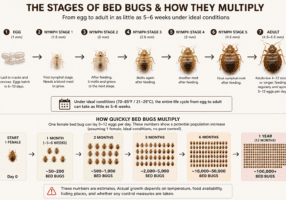
Properly delivered heat treatment can therefore target several stages of the bed bug life cycle during the same treatment.
Why Does Exposure Time Matter?
Imagine placing a cold, dense piece of furniture in a hot room.
The air surrounding it heats before the centre of the furniture does. The same principle matters during bed bug heat treatment.
Room Air Can Heat Quickly
Open areas may reach elevated temperatures relatively quickly, especially close to the incoming heated air.
Protected Areas Heat More Slowly
Mattresses, sofas, divan bases, floor-level areas and dense furniture may take longer to reach effective conditions.
Maintaining treatment conditions gives heat time to transfer into these slower-heating locations.
What Is a Lethal Hold Period?
A hold period is the time during which effective treatment conditions are maintained after the relevant locations have heated sufficiently.
This distinction matters because the treatment should not necessarily be considered to have started the instant the heater is switched on.
The property first has to warm up, and different locations can do so at different rates.
Why Doesn't MothKill Simply Use the Highest Possible Temperature?
Because unnecessarily high temperatures can increase the risk of damage without automatically making the treatment better.
Heat-sensitive materials can include:
- some plastics;
- UPVC components;
- laminated furniture;
- certain adhesives;
- vinyl;
- some electronics;
- plastic blinds and fittings;
- artwork; and
- other temperature-sensitive possessions.
How Does MothKill Monitor Bed Bug Heat Treatment?
Heat
Professional indirect heating equipment supplies clean heated air to the treatment area.
Circulate
Industrial fans move heated air around rooms and help reduce temperature differences.
Monitor
Multiple temperature sensors monitor conditions at different locations.
Maintain
Treatment conditions are maintained according to what the monitored areas are actually achieving.
Why Are Multiple Temperature Sensors Important?
One sensor tells you what is happening in one place.
During heating, substantial temperature differences can exist within the same room. An open-air sensor may show a high reading while another sensor in a more protected location remains cooler.
Multiple sensors help identify these differences so that airflow and equipment can be adjusted where necessary.
What Are Cold Spots During Heat Treatment?
A cold spot is an area that warms more slowly than the surrounding environment.
Potential slower-heating locations include:
- beneath beds;
- behind wardrobes;
- under sofas;
- floor-level areas;
- inside or around dense furniture;
- areas obstructed by clutter; and
- locations with poor air circulation.
These locations matter because they can overlap with places where bed bugs hide.
Why Are Fans Used During Bed Bug Heat Treatment?
Industrial fans help circulate heated air throughout the treatment area.
Without good airflow, hotter air can accumulate in one part of a room while protected or obstructed areas remain cooler.
Fans do not replace temperature monitoring, but they are an important part of achieving more even heat distribution.
Can Bed Bugs Hide From Heat?
A bed bug could potentially survive if it remains somewhere that does not become hot enough for long enough.
This is why preparation, treatment coverage, airflow, exposure time and temperature monitoring all matter.
Heat treatment can be highly effective when correctly delivered, but it would be misleading to describe any pest treatment as incapable of failure.
Does Heat Reach Mattresses, Furniture and Walls?
Mattresses
Mattresses warm progressively. Their thickness, construction and materials affect how quickly heat transfers through them.
Furniture
Dense furniture generally warms more slowly than surrounding air. Bed frames, divans and sofas can also contain important bed bug harbourages.
Walls & Voids
Heat transfers through materials, but heated room air should not be assumed to automatically create identical conditions inside every sealed structural void.
Electrical Areas
Bed bugs can use gaps around electrical fittings, but electrical areas require particular care and should never be treated unsafely.
Can Household Heat Kill Bed Bugs?
Can Washing and Tumble Drying Kill Bed Bugs?
Appropriate hot laundering and tumble-drying processes can be useful for suitable washable or dryable items.
Always follow the item's care instructions.
Treating clothes and bedding does not, however, eliminate bed bugs living in bed frames, furniture or elsewhere in the property.
Does Steam Kill Bed Bugs?
Steam can kill bed bugs and eggs when sufficient heat contacts them directly.
Its main limitation is reach. Steam can be useful for accessible seams, surfaces and harbourages but should not be assumed to treat insects hidden beyond the area receiving sufficient heat.
Is Heat Better Than Insecticide?
Heat and insecticides work differently, and both can have legitimate roles in professional bed bug management.
Suitable professional insecticides can provide direct or residual control. Heat offers the advantage of targeting different life stages, including eggs, without depending on insecticide susceptibility.
Some situations may benefit from an integrated approach using more than one method.
How Long Does Bed Bug Heat Treatment Take?
There is no universal treatment duration because properties heat at different rates.
Property size, construction, furniture, starting temperature, airflow and slower-heating harbourages can all affect the time required.
The useful measurement is not simply how long the heater has been running. It is whether the relevant locations have achieved effective conditions for sufficient time.
Read our guide to how long bed bug heat treatment takes .
How Does Professional Bed Bug Heat Treatment Work?
MothKill uses professional indirect heating equipment positioned outside the property. Combustion gases remain outside while clean heated air is ducted into the treatment area.
Industrial fans circulate heated air, while multiple temperature sensors monitor conditions at different locations.
Heating is managed according to the conditions being achieved throughout the treatment area rather than simply relying on one thermometer or a predetermined heater-running time.
Read our detailed guide to how professional bed bug heat treatment works .
Can Bed Bugs Survive Heat Treatment?
Any bed bug that fails to receive sufficient thermal exposure could potentially survive.
Possible reasons include a protected harbourage that remained too cool, an untreated area or another part of the property being outside the treatment zone.
Bed bugs can also be reintroduced after a successful treatment.
If you are concerned about continuing activity, read why you may still have bed bugs after treatment .
More Bed Bug Heat Treatment Guides
Frequently Asked Questions
What temperature kills bed bugs instantly?
It is better not to design whole-room treatment around an “instant kill” temperature. Higher temperatures generally reduce the exposure time required, but professional treatment needs to ensure lethal conditions reach hidden insects and eggs without unnecessarily overheating the property.
Does 50°C kill bed bugs?
Temperatures around 50°C can be lethal when bed bugs experience them for sufficient time. A room-air reading of 50°C does not prove that every hidden harbourage has reached the same temperature.
Does 60°C kill bed bugs and eggs?
Temperatures around 60°C can kill bed bugs and eggs. Professional treatment still requires controlled exposure, airflow and monitoring rather than simply producing the highest possible room temperature.
What temperature kills bed bug eggs?
Bed bug eggs are susceptible to sufficiently high temperatures. Temperature and exposure time work together, and effective conditions need to reach the location where the eggs are concealed.
Can central heating kill bed bugs?
No. Normal domestic central heating does not create the controlled lethal conditions used for professional bed bug heat treatment.
Can a hairdryer kill bed bugs?
A hairdryer may expose an individual insect to heat, but it is not an effective infestation treatment. It cannot reliably heat all hidden harbourages and may damage materials or disturb insects.
Can bed bugs survive professional heat treatment?
Heat treatment can be highly effective, but an insect in a location that fails to receive sufficient temperature and exposure could potentially survive. Preparation, airflow, treatment coverage and monitoring are therefore important.
What Temperature Kills Bed Bugs? – Final Answer
There is no useful single-number answer that explains professional bed bug heat treatment.
Temperature, exposure time, airflow and treatment coverage work together.
A very high reading beside a heater means little if a protected bed bug harbourage beneath furniture remains substantially cooler.
Professional treatment therefore concentrates on the areas that are hardest to heat rather than simply chasing the highest thermometer reading.
Need Professional Bed Bug Heat Treatment?
MothKill uses professional heating equipment, industrial air circulation and multiple temperature sensors to monitor treatment conditions throughout the affected property.