
Are Bed Bugs in My Walls

Yes, bed bugs can hide in cracks, gaps and fittings around walls, but they do not normally need to live deep inside a wall cavity.
Bed bugs usually stay reasonably close to where people rest or sleep because this gives them access to a host.
However, as an infestation becomes established, bed bugs may be found behind skirting boards, around wall fittings, beneath loose wallpaper, inside cracks and in other protected spaces around a room.
If you suspect bed bugs are coming from your walls, this guide explains where they may be hiding, what signs to look for and what to do next.
Can Bed Bugs Actually Live in Walls?
Bed bugs do not build nests inside walls in the way that rodents or some social insects do.
Instead, they use narrow cracks and crevices as harbourages — protected places where they can remain concealed between blood meals.
A suitable harbourage is typically:
- dark;
- protected;
- relatively undisturbed; and
- reasonably close to a sleeping or resting host.
A crack or gap associated with a wall can provide these conditions.
Where Do Bed Bugs Hide Around Walls?
Wall-related harbourages are generally associated with accessible cracks, gaps and protected fittings rather than bed bugs simply living throughout the entire wall.
Beds and nearby furniture should still be high-priority inspection areas.
Our guide to where bed bugs hide during the day covers the most important harbourage locations in more detail.
Do Bed Bugs Prefer Walls or Beds?
Bed bugs generally benefit from remaining reasonably close to their host.
For that reason, bed frames, mattress seams, headboards and nearby furniture are often important harbourage areas.
Wall-related hiding places become more relevant when suitable cracks and gaps exist close to the sleeping area or when an infestation has become more widely distributed.
A bed bug walking on a wall therefore does not automatically mean that the infestation originates inside the wall.
Can Bed Bugs Hide Behind Skirting Boards?
Yes. Narrow gaps behind or beneath skirting boards can provide protected harbourages.
Pay particular attention to skirting close to beds, sofas and other places where people spend long periods resting.
Evidence can include live bed bugs, cast skins, eggs and characteristic dark faecal spotting.
Can Bed Bugs Hide Behind Wallpaper?
Yes, particularly where wallpaper is loose, damaged or lifting away from the wall.
A narrow protected gap between wallpaper and the wall can potentially provide a harbourage.
This does not mean wallpaper should automatically be stripped from an infested room. Treatment decisions should be based on inspection evidence rather than unnecessary disturbance.
Can Bed Bugs Travel Through Walls?
Bed bugs can move through suitable structural gaps and openings.
Potential routes may include:
- gaps around pipes;
- service penetrations;
- openings around cables;
- gaps associated with skirting;
- cracks and junctions; and
- other connected openings within the structure.
However, it is too simplistic to assume that bed bugs routinely travel deep through every cavity wall.
The important question is whether accessible, connected routes allow insects to move between harbourages or adjoining areas.
Can Bed Bugs Spread Between Flats?
Yes. Bed bugs can spread between adjoining dwellings, which can be particularly relevant in blocks of flats, HMOs and other multi-occupancy buildings.
Movement may occur through suitable structural routes. Bed bugs can also be transported between properties on furniture, luggage, clothing and other belongings.
Where bed bug activity repeatedly returns in a flat despite appropriate treatment, adjoining accommodation may need to be considered as part of the investigation.
Can Bed Bugs Spread Between Terraced Houses?
Movement between adjoining properties is possible where suitable routes exist, but it should not automatically be assumed to be the source of an infestation.
Bed bugs are also introduced into homes through luggage, furniture, belongings and other forms of accidental transport.
Evidence should guide the investigation rather than assuming that bed bugs must have travelled through a party wall.
Do Cavity Walls Make Bed Bugs Worse?
A cavity wall does not automatically mean you have a more serious bed bug infestation.
Bed bugs need suitable access points and harbourages.
Building construction may influence the number and type of cracks, service penetrations and voids available, but assigning a simple bed bug risk to an entire wall type can be misleading.
Can Bed Bugs Hide in Plasterboard or Stud Walls?
Stud walls contain internal voids, but bed bugs still require accessible openings to enter them.
Gaps around services, damaged plasterboard and poorly sealed junctions may provide access to protected spaces.
Again, the presence of a hollow wall does not prove that bed bugs are living throughout it.
Can Bed Bugs Hide in Solid Brick Walls?
Bed bugs are not burrowing through solid brick.
However, older properties may contain cracks in plaster, gaps around timber, loose skirting and other small openings that can provide harbourages.
The accessible condition of the room is therefore more relevant than simply whether the wall behind it is constructed from brick.
What About Lath-and-Plaster Walls?
Older lath-and-plaster construction can contain numerous gaps and voids, particularly where the plaster has deteriorated.
These may provide potential harbourages where bed bugs have suitable access.
That does not mean every lath-and-plaster wall in an infested property needs to be opened.
How Do I Know If Bed Bugs Are Hiding Around My Walls?
Look for physical evidence rather than relying on bites alone.
Live Bed Bugs
Inspect cracks, skirting, headboards and nearby fittings for live insects.
Dark Spotting
Bed bug faecal spotting may occur around established harbourages and nearby surfaces.
Cast Skins
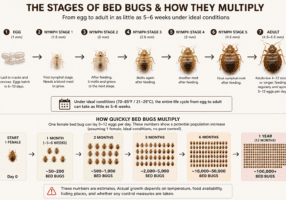
Nymphs shed their outer skin as they develop. These remains can provide evidence of established activity.
Eggs & Nymphs
Finding different life stages can indicate that bed bugs have been reproducing in the area.
How Should You Inspect a Room for Wall-Related Bed Bugs?
Start close to the sleeping area and work outwards rather than immediately assuming the insects are deep inside the structure.
Inspect the Bed
Check mattress seams, bed-frame joints, divan bases and other protected areas.
Check the Headboard
Inspect behind and around the headboard, particularly where it meets the wall.
Inspect Nearby Furniture
Check bedside furniture, sofas and other resting areas close to the suspected activity.
Inspect Wall Junctions
Examine accessible cracks, skirting, loose wallpaper and service penetrations for evidence.
Should I Seal Cracks If I Have Bed Bugs?
Sealing suitable cracks and gaps can be useful as part of longer-term bed bug management, but it should not be treated as a substitute for dealing with an active infestation.
If live bed bugs are already using a harbourage, inspection and appropriate treatment should be considered before simply sealing accessible openings.
Can Bed Bug Spray Reach Bugs Inside Walls?
Not necessarily.
An insecticide applied to an exposed surface does not automatically reach insects concealed behind inaccessible materials or within structural voids.
Professional insecticide treatment depends on using an authorised product correctly and applying it to appropriate locations according to its label.
More product is not automatically better, and householders should not inject sprays or powders blindly into wall cavities or electrical fittings.
Can Steam Kill Bed Bugs Around Walls?
Steam can kill bed bugs and eggs when sufficient heat makes direct contact with them for an appropriate period.
Its limitation is penetration. Steam applied to an exposed crack does not mean that heat has reached every concealed area behind a wall.
Steam also needs to be used carefully around heat-sensitive materials and electrical equipment.
Can Heat Treatment Kill Bed Bugs Hiding Around Walls?
Professional heat treatment can kill bed bugs and eggs when lethal thermal conditions reach their harbourages for sufficient time.
Effective treatment therefore depends on controlled heating, airflow, exposure time and temperature monitoring throughout the treatment area.
Heat should not be described as automatically penetrating every sealed wall cavity. The important question is whether effective temperatures reach the locations where the bed bugs are actually harbouring.
Learn more about how bed bug heat treatment works .
Why Can Bed Bugs Come Back After Treatment?
Recurring activity does not have one single explanation.
Possible reasons include:
- missed harbourages;
- incomplete treatment coverage;
- surviving insects or life stages;
- insecticide resistance where relevant;
- activity in an untreated adjoining area;
- reintroduction from luggage, furniture or belongings; and
- movement from another affected dwelling.
If this is happening, read why you may still have bed bugs after treatment .
Do I Need to Open My Walls?
Usually, this should not be the starting point.
Bed bug inspection should first concentrate on accessible harbourages and evidence around the bed, nearby furniture, skirting and wall junctions.
Opening walls without evidence can create unnecessary disruption without identifying the actual source of the infestation.
Should I Throw Away My Bed or Furniture?
Not automatically.
Beds, mattresses and furniture can often be treated, depending on their condition and the treatment method being used.
Discarding items unnecessarily can be expensive and moving infested furniture through a property may also spread bed bugs to other areas.
Frequently Asked Questions
Can bed bugs live inside walls?
Bed bugs can use accessible cracks, gaps and voids associated with walls as harbourages. This does not mean they normally live throughout the entire internal wall cavity.
Why am I seeing bed bugs crawling on my wall?
A bed bug on a wall may be moving between harbourages or towards or away from a host. Its presence on the wall does not by itself identify where the main infestation is located.
Can bed bugs hide behind skirting boards?
Yes. Narrow gaps behind or beneath skirting can provide protected harbourages, particularly close to beds and other resting areas.
Can bed bugs hide behind wallpaper?
They can use gaps behind loose or lifting wallpaper, although wallpaper should not automatically be stripped simply because bed bugs are present in a room.
Can bed bugs travel through walls between flats?
Movement between adjoining dwellings is possible where suitable connected openings exist. Bed bugs can also be transported between properties on furniture, luggage, clothing and other belongings.
Can bed bugs hide around plug sockets?
They can use gaps associated with electrical fittings. Do not dismantle or introduce treatment products into electrical equipment unless the work and product are specifically appropriate and can be used safely.
Will heat treatment kill bed bugs around walls?
Heat can kill bed bugs and eggs when the required temperature and exposure conditions reach their harbourage. It should not be assumed that heat automatically reaches every sealed structural cavity.
Do I need to open the wall to get rid of bed bugs?
Usually not as a first step. Inspection should begin with accessible harbourages around the bed, furniture, skirting and nearby structural gaps and be guided by physical evidence.
Are Bed Bugs in My Walls? – Final Answer
Bed bugs can hide in cracks, gaps and protected spaces associated with walls, including behind skirting, around wall fittings, beneath loose wallpaper and within accessible structural openings.
However, finding bed bugs on or near a wall does not automatically mean that the infestation is living deep inside the wall cavity.
Start by inspecting the bed, headboard and nearby furniture before working outwards towards skirting, wall junctions and other accessible cracks.
In flats and other adjoining properties, recurring activity may also justify considering whether another affected area is contributing to the problem.
Bed Bugs Hiding Around Your Home?
MothKill provides professional bed bug heat treatment for established infestations. We can help you assess the extent of the problem and choose an appropriate treatment approach.