
Bed Bug Spray Does It Really Work


Bed bug sprays can work — but spraying a bed or bedroom is not automatically the same as eliminating a bed bug infestation.
Some insecticides can kill bed bugs when correctly selected and applied. Professional insecticide treatments can also form an effective part of bed bug control.
So why do so many people spray for bed bugs and still find them afterwards?
The answer involves insecticide resistance, hidden harbourages, treatment coverage, bed bug eggs, follow-up and the way the treatment is applied.
Here's what bed bug spray can realistically do — and where its limitations begin.
Does Bed Bug Spray Work? The Quick Answer
Yes, an appropriate bed bug insecticide can work.
But there is a major difference between killing an exposed bed bug and eliminating an infestation.
A successful insecticide programme may depend on:
- using a product authorised for the intended use;
- correct application;
- finding the bed bug harbourages;
- adequate treatment coverage;
- understanding where insecticide can and cannot safely be applied;
- dealing with different life stages;
- resistance to particular insecticides; and
- appropriate inspection and follow-up.
A good insecticide applied in the wrong places can still produce a poor result.
What Happens If You Spray a Bed Bug Directly?
Some insecticidal sprays can kill bed bugs following direct exposure when the product is used according to its label.
That sounds straightforward, but exposed bed bugs are not usually the hardest part of an infestation.
The bigger problem is finding the insects you cannot see.
Bed bugs spend much of their time concealed in harbourages. Depending on the infestation, these can include:
- bed frames and joints;
- headboards;
- mattress seams;
- divan bases;
- bedside furniture;
- skirting edges;
- cracks and crevices;
- upholstered furniture; and
- other protected locations close to where people rest.
See our detailed guide to where bed bugs hide during the day .
Does Bed Bug Spray Kill Eggs?
This depends on the insecticidal product and its authorised use.
You should not assume that every bed bug spray will reliably kill every egg.
Bed bug eggs can also be positioned in concealed harbourages, which creates a second problem: even a product with activity against eggs cannot act effectively on an egg it never reaches.
The question isn't only whether an insecticide can affect bed bug eggs. You also need to consider whether the treatment reaches the places where eggs and other bed bug stages are actually present.
What Is a Residual Bed Bug Spray?
Some insecticides are designed to leave an active residue on appropriately treated surfaces.
This means the treatment isn't necessarily limited to insects present at the moment of application.
Depending on the product, surface, application and other factors, bed bugs subsequently contacting an appropriately treated area may also be exposed.
This is one reason professional insecticide control should not be confused with simply chasing visible bed bugs around with an aerosol can.
Why Can Bed Bug Spray Fail?
🔎 Harbourages Were Missed
Bed bugs concealed away from treated areas may receive little or no exposure to the insecticide.
🧪 Insecticide Resistance
Some bed bug populations show resistance to certain insecticides, which can reduce the effectiveness of particular products.
🥚 Different Life Stages
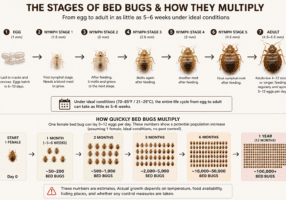
An infestation can contain adults, nymphs and eggs at the same time. A treatment programme needs to take the full infestation into account.
🏠 The Infestation Is Wider Than Expected
Activity may not be confined to the mattress or even to the room where the first bed bug was discovered.
📅 Follow-Up Was Needed
Some insecticidal programmes deliberately include subsequent inspection or treatment rather than relying on one application.
🔄 Reintroduction
New bed bugs can occasionally be brought into a property after treatment, creating a new problem rather than survival from the original treatment.
Bed Bug Insecticide Resistance
Resistance is one of the important challenges in modern bed bug control.
Repeated exposure over generations can select bed bugs with traits that make particular insecticides less effective against them.
But resistance should not be turned into the simplistic claim that “bed bug sprays don't work anymore.”
Different active ingredients work differently, resistance varies between populations, and professional control can involve product selection and integrated treatment strategies.
Resistance is therefore one possible reason for treatment difficulty — not the explanation for every failed treatment.
The Bigger Problem: Missed Bed Bug Harbourages
In my experience, people understandably concentrate on the bed.
After all, they're called bed bugs.
But treating only the mattress can leave significant harbourages untouched.
Bed bugs can hide within the construction of the bed, around the headboard, in furniture and in other protected areas.
As an infestation develops, its distribution can become more complicated.
This is why inspection is one of the most important parts of bed bug control.
Can I Just Spray My Mattress?
No — you should not assume that spraying a mattress will eliminate an infestation.
Firstly, pesticides should only be used on surfaces specifically permitted by the product label.
Secondly, the mattress may represent only one part of the bed bug harbourage environment.
Even an apparently spotless mattress doesn't rule out bed bugs elsewhere around the sleeping area.
Shop-Bought Bed Bug Spray vs Professional Treatment
| Factor | DIY Spray | Professional Treatment |
|---|---|---|
| Inspection | Depends on the householder finding relevant areas. | Inspection forms part of the treatment planning. |
| Product choice | Limited to products legally available for DIY use. | Professional products and methods can be selected according to the treatment programme. |
| Application | Depends heavily on label interpretation and user technique. | Applied by a trained technician according to the product and treatment plan. |
| Harbourage coverage | Hidden locations can easily be overlooked. | A professional inspection can help identify less obvious harbourages. |
| Follow-up | Often depends on the householder recognising continuing activity. | Can form a planned part of the treatment programme. |
Does One Bed Bug Spray Treatment Work?
Sometimes insecticidal control involves more than one stage.
That does not automatically mean the first treatment failed.
A professional treatment programme may include follow-up inspection, monitoring or further treatment depending on the product, infestation and circumstances.
For the same reason, seeing activity shortly after a treatment does not automatically tell you why that activity occurred.
We've covered this in more detail in Still Got Bed Bugs After Treatment?
What About Bed Bug Foggers and Bug Bombs?
Total-release foggers and similar products should not be confused with a carefully targeted professional insecticide treatment.
Bed bugs are cryptic insects that spend much of their time concealed in protected harbourages.
A pesticide dispersed into the open room may not necessarily reach those harbourages in an effective way.
There is also a risk of inappropriate pesticide exposure or misuse when products are not used exactly according to their instructions.
Never assume that filling a room with more insecticide means better bed bug control.
Do Natural Bed Bug Sprays Work?
Products marketed as “natural” can contain a variety of ingredients, including essential oils.
Some substances may have insecticidal or repellent effects under particular conditions, but that does not mean every natural bed bug spray will eradicate an established infestation.
There is another potential problem with repellency.
If a product mainly causes bed bugs to move away from an area rather than providing effective control, that isn't necessarily the result you want.
For an established infestation, I would not rely on a product simply because the label uses words such as natural or chemical-free.
Should You Keep Spraying If You Still See Bed Bugs?
Not blindly.
If treatment doesn't appear to be working, repeatedly applying more product without understanding why can be counterproductive and may create unnecessary pesticide exposure.
Instead, reassess:
Was the Pest Correctly Identified?
Confirm that the insects or evidence really are bed bugs.
Where Are They Hiding?
Inspect beyond the mattress and identify likely harbourages.
What Has Already Been Treated?
Work out whether important areas were excluded or overlooked.
Was Follow-Up Part of the Programme?
Check the instructions or professional treatment plan rather than assuming one application was intended to finish the programme.
Is It Time to Change Strategy?
Persistent activity may justify professional assessment or a different treatment approach.
Bed Bug Spray vs Steam vs Heat Treatment
These methods work differently, and each has strengths and limitations.
| Method | How It Works | Main Limitation |
|---|---|---|
| Insecticide | Uses an authorised insecticidal product through direct and/or residual action depending on the formulation. | Product selection, resistance, application and coverage can affect results. |
| Steam | High-temperature steam can kill bed bugs and eggs that receive sufficient direct thermal exposure. | It is essentially a contact treatment and has limited penetration. |
| Professional heat | Raises the treatment environment to controlled temperatures lethal to bed bugs when sufficient thermal exposure reaches them. | Requires suitable heating capacity, preparation, airflow, monitoring and treatment coverage. |
Why MothKill Uses Professional Heat Treatment
Heat gives us a fundamentally different way to approach a bed bug infestation.
Bed bugs and their eggs are vulnerable when sufficient thermal conditions reach them for sufficient exposure.
That means heat can target the different bed bug life stages within the successfully heated treatment environment without relying solely on an insect contacting an insecticide deposit.
But professional heat treatment isn't simply a case of putting a heater in the room.
MothKill uses professional heating equipment, industrial air-moving fans and multiple temperature sensors.
Our indirect diesel heating equipment remains outside the property. Combustion gases remain outdoors while clean heated air is ducted into the treatment area.
Airflow helps distribute heat, and temperature monitoring helps us identify how different areas are heating.
Different materials and locations heat at different rates, which is why monitoring matters as much as the room feeling hot.
Learn more about professional bed bug heat treatment .
Does Heat Treatment Guarantee Every Bed Bug Dies?
No responsible treatment should be described as magic.
Heat can kill bed bugs and eggs when the required thermal exposure reaches them, but treatment success depends on factors including:
- preparation;
- heating capacity;
- airflow;
- temperature distribution;
- monitoring;
- treatment coverage;
- property conditions; and
- the possibility of later reintroduction.
This is why we monitor the treatment rather than relying on a single air-temperature reading.
See What Temperature Kills Bed Bugs? for a fuller explanation.
What Is Hybrid Bed Bug Treatment?
Heat and insecticides don't always have to be presented as competing methods.
A treatment strategy can combine methods where appropriate.
For example, a hybrid approach may use heat as a major component of treatment alongside appropriately selected insecticidal measures.
The purpose is not simply to use more treatments. It is to use different methods strategically.
Read more about hybrid bed bug treatment .
Can I Treat a Small Bed Bug Infestation Myself?
A very small and genuinely localised infestation may be easier to control than a long-established one, but bed bugs are particularly good at hiding.
If you intend to use a DIY pesticide:
- use only an authorised product intended for the relevant use;
- read and follow the entire label;
- do not apply it to beds, clothing or other surfaces unless the label permits it;
- do not increase the dose or application frequency beyond the instructions;
- keep people and pets away as directed; and
- monitor carefully afterwards.
If activity continues, repeatedly buying different sprays without identifying the reason for failure may simply delay effective control.
When Should You Consider Professional Bed Bug Treatment?
Professional help becomes increasingly sensible when:
- you are finding bed bugs repeatedly;
- the infestation has been present for some time;
- more than one sleeping or sitting area appears affected;
- DIY treatment has already failed;
- you cannot locate the harbourages;
- the property contains substantial clutter or complex furniture; or
- you need a structured treatment and follow-up plan.
Bed Bug Spray FAQs
Does bed bug spray really work?
Yes, appropriate insecticidal products can kill bed bugs when correctly selected and applied. However, killing individual insects is different from eliminating an infestation. Harbourage coverage, resistance, life stages and follow-up can all affect the outcome.
Can bed bugs become resistant to sprays?
Bed bug populations can develop resistance to particular insecticides. Resistance varies, however, so it should not be interpreted as meaning that all insecticides are ineffective against all bed bugs.
Does bed bug spray kill eggs?
That depends on the product and its authorised use. Do not assume every spray will reliably kill every egg. Treatment also needs to reach the locations where eggs are present.
Can I spray my mattress for bed bugs?
Only use a pesticide on a mattress if its label specifically permits that application, and follow all instructions. Treating a mattress alone should not be assumed to eliminate an infestation elsewhere around the bed or room.
Why am I still seeing bed bugs after spraying?
Possible explanations include missed harbourages, incomplete coverage, surviving life stages, resistance, activity elsewhere in the property, the planned treatment programme not yet being complete, or later reintroduction.
Are bed bug foggers effective?
Bed bugs spend much of their time in protected harbourages, so dispersing pesticide into the open room should not be assumed to reach them effectively. Any pesticide product must also be used strictly according to its instructions.
Does steam kill bed bugs?
Steam can kill bed bugs and eggs that receive sufficient thermal exposure, but it is essentially a contact treatment. Technique, temperature, speed of application and access to harbourages therefore matter.
Does heat treatment kill bed bug eggs?
Yes. Bed bug eggs are vulnerable when sufficient thermal conditions reach them for adequate exposure. Professional whole-room heat treatment therefore relies on controlled heating, airflow and temperature monitoring.
Is heat better than bed bug spray?
They are different treatment approaches. Insecticides can be effective when appropriately selected and applied, while heat uses thermal exposure and can target multiple life stages within the successfully heated environment. The appropriate treatment depends on the infestation and property.
The Bottom Line: Does Bed Bug Spray Really Work?
Yes — bed bug sprays can work.
But that answer needs an important qualification.
Killing a bed bug with a spray is not the same as eliminating a bed bug infestation.
Effective insecticide treatment depends on the product, application, bed bug susceptibility, harbourage location, treatment coverage and follow-up strategy.
So if you've sprayed the bed and you're still finding bed bugs, don't automatically conclude that all insecticides are useless.
Equally, don't keep spraying blindly.
Find out why the treatment hasn't resolved the infestation.
For established infestations, professional insecticide treatment, steam, heat or a combination of methods may be appropriate depending on the circumstances.
At MothKill, professional heat treatment gives us another powerful option because it targets bed bugs through controlled thermal exposure rather than relying solely on insecticide contact.
Still Finding Bed Bugs After Using Spray?
Tell MothKill what you've found, which rooms appear affected and what treatment you've already tried. We can discuss whether professional bed bug heat treatment or another approach is appropriate.