Clothes Moths London and Where to Find Them

Clothes moths are found throughout London and across the UK, and an infestation can become established in almost any property containing suitable natural-fibre materials.
London homes can present particular challenges because the capital contains a mixture of older properties, flats, rental accommodation, valuable wool carpets, upholstered furniture and large quantities of stored clothing and textiles.
However, there is no reliable current national league table that allows us to rank every town or city by clothes moth infestation rate.
What matters more is the environment inside an individual property: the materials available to the larvae, where those materials are located, how often hidden areas are disturbed and whether an infestation is detected early.
This guide explains where clothes moths are found in London and the UK, which homes and materials can be vulnerable, how to find hidden activity and what can be done about it.
Are Clothes Moths Common in London?
Clothes moths are a well-established household textile pest in London and elsewhere in Britain.
They can occur in:
- houses and flats;
- rental properties;
- hotels and serviced accommodation;
- student accommodation;
- historic properties;
- modern apartments;
- commercial premises containing vulnerable textiles; and
- homes with wool carpets, rugs, clothing or natural-fibre furnishings.
Clothes moths are not evidence that a property is dirty. Even very clean homes can develop an infestation if moths or infested materials are introduced and suitable food sources are available.
What Clothes Moths Are Found in UK Homes?
Two clothes moths commonly associated with household textile damage in Britain are the common or webbing clothes moth (Tineola bisselliella) and the case-bearing clothes moth (Tinea pellionella).
The important point for homeowners is that the larvae cause the damage.
Adult moths may be the stage you notice flying or resting around the property, but the larvae feed on susceptible materials.
These can include:
- wool;
- cashmere;
- fur;
- feathers;
- animal hair;
- wool carpets and rugs;
- some upholstered furniture; and
- other susceptible animal-derived textile materials.
If you are unsure which moth you have, see our guide to how to identify clothes moths .
Why Can London Homes Be Vulnerable to Clothes Moths?
It is tempting to explain London's clothes moth problem simply by calling the capital a "hotspot". In reality, several property and lifestyle factors can create suitable conditions.
🏠 Older Properties
Period homes may contain wool carpets, traditional upholstery and other natural materials that can provide suitable larval food sources.
🏢 Flats & Apartments
Dense residential buildings can make investigation more complicated, particularly where communal textiles, stored belongings or neighbouring accommodation also require consideration.
🌡️ Heated Homes
Indoor heating can provide suitable temperatures for moth development beyond the warmer months, so activity should not be dismissed simply because it is winter.
🧥 Natural Fibres
Wool carpets, cashmere clothing, rugs, feather-filled items and traditional upholstery can provide food for clothes moth larvae.
📦 Stored Textiles
Clothing, blankets and other susceptible materials that remain undisturbed for long periods can allow larval activity to go unnoticed.
🪑 Movement of Belongings
Infested clothing, rugs, furniture and other textile items can move clothes moths from one property to another.
Are Clothes Moths More Common in Older London Houses?
Not automatically.
An older Victorian or Edwardian property is not inherently infested simply because of its age.
What can matter is the presence of vulnerable materials and areas that are difficult to inspect or clean.
For example:
- fitted wool carpet beneath heavy furniture;
- natural-fibre rugs;
- traditional upholstered furniture;
- stored wool clothing;
- unused cupboards;
- textiles stored beneath beds; and
- other quiet areas containing suitable larval food.
A modern apartment containing extensive wool carpeting can therefore be just as relevant as an older house.
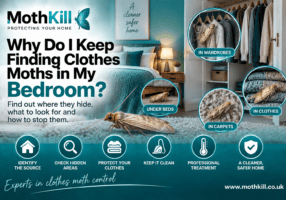
Where Are Clothes Moths Usually Found in a Home?
Many people start by checking their wardrobe. That's sensible, but the wardrobe is only one possible source.
Clothes moth larvae can be found in sheltered areas where suitable materials remain relatively undisturbed.
| Area | Why It Matters | What to Inspect |
|---|---|---|
| Wardrobes | Stored wool and other susceptible clothing may remain undisturbed | Garments, shelves, wardrobe floors, corners and stored textiles |
| Under Furniture | Carpet beneath heavy furniture may receive little cleaning or disturbance | Wool carpet, edges, larvae, cases, webbing and textile damage |
| Carpet Edges | Sheltered edges can accumulate hair and textile debris | Skirting edges, beneath radiators and behind furniture |
| Sofas & Armchairs | Some upholstery and fillings contain vulnerable animal-derived materials | Undersides, seams, cushions and surrounding carpet |
| Stored Textiles | Long periods without disturbance can allow feeding to continue unnoticed | Blankets, woollens, rugs, bags and storage containers |
| Under Beds | Dust, hair, stored textiles and vulnerable carpet may all be present | Carpet, storage boxes, clothing and edges |
Can Clothes Moths Live in Carpets?
Yes. Wool carpets can provide a substantial food source for clothes moth larvae.
Damage is often particularly noticeable in areas that are rarely disturbed, including:
- beneath sofas;
- under beds;
- beneath wardrobes;
- around carpet edges; and
- in quiet corners.
In some homes, the first obvious sign appears when a piece of furniture is moved and a previously concealed patch of damaged carpet is exposed.
Our guide to carpet moths explains why the term is commonly used and what may actually be damaging the carpet.
Can Clothes Moths Damage Furniture?
Yes, where furniture contains materials that clothes moth larvae can feed on.
The larvae are not normally eating the wooden or metal frame. The concern is materials such as wool upholstery, animal-hair stuffing, feathers and other susceptible textile components.
Furniture can also create sheltered areas over wool carpeting where an infestation develops out of sight.
Read our detailed guide to clothes moth damage to furniture .
What Are the Signs of Clothes Moths?
Do not rely on an occasional adult moth alone. Look for evidence associated with vulnerable materials.
Possible signs include:
- live clothes moth larvae;
- irregular damage to susceptible clothing;
- thinning or bald areas in wool carpet;
- silken webbing associated with larval activity;
- portable larval cases from case-bearing clothes moths;
- cast larval material; and
- adult clothes moths repeatedly appearing around suitable textile areas.
Why Are Clothes Moth Infestations Often Discovered Late?
The damaging stage can remain concealed.
Larvae may be feeding beneath furniture, among stored textiles, around carpet edges or within vulnerable furnishings while the homeowner sees very little activity.
Another problem is that people often concentrate on killing the adult moths they can see.
Adult moth activity can be useful evidence, but killing a few flying adults does not tell you whether larvae remain elsewhere.
Understanding the clothes moth life cycle helps explain why inspection needs to focus on the larval source.
Do Clothes Moths Have a Season in London?
Adult moth activity can become more noticeable during warmer periods, but an indoor infestation should not be regarded as purely seasonal.
Heated homes can provide conditions that allow development to continue when outdoor temperatures are much lower.
So if you find larvae or fresh textile damage during winter, don't assume the problem will disappear by itself.
See our guide to the clothes moth season in the UK .
How Do Clothes Moths Get Into London Homes?
Sometimes it is impossible to establish exactly how an infestation began.
One important route is the movement of infested materials.
Potential introductions include:
- second-hand clothing;
- used rugs and carpets;
- upholstered furniture;
- stored textiles;
- belongings moved from another property; and
- other susceptible items already containing eggs or larvae.
Adult moths can also move locally, but an infestation should not automatically be blamed on a neighbour simply because you live in a flat or terraced property.
Can Clothes Moths Spread Between Flats?
Clothes moth activity in blocks of flats can sometimes be more complicated than activity in a detached property, but the route needs investigating rather than assuming insects are travelling freely through every connected home.
Relevant factors may include:
- communal carpeting;
- shared textile storage;
- movement of belongings between flats;
- discarded or second-hand furnishings; and
- separate infestations within neighbouring accommodation.
If moth activity repeatedly returns after appropriate treatment, the wider building environment may deserve consideration.
Are Student Accommodation and Rental Properties at Risk?
Any property can develop clothes moths, but accommodation with frequent movement of belongings provides repeated opportunities for pests to be introduced.
This makes good inspection particularly useful:
- between tenancies;
- when new textile damage appears;
- after vulnerable second-hand furnishings are introduced; and
- when occupants repeatedly report moth activity.
The presence of clothes moths should not automatically be attributed to the current tenant. Establishing when and how an infestation began can be difficult.
Can You Get Rid of Clothes Moths Yourself?
Sometimes.
A small, localised problem where the source can be identified is very different from an established infestation involving fitted carpets, furniture and several rooms.
A sensible DIY strategy may include:
- identifying the pest correctly;
- finding the affected materials;
- thorough vacuuming;
- laundering suitable textiles according to their care instructions;
- professional dry cleaning where appropriate;
- freezing suitable items using an appropriate method;
- careful storage of clean susceptible textiles;
- monitoring; and
- using authorised pest-control products correctly where appropriate.
Do Clothes Moth Pheromone Traps Work?
They are useful, but their role is often misunderstood.
Clothes moth pheromone traps are primarily a monitoring tool. They attract particular adult male moths and can help establish whether activity is present and monitor changes over time.
They do not directly remove larvae feeding beneath your sofa, in your carpet or among stored clothing.
Read more about what clothes moth pheromone traps do .
Do Cedar and Natural Moth Repellents Work?
Cedar and other products marketed as natural moth deterrents should not be confused with treatment of an established infestation.
Some products may have repellent effects under certain conditions, but a pleasant-smelling wardrobe does not establish that eggs and larvae elsewhere have been eliminated.
If larvae are already damaging carpets or clothing, concentrate on locating and treating the infestation.
Do Clothes Moth Sprays Work?
Appropriately authorised insecticides can have a legitimate role in clothes moth control.
Effectiveness depends on factors including:
- using a product authorised for the intended purpose;
- following the product label;
- treating appropriate surfaces;
- achieving adequate coverage;
- locating the infestation; and
- integrating treatment with cleaning and monitoring where required.
Spraying an adult moth flying across a room is very different from addressing larvae established beneath furniture or in vulnerable textiles.
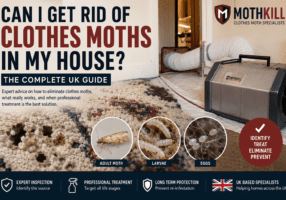
Professional Clothes Moth Heat Treatment
Professional heat treatment can be particularly useful for established clothes moth infestations involving carpets, furniture and multiple areas of a property.
Eggs, larvae, pupae and adult clothes moths are vulnerable to sufficiently high temperatures when effective thermal conditions actually reach them for sufficient exposure.
This is why professional heat treatment involves more than simply warming the room.
MothKill uses professional heating equipment, industrial air-moving fans and multiple temperature sensors.
Our indirect diesel heating equipment remains outside the property. Combustion gases remain outdoors while clean heated air is ducted into the treatment environment.
Fans help distribute heated air, while temperature sensors allow conditions to be monitored at different locations.
The objective is controlled and monitored thermal exposure throughout the treatment environment — not simply achieving a high air temperature in one part of the room.
Learn more about professional clothes moth heat treatment .
Can Heat Treatment Kill Clothes Moth Eggs?
Yes. Clothes moth eggs are vulnerable to sufficiently high temperatures when the necessary thermal conditions reach them for sufficient exposure.
The same principle applies to larvae, pupae and adults.
However, dense furniture, carpets, stored belongings and different areas of a room can heat at different rates.
That is why airflow, preparation, monitoring and treatment conditions are important.
For more detail, see how clothes moth heat treatment works .
Does Professional Treatment Always Work in One Visit?
The appropriate treatment programme depends on the property, infestation and method being used.
Heat can target all clothes moth life stages during a treatment when the necessary thermal conditions are achieved throughout the relevant environment, but it should not be presented as incapable of failure.
Potential complications include:
- inadequate preparation;
- areas not included in the treatment;
- poor heat distribution;
- missed infested belongings;
- activity elsewhere in the property or building; and
- later reintroduction.
A professional treatment plan should therefore consider the entire extent of the infestation rather than only the room where adult moths were first noticed.
How to Reduce the Risk of Clothes Moths
Vacuum Thoroughly
Clean beneath movable furniture, along carpet edges, around skirting boards and in other sheltered areas rather than vacuuming only the visible centre of the room.
Clean Clothes Before Long-Term Storage
Launder or professionally clean suitable garments according to their care instructions before storing them for long periods.
Use Suitable Storage
Once susceptible textiles are clean and confirmed free from infestation, store seasonal items in suitable closed containers or protective garment storage where practical.
Inspect Wool Carpets
Periodically check beneath furniture and around edges for thinning, larvae, cases or other evidence.
Check Second-Hand Textiles
Inspect used rugs, wool clothing, upholstered furniture and other vulnerable items before introducing them into the home.
Monitor Activity
Suitable pheromone traps can provide useful information about adult male moth activity, particularly when combined with physical inspection.
When Should You Consider Professional Treatment?
Not every clothes moth sighting requires whole-property professional treatment.
Professional help becomes more appropriate when:
- larvae or fresh damage are appearing in several rooms;
- wool fitted carpets are extensively affected;
- the source cannot be located;
- activity repeatedly returns after DIY measures;
- multiple pieces of furniture or stored textiles are involved;
- valuable clothing, rugs or furnishings are at risk; or
- the infestation is clearly established or widespread.
Clothes Moths in London: What Should You Do First?
If you live in London and suspect clothes moths, don't begin by spraying every room.
Start by establishing what you are dealing with.
- Identify the moth.
- Find the larval source.
- Inspect susceptible textiles and carpet.
- Determine whether one room or several areas are involved.
- Choose treatment according to the extent of the infestation.
That approach is far more useful than treating London itself as the reason for the problem.
Are Clothes Moths a Problem Outside London?
Absolutely.
Clothes moths can become established anywhere in Britain where suitable materials and environmental conditions exist.
They are not restricted to large cities, historic houses or expensive properties.
A home in a small town containing wool carpets and stored natural-fibre clothing can provide perfectly suitable conditions.
Likewise, a newly built property is not automatically protected simply because it is modern.
Frequently Asked Questions
Are clothes moths common in London?
Clothes moths are an established textile pest in London and elsewhere in the UK. London contains many properties with wool carpets, natural-fibre furnishings and stored textiles, but there is no simple current league table that reliably ranks every UK city by infestation rate.
Which areas of London have the most clothes moths?
Reliable current data are not sufficient to rank individual London areas confidently. Rather than relying on postcode alone, assess the property, vulnerable materials and physical evidence of infestation.
Are clothes moths only found in old houses?
No. Older properties may contain vulnerable traditional materials, but modern homes can also experience clothes moth infestations, particularly where wool carpets, natural-fibre clothing or suitable furnishings are present.
Can clothes moths live in wool carpets?
Yes. Clothes moth larvae can damage susceptible wool carpets, particularly in sheltered areas beneath furniture and around edges that receive little disturbance.
Can clothes moths spread between London flats?
Activity in multi-unit buildings can be complicated, but the route should be investigated rather than automatically blaming a neighbouring flat. Movement of belongings, communal textiles and activity elsewhere in the building may all be relevant in some cases.
Do clothes moths disappear in winter?
Not necessarily. Indoor heating can provide suitable conditions for development outside the warmer months, so confirmed larval activity should not be ignored because it is winter.
Do pheromone traps get rid of clothes moths?
Pheromone traps are useful primarily for monitoring particular adult male clothes moths. They do not directly eliminate larvae feeding in carpets, clothing or furniture.
Can I treat clothes moths myself?
A small, localised infestation may sometimes be manageable with careful inspection, cleaning, appropriate treatment of affected textiles and monitoring. Established infestations involving fitted carpets, furniture or several rooms can be considerably harder to manage.
Does heat treatment kill clothes moth eggs and larvae?
Clothes moth eggs, larvae, pupae and adults are vulnerable to sufficiently high temperatures when effective thermal conditions reach them for sufficient exposure. Professional treatment therefore depends on controlled heating, airflow and temperature monitoring.
Do clothes moths mean my house is dirty?
No. Clothes moths can occur in clean homes. Regular cleaning can remove accessible larvae, eggs, hair and debris and can disturb hidden areas, but an infestation can still be introduced into a well-maintained property.
Clothes Moths in London & the UK: The Bottom Line
Clothes moths are not exclusively a London problem and they are not confined to old or poorly maintained properties.
They can become established wherever their larvae have access to suitable materials such as wool, animal hair, feathers and other vulnerable animal-derived fibres.
London contains many properties where those materials are present, including period houses, flats, rental accommodation and homes with fitted wool carpets. But postcode alone does not determine whether a property will develop an infestation.
The most important steps are to identify the pest, locate the larval source, establish how widespread the activity is and then choose treatment appropriate to the infestation.
For small localised problems, cleaning and treatment of individual items may be sufficient. Where larvae have become established across carpets, furniture or several rooms, a professional treatment programme may be more appropriate.
Clothes Moth Problem in London or Elsewhere in the UK?
MothKill provides professional clothes moth heat treatment using controlled heating, industrial airflow and multiple temperature sensors for suitable properties within our service area.