
How to Deal With Bed Bugs Between Tenancies
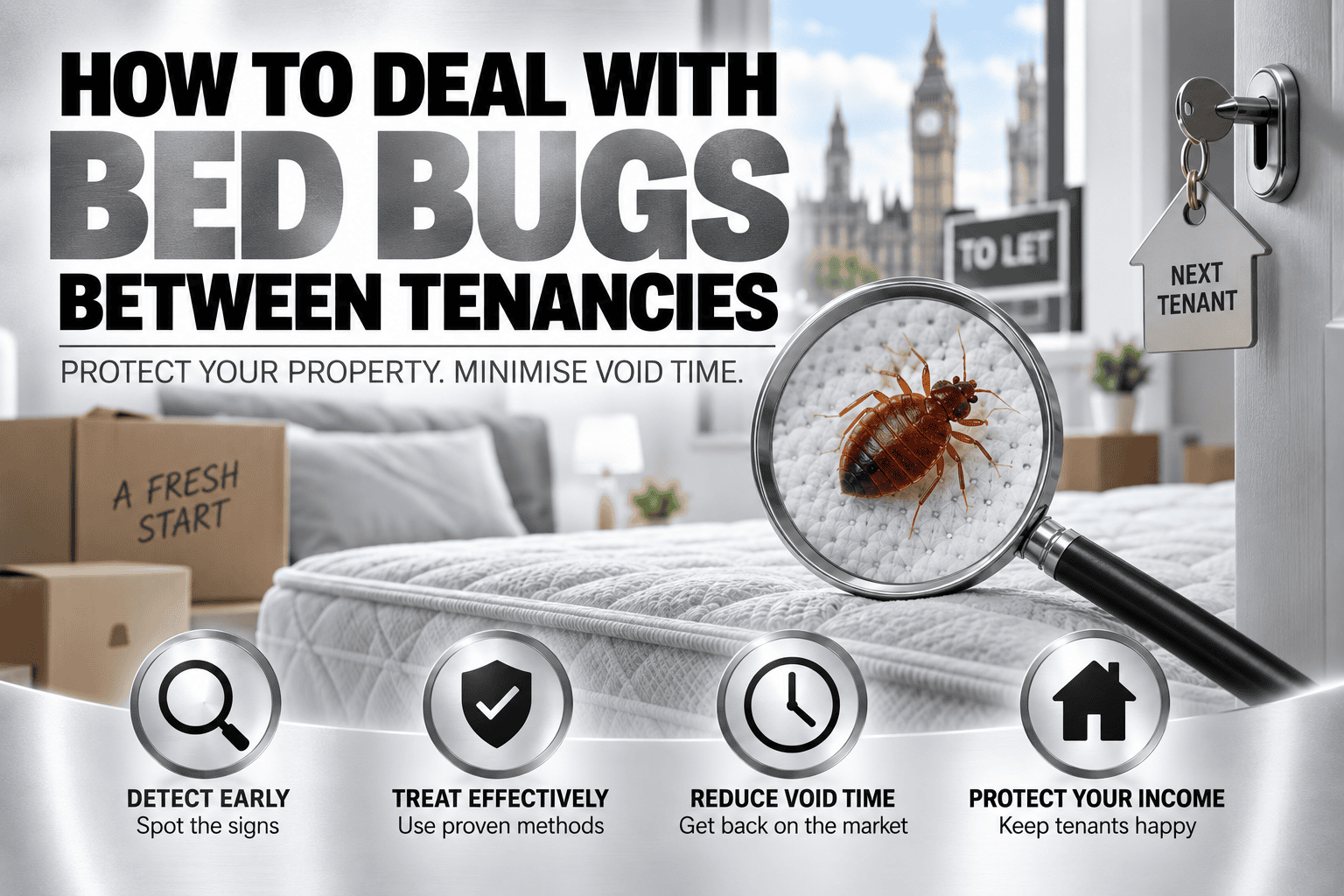
The gap between tenants can be one of the best opportunities a landlord has to investigate and treat a bed bug problem.
The property is accessible, furniture can be inspected properly and treatment can be organised without working around normal day-to-day occupancy.
But speed shouldn't mean guessing.
If a previous tenant has reported bed bugs, bites or suspicious insects, the objective is to confirm the problem, establish its extent, treat appropriately and document what was done before the next tenancy begins.
The Ideal Bed Bug Changeover
A good void-period strategy is straightforward:
Inspect → Identify → Assess → Treat → Check → Document → Re-let.
What you don't want is:
Tenant leaves → quick spray → new mattress → new tenant → bed bugs reported again.
The second route can become much more expensive than dealing with the original infestation properly.
Don't Assume an Empty Property Will Starve Bed Bugs
Leaving a property vacant for a few days or weeks should not be treated as a bed bug control method.
Bed bugs are capable of surviving prolonged periods without feeding, although survival varies with factors such as life stage and environmental conditions.
A void period therefore gives you access to deal with the infestation. It does not automatically deal with the infestation for you.
Use the changeover period to investigate and resolve credible bed bug activity rather than hoping it disappears before the next tenant arrives.
Step 1: Review What the Previous Tenant Reported
Before stripping the property or moving furniture, check whether there were previous reports of:
- confirmed bed bugs;
- unexplained insects around beds;
- spotting around mattresses or bed frames;
- repeated bites or skin reactions;
- previous pest-control treatment; or
- activity in neighbouring rooms or flats.
Bites alone do not prove bed bugs, but they may provide a reason to inspect more carefully.
Step 2: Inspect Before Everything Is Cleaned Away
Ideally, inspect sleeping and resting areas before a deep clean removes useful pest evidence.
Pay particular attention to:
🛏 Beds
Inspect mattress seams, labels, bed-frame joints, slats, fixings and headboards.
🛋 Sofas
If tenants regularly sleep or rest on a sofa, inspect seams, folds, frames and sheltered areas.
🗄 Nearby Furniture
Check bedside cabinets and furniture immediately around sleeping areas.
🔎 Cracks & Edges
Inspect sheltered gaps and other locations close to beds where evidence is present.
Our guide to where bed bugs hide during the day covers the main harbourages in more detail.
What Evidence Should a Landlord Look For?
Useful evidence can include:
- live bed bugs;
- cast skins;
- eggs;
- characteristic spotting around harbourages; and
- confirmed insects or good-quality photographs.
Do not diagnose a bed bug infestation solely from stains on bedding or a photograph of a skin reaction.
Step 3: Establish How Far the Problem Extends
Finding activity in one bedroom doesn't automatically prove that every room is infested.
Equally, assuming that only one mattress needs attention can miss a wider problem.
Consider:
- which rooms were occupied;
- where people slept;
- whether anybody slept on a sofa;
- whether belongings were moved between bedrooms;
- whether bed bugs have been found anywhere else; and
- whether neighbouring accommodation is relevant in a flat or HMO.
The treatment scope should be based on evidence and inspection rather than simply choosing the smallest area possible.
Step 4: Don't Automatically Throw Away the Furniture
One of the quickest ways to turn a bed bug problem into an expensive refurbishment is to start disposing of beds, mattresses and sofas unnecessarily.
Bed bugs can occupy the mattress, but they can also harbour in:
- bed frames;
- headboards;
- bedside furniture;
- upholstered furniture; and
- other sheltered areas nearby.
Replacing the mattress while leaving the infestation elsewhere may achieve very little.
Read: Should You Throw Away Your Mattress If You Have Bed Bugs?
Be Careful Moving Infested Furniture Through the Building
If furniture does need to be removed, plan how it will be handled.
Dragging potentially infested beds or sofas through communal corridors, stairwells and lifts without appropriate precautions can create unnecessary opportunities for bed bugs to be dislodged elsewhere.
Disposal should therefore be part of the treatment plan rather than the first reaction.
Step 5: Choose the Treatment Method
There is no single treatment method that is automatically best for every rental property.
| Method | Potential Role | Important Limitation |
|---|---|---|
| Vacuuming | Removing accessible bugs and debris | Doesn't reliably reach hidden harbourages |
| Steam | Treating accessible harbourages and suitable surfaces | Limited penetration and relatively slow application |
| Professional insecticide | Can form an effective bed bug treatment programme | Coverage, product selection, resistance and follow-up can matter |
| Professional heat | Whole-room or wider thermal treatment where suitable | Requires sufficient heating capacity, airflow, monitoring and preparation |
| Hybrid treatment | Combines treatment methods where appropriate | Needs a properly designed treatment plan |
Can DIY Treatment Work Between Tenancies?
Some DIY measures can be useful.
Vacuuming, appropriate laundering, steam and correctly authorised pest-control products can all have roles.
The difficulty is knowing whether you are treating the full infestation.
Repeatedly buying different sprays or foggers without understanding where bed bugs are harbouring can consume valuable changeover time without resolving the problem.
If using a pesticide, always use a product authorised for its intended purpose and follow the label instructions exactly.
Why Insecticide Treatments Sometimes Need Follow-Up
Professional insecticide treatment can be effective, but treatment programmes vary.
Follow-up may be needed because of factors such as:
- the product being used;
- bed bug susceptibility;
- treatment coverage;
- egg hatch after the initial treatment;
- missed harbourages; and
- the extent of the infestation.
That does not mean insecticides don't work.
It means the landlord should understand the proposed programme before promising a new tenant that the property will be ready on a particular date.
Professional Heat Treatment Between Tenancies
Professional heat treatment can be particularly practical during a void period because technicians can work in an unoccupied property without normal tenant activity.
Bed bugs at all life stages, including eggs, are vulnerable when sufficient thermal conditions reach them for sufficient exposure.
MothKill uses professional heating equipment, industrial fans and multiple temperature sensors.
Our indirect diesel heater remains outside the property. Combustion gases remain outdoors while clean heated air is ducted into the treatment area.
Multiple sensors are used because different parts of a property and different materials can heat at different rates.
Learn more about professional bed bug heat treatment .
Does Heat Automatically Penetrate Every Crack and Piece of Furniture?
No.
Heat moves through different materials at different rates.
Furniture construction, belongings, airflow, insulation and room layout can all affect temperature distribution.
This is why professional treatment should involve monitoring rather than relying on one temperature reading in the open room.
See: What Temperature Kills Bed Bugs?
Can Heat Treatment Be Carried Out in One Day?
The active heat-treatment process can often be completed within a working day, depending on the property and treatment scope.
Preparation, treatment duration, cooling and re-entry arrangements vary.
Landlords should therefore plan the changeover using the timetable given for the particular job rather than relying on a fixed universal number of hours.
Our guide to how long bed bug heat treatment takes explains this further.
Heat Treatment Can Reduce Reliance on Insecticides
The heat process itself does not leave an insecticide residue.
That can be useful where a landlord wants a thermal treatment approach before the next tenancy begins.
However, this does not mean insecticides are inherently unsafe or that they never have a role.
Depending on the treatment strategy, heat may be used alone or alongside other appropriately selected control measures.
Read about hybrid bed bug treatment .
Step 6: Use the Empty Property to Prepare Properly
A void property can make preparation easier, but don't simply strip everything out.
Potentially infested furniture and belongings may still need to remain within the treatment scope.
For heat treatment, attention may also be required for heat-sensitive items such as:
- aerosols and pressurised containers;
- wax products;
- medicines;
- some batteries and electronics;
- plastic blinds and rails;
- certain laminate or bonded furniture; and
- other temperature-sensitive belongings.
Follow the preparation instructions for the treatment being carried out.
See our bed bug heat treatment preparation checklist .
Step 7: Keep a Proper Treatment Record
Landlords and property managers should keep useful documentation rather than simply recording “pest control done”.
A file might contain:
- the outgoing tenant's report;
- photographs or identification evidence;
- inspection findings;
- the treatment date;
- the rooms or areas treated;
- the treatment method;
- the contractor's report;
- any follow-up findings; and
- relevant correspondence.
This can be particularly useful if bed bugs are reported again during a later tenancy.
Step 8: Check Before the New Tenant Moves In
Once treatment is complete, follow the contractor's aftercare and monitoring advice.
A final property check can also confirm that:
- heat-sensitive belongings have been dealt with;
- furniture is back in appropriate positions;
- treatment equipment has been removed;
- any required cleaning has been completed; and
- the treatment documentation is on file.
If you are concerned about activity after treatment, don't rely solely on whether somebody reports bites.
Read: How Do I Know If Bed Bugs Are Gone After Treatment?
What If the New Tenant Reports Bed Bugs?
Don't immediately assume either that the previous treatment failed or that the new tenant introduced them.
Investigate.
Useful questions include:
- What physical evidence has been found?
- When was it first noticed?
- Where in the property was it found?
- Was the same area previously affected?
- Could activity have survived in an untreated area?
- Could bed bugs have been reintroduced?
The treatment record from the void period becomes especially valuable here.
Bed Bugs in Flats and HMOs
A changeover in one room or flat may not tell you everything about the wider building.
If there is credible evidence suggesting activity in neighbouring rooms or accommodation, the wider situation may need investigation.
But don't automatically assume every neighbouring property is infested.
Use evidence to determine the scope.
Who Pays for Bed Bug Treatment?
Responsibility in rented accommodation is not always straightforward.
It can depend on the circumstances, property condition, cause of the infestation, tenancy arrangements and applicable legal obligations.
A pest problem associated with a property defect may raise different issues from an infestation clearly introduced with belongings.
HMOs and multi-occupancy properties can introduce additional considerations.
This article provides practical pest-control information, not legal advice. Where responsibility is disputed, obtain appropriate housing or legal advice based on the individual circumstances.
Don't Delay Treatment Just to Settle the Blame
Where an infestation is confirmed, allowing it to remain unresolved while landlord and tenant argue about responsibility can make the practical problem harder to manage.
Investigation, documentation and appropriate treatment can continue while contractual or legal responsibility is considered separately.
How Can Landlords Reduce Void Time?
The answer isn't simply “choose the fastest treatment”.
A fast treatment that doesn't address the infestation may create another void later.
A better approach is:
Inspect Early
Don't wait until the day before the new tenancy begins.
Confirm Before Treating
Make sure you're dealing with bed bugs rather than treating unexplained bites.
Book Treatment Promptly
Once the infestation and treatment scope are established, organise the work while the property is accessible.
Prepare Correctly
Avoid losing treatment time because heat-sensitive items or other preparation issues have not been addressed.
Keep the Paperwork
Document what was found, what was treated and what happened afterwards.
The objective is to get the property ready for occupation without carrying an unresolved bed bug infestation into the next tenancy.
Should You Tell the Incoming Tenant?
Questions about what must legally be disclosed can depend on the circumstances and should not be decided from a generic pest-control article.
From a practical property-management perspective, however, accurate records are important.
If questions arise later, you should be able to establish what was found, what treatment was carried out and when.
Where you are unsure about legal disclosure obligations, obtain appropriate housing advice.
Preventing Bed Bug Problems During Future Changeovers
There is no method that guarantees bed bugs will never be introduced, but landlords can improve early detection.
- Make pest reporting easy for tenants.
- Inspect furnished beds during normal changeover checks.
- Check second-hand beds and upholstered furniture before installation.
- Keep records of previous infestations and treatment.
- Investigate credible reports promptly.
- Don't rely on bites alone for identification.
Bed Bugs Between Tenancies: FAQs
Will bed bugs die if I leave the property empty?
Do not rely on vacancy as a treatment. Bed bugs can survive prolonged periods without feeding, so a normal void period may leave the infestation unresolved.
Should I replace the mattress before the next tenant arrives?
Not automatically. Bed bugs may also be present in the bed frame and surrounding areas. Replacing the mattress without addressing the infestation may simply add unnecessary cost.
Can bed bug heat treatment be done during a void period?
Yes. A void period can be particularly practical because the property is accessible and unoccupied. Suitability and treatment scope should still be assessed for the individual property.
Can heat treatment kill bed bug eggs?
Yes. Bed bug eggs are vulnerable when sufficient thermal conditions reach them for sufficient exposure. Heating capacity, airflow, monitoring and treatment coverage are therefore important.
Can heat treatment be completed in one visit?
Professional heat treatment may be carried out in a single treatment visit where suitable, but success depends on preparation, treatment scope, thermal distribution and the individual property.
Do I need to treat every room?
Not automatically. Treatment scope should be based on inspection, evidence and the circumstances of the infestation rather than assuming either one room or the entire property without assessment.
Are landlords always responsible for paying for bed bug treatment?
No single answer applies to every tenancy. Responsibility can depend on the cause, property condition, tenancy circumstances and applicable legal obligations. Seek appropriate housing or legal advice where responsibility is disputed.
Should I use a smoke bomb before calling pest control?
Don't automatically apply additional products before professional assessment. If pesticides have already been used, tell the pest controller exactly what was applied and where.
The Bottom Line
Between tenancies is one of the best times to deal with a suspected bed bug infestation — not because an empty property kills the bugs, but because it gives you access and control over the timetable.
Use that opportunity properly.
Confirm the pest. Establish the extent. Choose an appropriate treatment. Keep the records. Then prepare the property for the next tenant.
That is a much better way to protect rental income than rushing a new tenant into a property where the original problem may still be unresolved.
Bed Bugs Found During a Tenant Changeover?
MothKill provides professional bed bug heat treatment for landlords, letting agents and property managers. Tell us the property type, location, number of rooms and what evidence has been found and we can advise on the next step.