10 Signs You Have Carpet Beetles in Your House
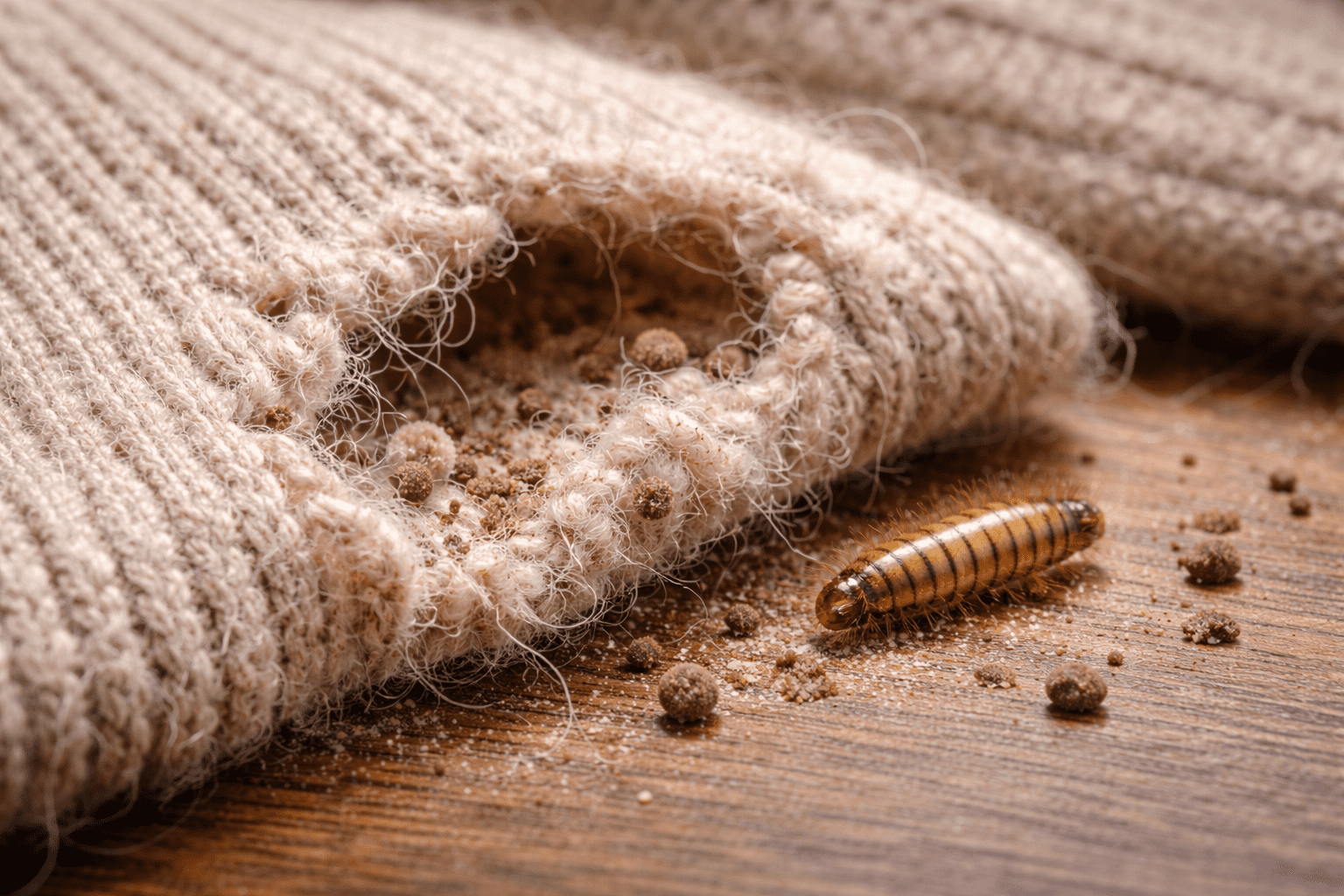

The clearest signs of carpet beetles are live larvae, shed larval skins, damage to natural-fibre textiles and adult beetles appearing around windows.
Finding one adult carpet beetle does not automatically mean you have a serious infestation. Adults can enter UK homes from outside.
The more important question is whether carpet beetle larvae are feeding and developing somewhere inside the property.
Here are 10 signs that can help you find out.
10 Signs of Carpet Beetles
- Small adult beetles around windows
- Brown, hairy carpet beetle larvae
- Shed larval skins
- Irregular damage to wool carpets
- Holes in wool clothing and natural-fibre textiles
- Larvae crawling up walls
- Larvae beneath furniture
- Damage in several areas of the house
- Carpet beetles that keep coming back
- Activity associated with a loft or old bird nest
1. Small Adult Beetles Around Windows
Adult carpet beetles are frequently noticed on windowsills and around window frames.
They are attracted towards light, so finding an adult at a window is common.
However, an adult beetle does not tell you where the larvae are living.
It could have developed somewhere inside the property or simply entered from outdoors.
If you repeatedly find adult beetles indoors, inspect for larvae and other evidence.
2. Brown, Hairy Carpet Beetle Larvae
Finding larvae is much stronger evidence of an indoor problem.
Carpet beetle larvae are small, brownish and noticeably bristly or hairy.
They are sometimes described as looking like tiny hairy caterpillars or “woolly bears”.
The larvae are the stage responsible for damage to carpets, clothing and other susceptible materials.
Our carpet beetle larvae identification guide shows what to look for in more detail.
3. Shed Carpet Beetle Larval Skins
As carpet beetle larvae develop, they moult and leave their old skins behind.
These cast skins can remain long after the larva has moved elsewhere.
They are usually:
- small;
- brownish;
- dry;
- hairy or bristly; and
- shaped like the larva that left them.
4. Irregular Damage to Wool Carpets
Carpet beetle larvae can damage wool and other animal-derived natural fibres.
Carpet damage is often most noticeable in dark, undisturbed areas.
Check:
- beneath sofas;
- under beds;
- beneath wardrobes;
- under rugs;
- around carpet edges; and
- behind furniture that rarely moves.
The visible middle of a frequently vacuumed carpet may show little damage while hidden sections beneath furniture are heavily affected.
5. Holes in Wool Clothing and Natural-Fibre Textiles
Carpet beetle larvae are not restricted to carpets.
They can damage susceptible clothing and stored textiles.
Inspect:
- wool jumpers;
- cashmere;
- wool coats;
- blankets;
- felt;
- fur;
- feather-filled items; and
- other animal-based natural materials.
Pay particular attention to items that have remained undisturbed for long periods.
6. Larvae Crawling Up Walls
One of the more confusing signs is finding a small hairy larva crawling on a wall.
This does not necessarily mean it has been feeding inside the wall.
Carpet beetle larvae can wander away from feeding areas as they develop and search for protected places.
If you find one on a wall, inspect the surrounding room carefully.
The source may be beneath nearby furniture, inside a wardrobe, around the carpet perimeter or somewhere above or below the location where you spotted it.
7. Larvae Beneath Furniture
Carpet beetle larvae prefer places that remain relatively undisturbed.
This makes the underside of heavy furniture particularly important during an inspection.
Move furniture where practical and inspect:
- the carpet underneath;
- floor edges;
- furniture undersides;
- accumulations of hair and lint; and
- nearby cracks and gaps.
This is one reason ordinary surface cleaning can miss an infestation.
8. Damage in Several Areas of the House
Finding evidence in more than one room may indicate that the infestation is more widespread.
Alternatively, there may be more than one suitable food source.
Do not automatically assume that every damaged textile has the same source.
Inspect each affected area and try to establish where living larvae are concentrated.
9. Carpet Beetles Keep Coming Back
Repeated adult beetles or larvae after cleaning can indicate that the original breeding or feeding source remains.
Possible overlooked sources include:
- wool beneath furniture;
- stored textiles;
- pet hair;
- dead insects;
- feathers;
- old bird-nest material; and
- organic debris in undisturbed areas.
If this sounds familiar, read why carpet beetles keep coming back .
10. Activity Associated With a Loft or Old Bird Nest
Not every carpet beetle infestation starts with a carpet.
Old bird nests can contain feathers and other animal-derived material capable of supporting dermestid beetles.
If adult beetles or larvae repeatedly appear around an upstairs room, loft hatch, chimney or roof area, consider whether a concealed source could be involved.
What Do Carpet Beetles Look Like?
Adults and larvae look completely different.
Adult carpet beetles are small beetles, while the larvae are elongated and covered with noticeable hairs or bristles.
This difference causes many infestations to be misidentified.
People may find an adult at a window and a larva beneath a bed without realising they are two stages of the same pest.
How Big Are Carpet Beetles?
Adult carpet beetles are only a few millimetres long, depending on the species.
The larvae are also small, which allows them to remain unnoticed in carpet edges, wardrobes and other protected locations.
Their size is another reason close inspection with a bright torch is useful.
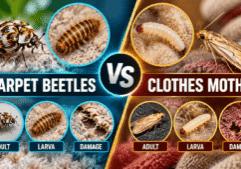
Are Carpet Beetles the Same as Clothes Moths?
No.
They are completely different insects.
However, their larvae can damage some of the same materials, including wool and other animal-derived natural fibres.
Correct identification matters because the insects, life cycles and monitoring methods differ.
Carpet Beetle Larvae vs Clothes Moth Larvae
Carpet beetle larvae are usually noticeably hairy or bristly.
Clothes moth larvae tend to be paler and more caterpillar-like, and some species produce silk or portable cases.
If you are finding textile damage but cannot identify the insect, collect a specimen or take a clear close-up photograph before treating.
Do Carpet Beetles Bite?
No.
Carpet beetles do not feed on people.
However, hairs associated with the larvae can cause irritation in some individuals.
This can sometimes be mistaken for insect bites.
Skin symptoms alone should not be used to diagnose a carpet beetle infestation.
Can Carpet Beetles Cause a Rash?
Some people can develop irritation after contact with larval hairs.
If you have a significant, unexplained or persistent skin reaction, seek appropriate medical advice rather than assuming carpet beetles are responsible.
From a pest-control perspective, confirm the presence of the insects themselves.
Do Carpet Beetles Live in Beds?
Carpet beetles are not blood-feeding pests like bed bugs.
They do not need to live close to a sleeping person.
However, larvae may occasionally be found around beds if suitable materials, hair, feathers or other food sources are present.
Finding a hairy larva near your bed does not mean it is feeding on you.
Can Carpet Beetles Live in Mattresses?
A mattress is not automatically a carpet beetle breeding site.
However, natural materials, hair, feathers or organic debris associated with bedding and furniture can potentially provide suitable resources.
Inspect the surrounding environment rather than assuming the mattress itself must be discarded.
Do Carpet Beetles Live in Synthetic Carpets?
Finding carpet beetle larvae on synthetic carpet does not necessarily mean they are eating the synthetic fibres.
They may instead be feeding on:
- pet hair;
- human hair;
- dead insects;
- natural-fibre debris;
- food material beneath furniture; or
- another nearby source.
Always investigate what is actually supporting the larvae.
Where Should I Check for Carpet Beetles?
Start with quiet, undisturbed locations.
- under beds;
- beneath sofas;
- behind wardrobes;
- inside wardrobes;
- around carpet edges;
- under rugs;
- airing cupboards;
- stored clothing;
- pet sleeping areas;
- window areas;
- lofts; and
- locations containing dead insects or bird-nest material.
Does One Carpet Beetle Mean an Infestation?
No.
One adult beetle at a window does not automatically establish that larvae are breeding inside your home.
Adults can enter from outdoors.
Finding repeated adults, living larvae, shed skins or fresh textile damage provides much stronger evidence of an indoor infestation.
Does One Carpet Beetle Larva Mean an Infestation?
Finding a larva deserves more attention than finding one adult beetle.
It shows that an immature carpet beetle is present inside the property.
However, one larva still does not tell you the size of the problem.
Search the surrounding area for additional larvae, shed skins and a possible food source.
Why Am I Suddenly Seeing Carpet Beetles?
Adult activity can become more noticeable at certain times of year, particularly when beetles move towards light and windows.
You may also suddenly discover an infestation that has been developing unnoticed beneath furniture for some time.
The first beetle you see is not necessarily the first beetle that was present.
How Serious Is a Carpet Beetle Infestation?
Severity depends on the amount of larval activity and what is being damaged.
A single adult beetle at a window may require little more than inspection and monitoring.
Multiple larvae damaging expensive wool carpets, clothing or other valuable natural-fibre materials require more attention.
Evidence in several rooms can also indicate that the source is more widespread or that several suitable feeding sites are present.
What Should I Do If I Find Carpet Beetles?
Start by identifying whether you have found an adult beetle, a larva or simply suspected textile damage.
Then inspect for the feeding source rather than treating only the place where you happened to see the insect.
- Inspect beneath beds and heavy furniture.
- Check carpet edges and hidden areas of wool carpet.
- Inspect wardrobes and stored natural-fibre clothing.
- Look for live larvae and shed skins.
- Check accumulations of pet hair, lint and dead insects.
- Consider lofts and old bird-nest material where relevant.
- Vacuum affected and surrounding areas thoroughly.
- Assess whether activity is confined to one location or more widespread.
Can Vacuuming Help With Carpet Beetles?
Yes.
Thorough vacuuming can remove larvae, cast skins, debris and some of the material on which larvae may feed.
Pay particular attention to carpet edges, beneath furniture, wardrobes, skirting edges and other areas that are normally missed during routine cleaning.
However, vacuuming only visible areas may not solve an established infestation if the main source remains hidden.
Should I Throw Away My Carpet?
Not automatically.
Finding carpet beetles does not mean an entire carpet has to be discarded.
The extent of damage, the carpet material and the location of larval activity should be assessed first.
Finding and treating the source is more important than simply removing one visible damaged item while larvae remain elsewhere.
Can Carpet Beetles Be Professionally Treated?
Yes.
Professional treatment should begin with identification and inspection so that likely larval feeding sites can be located.
Depending on the property and extent of activity, treatment may involve cleaning, source removal, appropriately authorised pest-control products, monitoring or professional heat treatment.
Does Heat Treatment Kill Carpet Beetles?
Professional heat treatment can kill carpet beetles at different life stages when effective temperatures reach the insects for sufficient time.
As with other heat treatments, simply making the room feel hot is not enough. Treatment depends on appropriate heating capacity, airflow, exposure time and temperature monitoring.
This can be particularly useful where activity is widespread or associated with numerous inaccessible textile harbourages.
Learn more about professional carpet beetle heat treatment .
Why Do Carpet Beetles Sometimes Return After Treatment?
Recurring activity can happen when the original source has not been located or when suitable larval food remains elsewhere in the property.
Examples include overlooked wool beneath furniture, stored textiles, pet hair, dead insects or old bird-nest material.
Adult beetles can also enter from outdoors, so seeing an occasional adult after treatment does not by itself prove that an indoor infestation has survived.
Our guide to why carpet beetles keep coming back explains the problem in more detail.
Frequently Asked Questions About Carpet Beetles
What is the clearest sign of a carpet beetle infestation?
Live larvae, multiple shed larval skins and fresh damage to susceptible natural-fibre materials provide much stronger evidence of indoor activity than one adult beetle at a window.
Does one carpet beetle mean I have an infestation?
Not necessarily. Adult carpet beetles can enter homes from outdoors. Repeated adults, live larvae, cast skins or fresh textile damage provide stronger evidence that larvae are developing inside.
What do carpet beetle larvae look like?
They are small, brownish larvae with noticeable hairs or bristles and are sometimes described as looking like tiny hairy caterpillars or woolly bears.
Why am I finding carpet beetle larvae on my walls?
Larvae can wander away from feeding areas. Finding one on a wall does not necessarily mean it has been feeding there, so inspect nearby furniture, carpet edges, wardrobes and other protected areas.
Do carpet beetles bite people?
No. Carpet beetles do not feed on people. However, hairs associated with the larvae can cause irritation in some individuals.
Can carpet beetles damage clothes?
Yes. Larvae can damage susceptible animal-derived natural materials including wool, cashmere, felt, fur, feathers and some other stored textiles.
Can carpet beetles live in synthetic carpet?
Larvae may be found on synthetic carpet without feeding on the synthetic fibres themselves. Hair, dead insects, natural-fibre debris or another nearby food source may be supporting them.
Can carpet beetles be professionally treated?
Yes. The appropriate treatment depends on the source, extent of activity, materials affected and layout of the property. Finding the larval feeding source is an important part of effective control.
10 Signs of Carpet Beetles: Final Checklist
- Adults at windows: investigate, but do not assume infestation from one beetle.
- Hairy larvae: stronger evidence of indoor activity.
- Cast skins: look for concentrations near feeding areas.
- Wool carpet damage: inspect beneath furniture and around edges.
- Clothing damage: check stored natural-fibre textiles.
- Larvae on walls: search nearby for the actual source.
- Activity beneath furniture: move furniture where practical and inspect.
- Several affected rooms: investigate each area for food sources.
- Recurring beetles: consider whether the source remains.
- Loft activity: consider feathers, dead insects and old bird-nest material.
The key is not simply finding an adult carpet beetle. The important question is whether larvae are living, feeding and developing somewhere inside the property.
Found Signs of Carpet Beetles?
If you are finding carpet beetle larvae, cast skins or damage to carpets and textiles, MothKill can help identify the extent of the problem and recommend an appropriate professional treatment.