How to Get Rid of Carpet Beetles in Your Home

To get rid of carpet beetles, you need to find where the larvae are feeding, remove the food source, clean affected areas thoroughly and treat any remaining infestation appropriately.
Simply killing adult beetles on a windowsill is unlikely to solve the problem.
The damaging stage is the larva. Carpet beetle larvae can remain hidden beneath furniture, around carpet edges, inside wardrobes and in other undisturbed areas containing suitable food.
This guide explains how to get rid of carpet beetles step by step, when DIY control may be enough and when professional treatment should be considered.
How to Get Rid of Carpet Beetles: Quick Answer
- Confirm that the insects really are carpet beetles.
- Find where the larvae are living.
- Identify and remove their food source.
- Inspect carpets, clothing and furniture.
- Vacuum hidden areas thoroughly.
- Treat affected clothing and textiles appropriately.
- Remove accumulations of hair, lint and dead insects.
- Investigate bird-nest material where relevant.
- Monitor for new larvae and fresh damage.
- Consider professional treatment if activity persists or is widespread.
First, Make Sure They Really Are Carpet Beetles
Correct identification comes first.
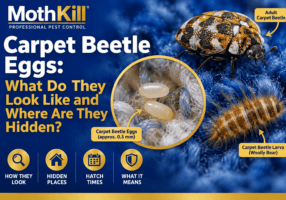
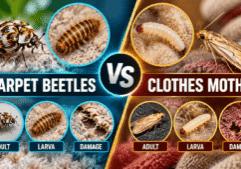
Adult carpet beetles are small beetles that are frequently noticed around windows because adults are attracted towards light.
The larvae look very different.
They are usually brownish, bristly and sometimes described as looking like tiny hairy caterpillars or “woolly bears”.
If you are unsure what you have found, see our guide to carpet beetle larvae .
Why Are Carpet Beetles in My House?
Adult carpet beetles can enter properties from outside.
The real problem begins when eggs are laid somewhere that provides suitable food for the developing larvae.
Carpet beetle larvae can feed on animal-based natural materials and organic debris.
Natural Materials
- Wool
- Fur
- Feathers
- Hair
- Some natural-fibre furnishings
Hidden Food Sources
- Dead insects
- Bird-nest material
- Lint
- Other suitable organic debris
Step 1: Find Where the Carpet Beetle Larvae Are Living
Do not concentrate solely on where you see adult beetles.
Search for larvae and shed skins.
Check:
- around carpet edges;
- under beds;
- beneath sofas;
- under wardrobes;
- inside wardrobes and cupboards;
- beneath rugs;
- around radiators;
- inside airing cupboards;
- stored blankets and clothing;
- upholstered furniture;
- loft spaces where appropriate; and
- areas containing pet hair, lint or dead insects.
A bright torch can make inspection considerably easier.
Step 2: Look for Shed Larval Skins
Carpet beetle larvae shed their skins as they develop.
These dry, brownish and hairy skins can remain behind after the larva has moved elsewhere.
Finding several shed skins in one location can therefore provide an important clue to a feeding or breeding area.
Pay particular attention to undisturbed locations rather than only inspecting the open centre of the room.
Step 3: Check Wool Carpets and Rugs
Natural-fibre carpets can provide a substantial food source.
Damage is often most noticeable where the carpet is rarely disturbed.
Check beneath:
- heavy furniture;
- bed legs and frames;
- sofas;
- wardrobes;
- rugs; and
- furniture positioned permanently against walls.
Also inspect the perimeter of the room.
Step 4: Inspect Clothing and Stored Textiles
Check vulnerable clothing, blankets and other stored natural materials.
Pay particular attention to items that have remained undisturbed for long periods.
Look for:
- irregular holes;
- thinning material;
- larvae;
- shed skins; and
- activity in folds or protected areas.
Do not put inspected items straight back into an infested wardrobe before dealing with the surrounding problem.
Step 5: Vacuum Thoroughly
Detailed vacuuming is one of the most useful DIY measures for carpet beetles.
Vacuuming can physically remove accessible larvae, shed skins, some eggs and the organic debris on which larvae may feed.
Concentrate on:
- skirting edges;
- carpet perimeters;
- under furniture;
- wardrobe floors;
- cupboards;
- upholstery seams; and
- other undisturbed areas.
Moving furniture where practical is important. Vacuuming only the visible centre of the carpet may leave the main harbourages untouched.
Step 6: Empty the Vacuum Safely
After vacuuming an infested area, empty the vacuum contents promptly.
Seal disposable contents appropriately and remove them from the living area.
If your vacuum has a reusable container, clean it according to the manufacturer's instructions.
The aim is to avoid leaving collected insects and debris sitting inside the property unnecessarily.
Step 7: Deal With Infested Clothing and Fabrics
Wash suitable items according to their care labels.
Dry cleaning may be appropriate for some delicate garments.
Controlled freezing can also be useful for certain items that cannot be washed, provided it is carried out appropriately and the material itself is suitable.
Step 8: Remove Accumulated Hair and Lint
This step is easily overlooked.
Carpet beetle larvae can survive on relatively small accumulations of suitable organic material.
Clean:
- beneath radiators;
- behind furniture;
- around skirting;
- under beds;
- pet sleeping areas; and
- other locations where hair and lint collect.
Regular cleaning makes the environment less favourable for developing larvae.
Step 9: Check for Bird Nests
Recurring carpet beetle activity can sometimes be associated with old bird nests.
Nest material can contain feathers and other organic matter capable of supporting dermestid beetles.
Potential areas include:
- lofts;
- eaves;
- chimneys;
- roof spaces; and
- other sheltered areas used by birds.
Step 10: Look for Dead Insects and Other Hidden Food Sources
Carpet beetle larvae do not need to be eating your carpet.
Accumulations of dead insects can provide another food source.
This can occur in lofts, window areas, light fittings and other undisturbed locations.
A recurring infestation is much easier to understand once the actual food source has been found.
Can You Get Rid of Carpet Beetles Just by Vacuuming?
For a very small and localised problem, intensive cleaning and source removal may be enough.
Vacuuming is particularly valuable because it removes both insects and food material.
However, it may not reach every egg or larva in an established infestation.
If larvae continue appearing despite thorough cleaning, investigate further rather than simply vacuuming the same visible area repeatedly.
Does Washing Clothes Kill Carpet Beetles?
Appropriate laundering can help deal with carpet beetles on washable clothing and fabrics.
Always follow the garment's care label.
Washing clothes does not, however, treat larvae living beneath a carpet or elsewhere in the room.
Infested items and the surrounding environment both need consideration.
Can You Freeze Carpet Beetle Larvae?
Controlled freezing can be useful for suitable items, particularly delicate belongings that cannot be washed.
The effectiveness depends on the temperature achieved, exposure time and whether the entire item reaches the required conditions.
A brief spell in a mildly cold environment should not be assumed to kill every life stage.
Do Carpet Beetle Traps Work?
Traps can sometimes assist with monitoring, particularly adult activity.
They should not be relied upon as the sole treatment for larvae hidden around the property.
The presence of larvae, shed skins and fabric damage provides more useful information about where control work needs to concentrate.
Do Home Remedies Get Rid of Carpet Beetles?
Several household products are frequently recommended online for carpet beetles. The problem is that treating a visible surface is not the same as eliminating larvae and their food source.
Does Vinegar Get Rid of Carpet Beetles?
Cleaning a surface with vinegar is not the same as carrying out a proven carpet beetle treatment.
It should not be relied upon to eliminate eggs and larvae hidden beneath furniture, inside textiles or around carpet edges.
Be particularly cautious about applying homemade mixtures to valuable carpets and fabrics.
Does Baking Soda Kill Carpet Beetles?
There is no good reason to use baking soda as your primary carpet beetle treatment.
It does not solve the underlying problem of locating larvae and removing their food source.
Detailed inspection and cleaning are much more useful starting points.
Do Essential Oils Get Rid of Carpet Beetles?
Strongly scented products may have repellent effects on some insects, but repelling an adult beetle is not the same as eliminating an established larval infestation.
Essential oils should not replace source identification, cleaning or appropriate pest treatment.
“Natural” does not automatically mean harmless to pets, people or valuable materials.
Do Insecticide Sprays Kill Carpet Beetles?
Authorised insecticides can play a useful role in professional and appropriate DIY carpet beetle control.
The product must be authorised for the intended use and applied exactly according to its label.
Residual insecticide can be particularly useful in appropriate harbourage areas where larvae are likely to travel.
However, spraying exposed carpet while leaving a hidden breeding source untouched may result in the problem returning.
Should I Spray My Entire Carpet?
Do not assume that applying more insecticide produces better control.
Use only products authorised for the intended surface and pest, and follow the label regarding application rates and locations.
Targeted treatment combined with source removal is preferable to indiscriminate spraying.
Can Carpet Beetles Live Under Floorboards?
Larvae can use protected structural gaps where suitable food material is available.
However, seeing larvae in a room does not automatically mean they are breeding beneath the floorboards.
Look for evidence before dismantling floors or other parts of the property.
Why Do I Keep Finding Carpet Beetle Larvae on My Walls?
Larvae can wander away from feeding areas as they develop.
Finding one on a wall therefore does not necessarily identify the breeding source.
Search the room below and nearby for shed skins, natural fibres, pet hair, dead insects and other potential food sources.
Why Are Adult Carpet Beetles on My Windowsill?
Adult carpet beetles are often attracted towards light.
Consequently, windowsills are a common place to notice them.
An adult beetle at a window does not tell you exactly where the larvae are located.
The breeding source may be elsewhere in the room or property.
Do I Need to Throw Away My Carpet?
Usually not.
A carpet does not automatically need replacing because carpet beetles are present.
The decision depends on the material, amount of damage and whether the infestation can be controlled effectively.
Removing an expensive carpet without addressing larvae elsewhere may also fail to solve the infestation.
Do I Need to Throw Away Infested Clothes?
Not necessarily.
Many affected garments can be treated appropriately depending on their material and condition.
Discarding belongings should not be the automatic first response.
Assess whether the item can be washed, dry cleaned, frozen or otherwise treated safely.
How Long Does It Take to Get Rid of Carpet Beetles?
There is no universal timescale.
A small localised source may be resolved relatively quickly once it is found and removed.
A widespread infestation involving several rooms, carpets, furniture or a concealed source can take considerably more work.
Monitoring is useful because old shed skins may remain after living larvae have been controlled.
How Do You Know If Carpet Beetles Are Gone?
Look for evidence of continuing activity rather than expecting every old sign to disappear immediately.
Useful indicators include:
- no new larvae;
- no fresh fabric damage;
- no new concentrations of shed skins;
- reduced adult activity; and
- no continuing activity in previously affected areas.
Continued monitoring helps distinguish historical evidence from an active infestation.
Why Do Carpet Beetles Keep Coming Back?
Recurring carpet beetles usually mean either the original source remains or new beetles are entering the property.
Common explanations include:
- an overlooked food source;
- larvae beneath furniture;
- infested stored textiles;
- bird-nest material;
- dead insects in hidden locations;
- incomplete treatment; or
- new adult beetles entering from outside.
Read our guide explaining why carpet beetles keep coming back if you have already tried treating the problem.
When Should You Call a Professional?
Professional help becomes more worthwhile when:
- larvae are present in several rooms;
- you cannot locate the source;
- valuable carpets or textiles are being damaged;
- activity continues despite thorough cleaning;
- the infestation repeatedly returns; or
- the extent of the infestation makes DIY treatment impractical.
Our guide to professional carpet beetle treatment explains the different options.
Does Professional Heat Treatment Kill Carpet Beetles?
Heat treatment can be used for established carpet beetle infestations.
When effective temperatures reach the insects for sufficient time, heat can kill larvae, adults and eggs.
Professional treatment uses heating equipment, air circulation and temperature monitoring to establish suitable conditions throughout the treatment area.
It should not be assumed that simply making a room hot will achieve the same result.
See MothKill's professional carpet beetle heat treatment .
Is Heat Treatment Always Necessary?
No.
A minor, clearly identified infestation may be manageable through cleaning, source removal and targeted treatment.
Heat becomes more attractive when activity is widespread, hidden throughout furnished areas or repeatedly returning despite other control measures.
The treatment should match the scale of the problem.
How Can I Prevent Carpet Beetles Returning?
- Vacuum carpet edges regularly.
- Clean beneath furniture.
- Remove accumulations of pet hair and lint.
- Store vulnerable textiles clean.
- Inspect wool clothing periodically.
- Check second-hand rugs and furniture.
- Investigate old bird nests where relevant.
- Monitor areas where larvae were previously found.
Frequently Asked Questions
What is the fastest way to get rid of carpet beetles?
The most useful first step is finding where the larvae are feeding. Remove or treat the source, vacuum affected areas thoroughly and then decide whether additional treatment is necessary.
Can I get rid of carpet beetles myself?
Small, localised infestations can sometimes be controlled through detailed cleaning, treatment of affected textiles and source removal. Widespread or recurring activity may require professional treatment.
Does vacuuming kill carpet beetles?
Vacuuming physically removes accessible larvae, some eggs, shed skins and food material. It is extremely useful but may not reach every hidden harbourage.
Do carpet beetles bite?
Carpet beetles do not feed on people. However, hairs associated with larvae can cause skin irritation in some individuals.
Why do carpet beetles keep appearing after cleaning?
A hidden feeding or breeding source may remain. Check beneath furniture, stored textiles, loft areas, old bird-nest material and places containing hair, lint or dead insects.
Will carpet beetles go away on their own?
An active indoor breeding source should not be expected to disappear simply because adult beetles are removed. The larval food source needs to be found and addressed.
Do I need professional carpet beetle treatment?
Not always. Professional help is most useful when the infestation is widespread, damaging valuable belongings, difficult to locate or continuing despite sensible DIY measures.
How to Get Rid of Carpet Beetles: Final Checklist
- Confirm that you have carpet beetles.
- Find the larvae rather than concentrating only on adults.
- Search for the food source.
- Inspect carpets, clothing and furniture.
- Vacuum hidden areas thoroughly.
- Treat affected textiles appropriately.
- Remove hair, lint and dead insects.
- Investigate bird-nest material where relevant.
- Monitor for fresh activity.
- Consider professional treatment if the infestation persists or is widespread.
Getting rid of carpet beetles is ultimately a source-finding exercise. The more accurately you locate where the larvae are feeding, the better your chances of controlling the infestation.
Carpet Beetles Still Coming Back?
If larvae are established in carpets, furniture or several rooms, MothKill can help identify the extent of the problem and provide professional treatment, including monitored heat treatment where appropriate.