
Why Do Carpet Beetle Keep Coming Back

Carpet beetles often seem to return because hidden larvae, eggs or an overlooked breeding source remain somewhere in the property.
You may remove the adult beetles you can see and thoroughly vacuum the carpet, yet larvae can remain beneath furniture, around carpet edges, inside wardrobes, among stored textiles or in loft areas.
When adults eventually emerge, it can look like a completely new infestation even though the original source was never fully removed.
Don't Just Look for the Adult Beetles
Adult carpet beetles are often the easiest stage to notice, especially when they appear around windows and light.
But the larvae are the stage responsible for feeding damage to vulnerable materials.
The important question is not “Where are the adult beetles?” — it is “Where are the larvae feeding?”
The Carpet Beetle Life Cycle Explains Why They Reappear
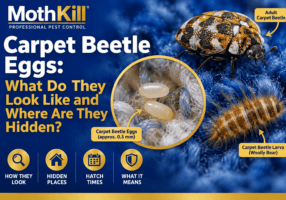
Carpet beetles develop through four main life stages. More than one stage may be present inside a property at the same time.
Larvae can remain concealed while feeding and developing. You may therefore stop seeing adults for a period while immature stages remain elsewhere in the property.
When another generation of adults emerges, the problem can appear to have suddenly returned.
If you are unsure what the immature stage looks like, see our guide to carpet beetle larvae .
Where Could the Hidden Source Be?
Recurring carpet beetle activity usually deserves a systematic search beyond the place where an adult beetle happened to be found.
Beneath Furniture
Beds, wardrobes, sofas and armchairs create dark, undisturbed areas where hair, lint and dead insects can accumulate.
Where practical, inspect beneath movable furniture and pay particular attention to carpet edges.
Wardrobes & Stored Textiles
Check wardrobes, drawers, blanket boxes and stored clothing, particularly items made from vulnerable animal-derived materials such as wool, cashmere, fur and feathers.
Lofts & Roof Spaces
Accessible loft areas can contain dead insects, animal hair, natural materials and old nesting debris that may support carpet beetle larvae.
Old Bird Nesting Material
Old nesting material can contain feathers, dead insects and other suitable organic material.
If activity repeatedly appears upstairs, a loft or roof source may be worth investigating.
Pet Areas
Animal hair can accumulate beneath furniture, along room edges and around pet sleeping areas, providing additional suitable material for larvae.
Second-Hand Items
Used rugs, upholstered furniture, woollen blankets, clothing and other natural-fibre items can occasionally introduce carpet beetles into a property.
Carpet Beetles Don't Only Live in Carpets
The name can be misleading. Carpet beetle larvae can feed on a range of suitable animal-derived materials and organic debris.
Why Do Carpet Beetles Appear on Windowsills?
Adult carpet beetles are often noticed around windows because adults may move towards daylight.
This does not necessarily mean the windowsill is the source of the infestation.
The larvae may have developed somewhere completely different before the adult beetle appeared near the window.
Can Seasonal Activity Make Carpet Beetles Look Like They've Returned?
Yes. Adult carpet beetles can become more noticeable during warmer periods, when you may suddenly see beetles around windows, curtains and other well-lit areas.
That sudden appearance does not necessarily mean the infestation began recently. Larvae may have been developing unnoticed elsewhere beforehand.
Why Does Vacuuming Help but Not Always Solve Carpet Beetles?
Thorough vacuuming is one of the most useful household measures for carpet beetle control.
It can remove larvae, eggs, shed skins, hair, lint, dead insects and other suitable material from accessible areas.
The limitation is accessibility.
If larvae or their food source remain beneath fitted furniture, inside stored belongings, in a loft or another inaccessible area, activity can continue.
Why Can Carpet Beetles Return After Spraying?
Appropriate insecticide products can kill susceptible carpet beetles when used correctly and according to their label instructions.
However, treating exposed insects does not automatically remove every hidden life stage or the material supporting the infestation.
For an established problem, finding the source is just as important as choosing a treatment method.
How to Find the Source of Recurring Carpet Beetles
Start where larvae, shed skins, textile damage or adult beetles have been found and gradually expand the inspection.
How Can You Stop Carpet Beetles Coming Back?
Long-term control generally means dealing with both the insects and the conditions supporting them.
Find the Source
Search beyond visible adult beetles and identify where larvae, shed skins or feeding damage are concentrated.
Remove Food & Debris
Vacuum room edges and beneath furniture, remove accumulated hair, lint and dead insects, and inspect vulnerable textiles.
Monitor the Property
Continue checking previously affected areas for larvae, shed skins, damage or repeated adult activity.
What About Bird Nests?
Old nesting material can sometimes support carpet beetle activity, but wildlife considerations matter.
Can Heat Treatment Control Carpet Beetles?
Carpet beetle eggs, larvae, pupae and adults can be killed by sufficiently high temperatures when the necessary exposure reaches them.
Professional heat treatment can therefore be an option for established or widespread infestations.
Successful heat treatment is not simply a matter of making a room hot. The required conditions need to reach relevant harbourages, with airflow and temperature monitoring used throughout the treatment.
It is also important to investigate sources that may sit outside the treatment area, such as old nesting material or stored belongings.
Learn more about MothKill professional carpet beetle heat treatment .
When Should You Consider Professional Treatment?
Professional investigation or treatment may be worth considering when:
- larvae continue appearing despite thorough cleaning;
- several rooms appear to be affected;
- damage to vulnerable textiles continues;
- you cannot locate the breeding source;
- activity appears to involve inaccessible areas; or
- the problem repeatedly returns after DIY treatment.
The appropriate treatment depends on where the insects are developing, what is supporting them and how widely activity has spread.
Frequently Asked Questions
Why do carpet beetles keep coming back after vacuuming?
Vacuuming can remove larvae, eggs and food material from accessible areas while activity remains beneath furniture, inside stored belongings, in loft areas or around another hidden source.
Why do carpet beetles keep coming back after spraying?
Treating exposed insects does not necessarily reach every hidden life stage or remove the breeding source. Locating where larvae are feeding remains important.
Does seeing one adult carpet beetle mean I have an infestation?
Not necessarily. An individual adult may enter from outside. Repeated sightings combined with larvae, shed skins or textile damage provide stronger evidence of indoor activity.
Can carpet beetles live in a loft?
Carpet beetle larvae can survive in loft areas where suitable material is available, including dead insects, feathers, animal hair or old nesting debris.
Can carpet beetles live under floorboards?
Larvae can survive in concealed spaces where suitable food is present. However, seeing an adult beetle in a room does not by itself prove that carpet beetles are living beneath the floor.
Will carpet beetles eventually disappear on their own?
If a suitable breeding source remains, the life cycle can continue. Removing suitable food sources, cleaning affected areas and using appropriate treatment where necessary provides a more reliable approach.
Can carpet beetles return after professional treatment?
Yes. New insects can be introduced after treatment, while an untreated breeding source elsewhere may also produce further activity. This is why identifying the extent and source of an infestation is important.
Why Do Carpet Beetles Keep Coming Back? – Final Thoughts
If carpet beetles keep appearing, don't concentrate solely on the adults you can see.
Look for the hidden source.
Larvae beneath furniture, stored natural-fibre materials, animal hair, dead insects and old nesting material can allow activity to continue unnoticed.
Smaller problems may sometimes be resolved through thorough inspection, source removal and cleaning. Established or widespread infestations may require professional treatment.
Carpet Beetles Keep Returning?
If you cannot locate the source or activity continues despite thorough cleaning, MothKill provides professional carpet beetle heat treatment using controlled heating, air circulation and temperature monitoring.