How Many Carpet Beetles Is an Infestation
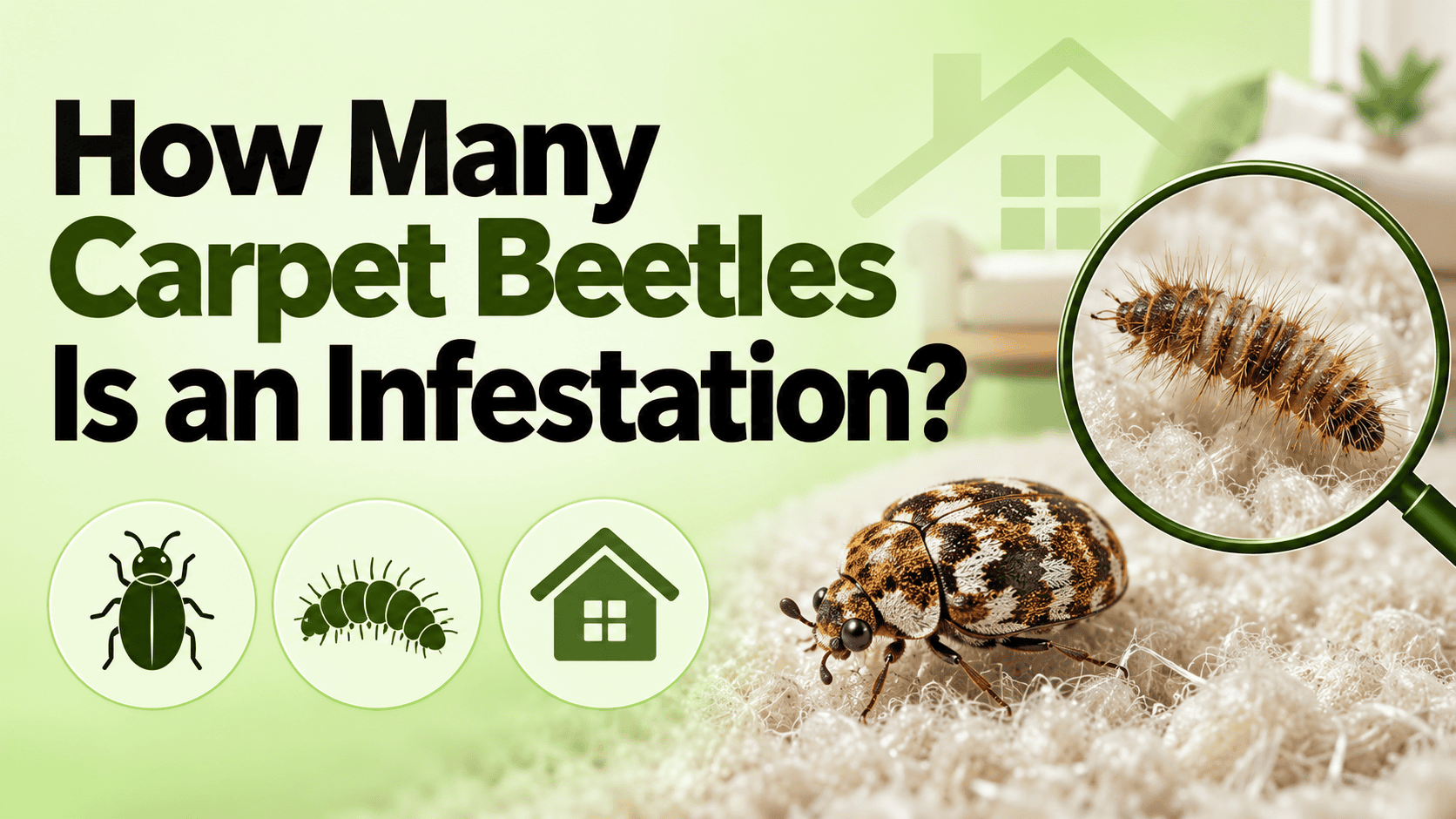
There is no fixed number of carpet beetles that officially defines an infestation. One adult beetle may simply have flown indoors. Finding larvae, shed skins, textile damage or larvae repeatedly appearing in several rooms is much stronger evidence of an established problem.
If you have found one carpet beetle, a few larvae or several small hairy insects around your carpets, you may be wondering: how many carpet beetles is an infestation?
The important thing to understand is that the number you can physically see does not necessarily tell you how many are actually present.
Carpet beetle larvae often remain hidden in quiet, undisturbed areas. This means that finding five or ten larvae could be more significant than the number initially suggests.
Does One Carpet Beetle Mean You Have an Infestation?
Not necessarily.
An occasional adult carpet beetle near a window can have come in from outside. Adult carpet beetles are attracted to light and may be noticed around windows and windowsills.
The larvae are much more important when assessing activity inside a property because the larval stage is responsible for damage to carpets, clothing and other susceptible materials.
How Many Carpet Beetle Larvae Is an Infestation?
There isn't a reliable numerical threshold.
In my experience treating carpet beetle problems, where the larvae are being found is often more useful than the number a homeowner has counted.
May simply have flown indoors and does not automatically confirm an established infestation.
Worth investigating, particularly if larvae are found around carpet edges or underneath furniture.
A stronger indication that activity may extend beyond one isolated location.
If you find one larva in one location, that is very different from repeatedly finding larvae in three bedrooms, along several carpet edges or in different areas of the house.
If several larvae are being discovered across the property, I would investigate more widely rather than assuming every insect has already been found.
Why Counting Carpet Beetles Can Be Misleading
Carpet beetle larvae are not usually sitting in the middle of a carpet waiting to be counted.
They prefer relatively quiet areas where suitable material and debris can accumulate.
- Along carpet edges
- Behind or underneath skirting boards
- Under beds and wardrobes
- Beneath furniture that is rarely moved
- Inside cupboards and wardrobes
- Between or underneath floorboards
- Around accumulated fluff, hair and debris
- Among wool and other suitable natural-fibre materials
- Near old bird nests and roof spaces
Important: Ten visible larvae do not necessarily mean there are only ten larvae in your home. What you see can be only part of the activity.
What Are the Signs of a Carpet Beetle Infestation?
Rather than concentrating entirely on numbers, look for evidence that carpet beetles are developing and feeding within the property.
- Live carpet beetle larvae
- Repeated sightings of larvae
- Cast or shed larval skins
- Damage to wool carpets
- Damage to clothing or natural-fibre textiles
- Activity underneath furniture or around carpet edges
- Adult carpet beetles appearing around windows
- Larvae being discovered in more than one room
Cast skins can be particularly useful evidence. Carpet beetle larvae moult as they develop and leave their old skins behind.
Are Carpet Beetle Larvae More Important Than Adult Beetles?
Yes. This is one of the most important distinctions to understand.
It is the larvae that cause the damage.
Depending on the species, carpet beetle larvae can feed on materials containing animal fibres and proteins, including wool, fur, feathers, hair and other suitable natural materials.
Adults behave differently and may be associated with flowers, pollen and nectar outdoors.
So if somebody tells me they have seen one adult beetle on a windowsill, I would not automatically describe that as an established household infestation.
If they tell me they have found larvae underneath beds and around carpet edges in several rooms, I take that much more seriously.
I Have Found 5 or 10 Carpet Beetle Larvae – Should I Worry?
Finding five or ten larvae doesn't tell us exactly how extensive an infestation is, but I certainly wouldn't ignore it.
If all of the larvae were discovered together while moving an old item or cleaning one small area, the activity could be relatively localised.
If you have found ten larvae spread between several bedrooms or different areas of the house, I would be more concerned about wider activity.
Where the larvae are appearing, whether you continue to find them, whether there are shed skins or damage, and whether activity is present in several rooms.
Why Are Carpet Beetles Difficult to Find?
One reason carpet beetle problems can become established is that larvae favour places we do not regularly inspect.
Think about the strip of carpet underneath a heavy wardrobe that hasn't moved for years, the gap beneath a skirting board or accumulated debris underneath flooring.
Those areas provide a very different environment from the middle of a bedroom carpet that is vacuumed regularly.
You may therefore discover only a handful of larvae even though activity extends into areas you cannot easily see.
Why Am I Finding Carpet Beetle Larvae in Several Rooms?
Finding larvae in several rooms deserves further investigation.
It can indicate that suitable food sources are available in different parts of the property or that activity has become more widely distributed.
At this stage, concentrating treatment only on the exact spot where you happened to see a larva can miss other harbourages.
This is why I prefer to understand the extent of the problem before deciding how a property should be treated.
Where Should You Check for Carpet Beetles?
If you have discovered larvae, start with the quieter parts of the room.
Move furniture where practical and inspect carpet edges, underneath beds, wardrobes, cupboards and areas that are not disturbed regularly.
Check natural-fibre clothing, stored textiles and woollen items for damage or shed skins.
Also think about the original source. Carpet beetles can be associated with wool, hair, feathers and other suitable materials, while old bird nests can sometimes provide a source of activity around buildings.
Can Vacuuming Get Rid of a Small Carpet Beetle Infestation?
Thorough vacuuming is an important part of carpet beetle control, particularly around carpet edges, underneath furniture and areas where lint, hair and organic debris accumulate.
If activity is genuinely small and localised, intensive cleaning and removal of the source may help bring the problem under control.
However, vacuuming the visible carpet surface does not necessarily reach larvae or eggs concealed around edges, behind fittings or in other inaccessible areas.
If larvae continue to appear after thorough cleaning, I would investigate further rather than simply vacuuming the same areas repeatedly.
When Does a Carpet Beetle Problem Need Professional Treatment?
Professional assessment is particularly worth considering when:
- Larvae are being found repeatedly
- Several rooms appear to be affected
- You cannot identify where they are coming from
- Carpets or other textiles are being damaged
- Cleaning has not stopped the activity
- The infestation keeps returning
- You suspect activity in inaccessible areas
The correct treatment depends on the property, the extent of the activity and where the insects are harbouring.
Can Heat Treatment Kill Carpet Beetles?
Professional heat treatment is one option for established carpet beetle infestations.
Unlike dealing only with individual insects that can be seen, a professionally planned heat treatment is designed to raise temperatures throughout the treatment area while temperatures are carefully monitored.
This can be particularly useful where carpet beetle activity is spread across several rooms or where larvae may be concealed around furnishings and other harbourages.
Preparation and temperature monitoring are important. Simply making a room warm is not the same as carrying out professional pest-control heat treatment.
Find out more about our professional carpet beetle heat treatment.
So, How Many Carpet Beetles Is Too Many?
There is no magic number. One adult does not automatically mean an infestation. Repeated larvae, shed skins, textile damage or activity across several rooms are much stronger warning signs.
If you have found several carpet beetle larvae, concentrate on establishing where they are coming from rather than trying to count every insect.
The earlier the source and extent of the problem are identified, the easier it generally is to prevent further damage.
Frequently Asked Questions
Does one carpet beetle mean an infestation?
No. A single adult carpet beetle may simply have flown indoors. However, finding larvae, shed skins or textile damage inside the property warrants further investigation.
Is finding carpet beetle larvae a bad sign?
Finding larvae is more significant than finding an isolated adult because larvae are the damaging stage and require suitable material on which to feed and develop.
Can you have carpet beetles without seeing them?
Yes. Larvae can remain in dark, undisturbed areas such as beneath furniture, around carpet edges and behind skirting boards, making activity difficult to spot initially.
Why do I keep finding carpet beetle larvae?
Repeated sightings suggest there may still be an active source or suitable harbourage somewhere in the property. The source needs to be identified rather than simply removing individual larvae as they appear.
Does finding carpet beetles in several rooms mean the infestation is serious?
It suggests the problem may be more widespread and deserves a thorough inspection. The number seen alone cannot determine the true extent of the infestation.
Should the whole property be treated for carpet beetles?
Not every situation requires identical treatment. The appropriate treatment area depends on where larvae, damage and other evidence are found. Where activity is spread across multiple rooms, treating only one visible hotspot may not address the complete problem.
Finding Carpet Beetle Larvae in Your Home?
If you are finding larvae around your property and are unsure how extensive the infestation is, MothKill provides professional carpet beetle treatment, including heat treatment for suitable properties.
Tell us where you have found the larvae, approximately how many you have seen and how many rooms appear to be affected.
Get a Carpet Beetle Treatment Quote