Carpet Beetle Eggs: What Do They Look Like and Where Are They Hidden?

Carpet Beetle Eggs: What Do They Look Like and Where Are They Hidden?
Carpet beetle eggs are tiny, pale and deliberately laid close to the materials their larvae will need after hatching. In many infestations, you are far more likely to notice the larvae or their cast skins than the eggs themselves.
When people discover carpet beetles in a house, they usually notice one of two things first: adult beetles around a window or small hairy larvae — often called woolly bears — somewhere inside the property.
The eggs are a different matter.
They are extremely small and can be concealed in cracks, fibres, old nesting material and other protected areas where most people would never think to look.
That raises an obvious question: if you have carpet beetles, where are all the eggs?
What Do Carpet Beetle Eggs Look Like?
Carpet beetle eggs are not something most householders will easily identify with the naked eye.
In species of the Anthrenus genus, which includes the varied carpet beetle commonly encountered in UK homes, the eggs are small and pale.
For the varied carpet beetle, they are typically described as cream-coloured and approximately 0.5 mm long.
Under magnification, small projections may be visible on the eggs. These help them remain attached to the surface where they have been deposited.
At normal viewing distance, however, you are unlikely to see that level of detail.
A tiny pale egg amongst carpet fibres, lint, wool, feathers or debris can be remarkably easy to miss.
How Big Are Carpet Beetle Eggs?
Think small — considerably smaller than the adult beetle.
The varied carpet beetle itself is only a few millimetres long, while its eggs are around half a millimetre.
That difference in size explains why somebody may have seen several adult beetles or larvae yet never knowingly seen an egg.
Even if an egg is exposed, it can easily be mistaken for dust, lint or some other tiny piece of debris.
Don't Rely on Finding the Eggs
When I investigate carpet beetle activity, I would not expect finding individual eggs to be the easiest way of confirming an infestation. Larvae, shed larval skins, adult beetles and textile damage are usually much more useful clues.
Where Do Carpet Beetles Lay Their Eggs?
The important thing to understand is that a female carpet beetle does not simply choose a random piece of carpet.
She needs the newly hatched larvae to have access to suitable food.
That means eggs tend to be deposited on or near materials the larvae can feed upon.
Depending on the species and the property, possible egg-laying locations can include:
Wool Carpets and Rugs
Natural-fibre carpets and rugs can provide a food source for developing larvae, particularly in quiet, undisturbed areas.
Wardrobes and Stored Textiles
Wool clothing, blankets, felt, fur and other animal-derived materials can provide suitable larval food.
Edges and Crevices
Protected gaps around skirting, floor edges and other concealed areas can provide shelter close to accumulated hair, fibres and debris.
Bird Nests
Old bird nests can provide feathers, hair and insect remains on which carpet beetle larvae can feed.
Under Furniture
Undisturbed areas can accumulate pet hair, dead insects, lint and natural fibres, creating potential larval feeding sites.
Lofts and Voids
Roof spaces and hidden voids may contain old nesting material, dead insects and other organic material capable of supporting carpet beetle larvae.
Are Carpet Beetle Eggs Actually Hidden in the Carpet?
They can be, but the name “carpet beetle” sometimes gives people the wrong impression.
Carpet beetles are not restricted to carpets.
A property with carpet beetles can contain suitable breeding material in wardrobes, furniture, lofts, floor edges, stored fabrics and old bird nests.
I have always found it more useful to think about food sources than simply thinking about carpets.
Ask yourself: where in this property could a newly hatched carpet beetle larva find wool, fur, feathers, hair, dead insects or other suitable material?
That question often points you towards the areas that deserve closer inspection.
Why Are Carpet Beetle Eggs So Difficult to Find?
There are several reasons.
- They are extremely small.
- Their pale colouring can blend into dust and fibres.
- They may be deposited inside cracks and crevices.
- They are often associated with undisturbed materials.
- Eggs can be close to concealed food sources rather than exposed carpet.
- Old bird nests and roof voids may be inaccessible during a normal household inspection.
So if you have found carpet beetle larvae but cannot find any eggs, that is not unusual.
The absence of visible eggs certainly does not prove that an infestation is inactive.
How Many Eggs Can a Carpet Beetle Lay?
The exact number depends on the carpet beetle species.
This is one area where online information can become misleading because figures for different species are often presented as though every carpet beetle behaves identically.
For the varied carpet beetle, published sources give figures ranging from around 40 eggs under some conditions to considerably higher numbers.
The practical lesson is more important than the precise number.
A single female can produce enough offspring to establish a significant larval population when suitable food and environmental conditions are available.
How Long Do Carpet Beetle Eggs Take to Hatch?
Again, there is no single number that applies in every situation.
Species, temperature and environmental conditions all affect development.
For varied carpet beetles, published guidance commonly places egg hatching somewhere within approximately 10 days to several weeks.
Under typical warm indoor conditions, research cited by university pest-management specialists gives around 10–20 days for varied carpet beetle eggs.
This matters because removing the adult beetles you can see does not necessarily end the problem.
Eggs may already have been deposited elsewhere in the property.
Adult Carpet Beetles Are Not What Damage Your Carpet
This distinction is important.
The adult beetles are not responsible for chewing holes in wool carpets and clothing.
The larvae are the damaging stage.
Once the eggs hatch, the small larvae begin searching for suitable food. Depending on what is available, they can feed on materials containing animal-derived fibres and proteins such as wool, fur, feathers and hair.
So finding and killing an adult beetle does not necessarily tell you whether larvae or eggs are already present elsewhere.
What Do Newly Hatched Carpet Beetle Larvae Look Like?
Newly hatched larvae are extremely small.
The Natural History Museum notes that newly hatched varied carpet beetle larvae are less than 0.5 mm long.
As they develop, the larvae become much easier to recognise.
They develop the characteristic hairy appearance that leads to the familiar name “woolly bear”.
For a closer look at this stage of the life cycle, read our guide to carpet beetle larvae.
What Are the Signs That Carpet Beetle Eggs Have Hatched?
You are unlikely to watch an egg hatch, so the evidence normally appears later.
Things worth looking for include:
- Small hairy larvae.
- Cast larval skins.
- Damage to wool carpets.
- Damage to natural-fibre clothing or stored textiles.
- Larvae underneath furniture or around floor edges.
- Adult carpet beetles appearing around windows.
- Repeated activity after apparently removing individual beetles.
If you're unsure whether the signs point to an infestation, our guide to the 10 signs you have carpet beetles in your house is a useful next step.
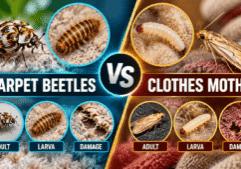
Are Carpet Beetle Eggs the Same as Clothes Moth Eggs?
No.
Carpet beetles and clothes moths are completely different insects, although their larvae can attack some of the same materials.
That overlap is why damage to wool carpets or clothing can sometimes be incorrectly attributed to the wrong pest.
Correct identification matters because you need to understand what pest is present, where it is breeding and what materials are supporting it.
Can Carpet Beetle Eggs Be in Clothes?
Potentially, particularly where clothing or stored textiles provide suitable food for the larvae.
Natural animal fibres are particularly relevant.
Wool, fur, felt, feathers and similar materials can all support carpet beetle larvae.
However, finding carpet beetles in a house does not mean every item of clothing contains eggs.
The aim should be to locate the areas of actual activity rather than assuming everything in the property is infested.
Can Carpet Beetle Eggs Be in a Wardrobe?
Yes.
A quiet wardrobe containing wool clothing, blankets or other susceptible natural materials can provide both shelter and a potential food source.
Pay particular attention to items that have been stored undisturbed for long periods.
Look underneath items, around corners and along the edges of the wardrobe rather than only examining the visible surfaces.
Can Carpet Beetle Eggs Be Under Furniture?
This is another area worth checking.
Under heavy furniture you can find accumulations of fluff, pet hair, fibres and dead insects that ordinary vacuuming may not reach.
Those materials can support carpet beetle larvae.
This is one reason a room can look spotlessly clean while carpet beetle activity continues in concealed areas.
Why Are Bird Nests Important?
Old bird nests are one of the most important hidden sources to consider.
They can contain feathers, hair and dead insects — exactly the sort of material carpet beetle larvae can utilise.
A nest in a loft, roof space, chimney area, eaves or another part of the structure can therefore support carpet beetles away from the rooms where the householder eventually notices them.
Adults or larvae can subsequently move away from the original source.
That can leave somebody repeatedly treating carpets downstairs while completely missing the underlying source above them.
Does Vacuuming Remove Carpet Beetle Eggs?
Thorough vacuuming is useful and should form part of carpet beetle management.
It can remove larvae, debris, shed skins and potentially some exposed eggs.
But there is an important limitation.
A vacuum cleaner can only remove what it can physically reach.
It cannot remove eggs hidden deep inside inaccessible cracks, beneath fixed materials or within an old bird nest in a roof void.
That is why repeated vacuuming can improve a problem without necessarily eliminating the underlying infestation.
Where Should You Inspect for Carpet Beetle Activity?
If I were investigating a property, I would be thinking beyond the middle of the carpet.
- Carpet edges and underneath furniture.
- Wool rugs and natural-fibre carpets.
- Wardrobes and stored wool clothing.
- Blankets and other stored textiles.
- Skirting-board edges and floor gaps.
- Accumulations of pet hair and lint.
- Window areas where adults have been found.
- Lofts and roof spaces.
- Old or abandoned bird nests.
- Dead insects and organic debris in undisturbed areas.
What If Carpet Beetles Keep Coming Back?
Repeated carpet beetle activity usually means there is a reason.
Simply killing the adults appearing on a windowsill does not tell you where the infestation is developing.
There may be larvae elsewhere in the property, eggs may already have been laid, or a hidden breeding source may still be present.
This is why source identification is so important.
Our guide Why Do Carpet Beetles Keep Coming Back? looks at this problem in more detail.
Do Carpet Beetle Eggs Mean You Have an Infestation?
Finding positively identified carpet beetle eggs would be strong evidence that reproduction is taking place or has recently taken place in that location.
But most people will never find the eggs themselves.
Instead, the question is usually based on finding adult beetles, larvae, cast skins or damage.
The number of adult beetles alone does not necessarily tell you the scale of the problem either.
Our guide How Many Carpet Beetles Is an Infestation? explains why larvae, cast skins, damage and repeated sightings are often more informative than simply counting adult beetles.
Can Heat Kill Carpet Beetle Eggs?
Carpet beetles have several life stages — egg, larva, pupa and adult.
Professional heat treatment is designed very differently from simply warming a room.
The objective is to achieve and monitor lethal temperatures throughout the treatment area, including the materials and harbourages where pest stages may be concealed.
This is why temperature monitoring and heat distribution matter.
You can read more in our guide to carpet beetle heat treatment explained.
When Should You Consider Professional Carpet Beetle Treatment?
Finding one adult carpet beetle near a window does not automatically mean an entire house needs professional treatment.
I would be more concerned when there is evidence of continuing breeding activity.
That can include repeated larvae, numerous cast skins, textile damage, activity across several rooms or carpet beetles that continue appearing despite thorough cleaning and source investigation.
At that stage, the objective is not simply to kill the beetles you can see.
It is to deal with the infestation and the areas supporting it.
You can read about MothKill's approach on our carpet beetle heat treatment page.
Carpet Beetle Eggs: The Important Thing to Remember
Carpet beetle eggs are tiny, pale and extremely easy to overlook.
They are normally deposited where newly hatched larvae have a realistic chance of finding food.
That could mean wool carpets or stored textiles, but it can also mean hidden accumulations of hair and debris, dead insects or old bird nesting material.
This is why finding the source matters more than finding an individual egg.
If carpet beetles keep appearing, don't just ask where the adult beetles are coming from. Ask where the next generation is developing.
Frequently Asked Questions
What Colour Are Carpet Beetle Eggs?
Carpet beetle eggs are generally pale. Varied carpet beetle eggs are typically described as cream-coloured, which can make them extremely difficult to see amongst light-coloured fibres and debris.
How Big Are Carpet Beetle Eggs?
They are extremely small. Varied carpet beetle eggs are around 0.5 mm long, meaning they can easily be overlooked without magnification.
Where Do Carpet Beetles Lay Their Eggs?
Females lay eggs on or near suitable larval food. Indoors this can include natural-fibre materials and protected cracks or crevices. Old bird nests and other hidden sources can also support carpet beetle development.
How Long Do Carpet Beetle Eggs Take to Hatch?
It depends on the species and conditions. Varied carpet beetle eggs may hatch in roughly 10 days to several weeks, with temperature influencing development.
Can Carpet Beetle Eggs Be in Clothes?
Yes. Eggs can be deposited close to suitable larval food, including susceptible natural-fibre textiles such as wool and other animal-derived materials.
Does Vacuuming Kill Carpet Beetle Eggs?
Vacuuming can remove some exposed eggs and is useful for removing larvae, cast skins, hair and debris. It cannot reach eggs or larvae concealed inside inaccessible cracks, voids or hidden breeding sources.
Do Adult Carpet Beetles Damage Carpets?
No. It is the larval stage that causes damage to susceptible materials such as wool, fur, feathers and other animal-derived fibres.
Finding Carpet Beetle Larvae Around Your Home?
If carpet beetles keep appearing, the visible insects may only be part of the problem. MothKill provides professional carpet beetle treatment across London and large parts of England.
Carpet Beetle Treatment Contact MothKill