Carpet Beetle Larvae on Walls and Ceilings
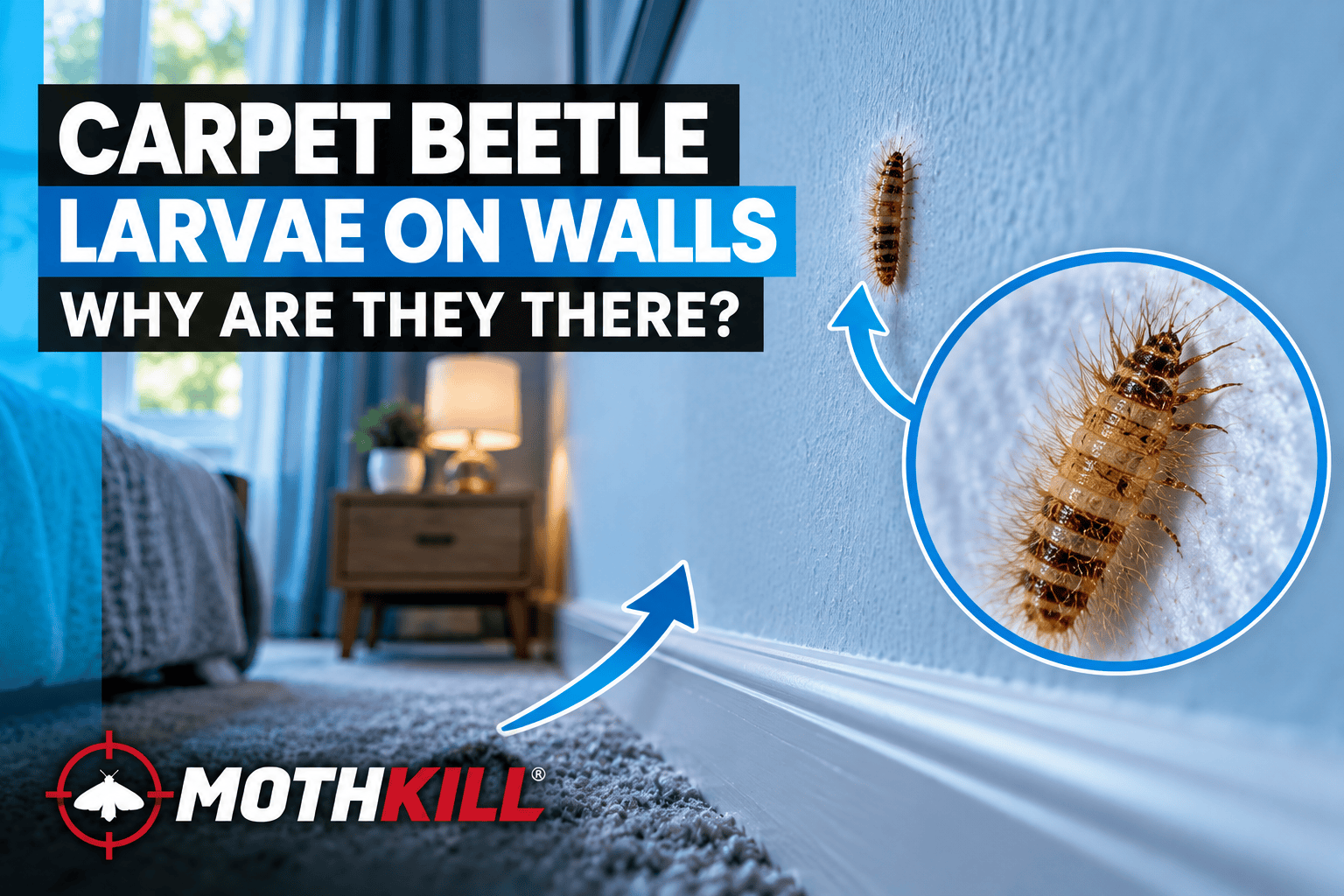
Finding carpet beetle larvae on walls can seem strange. You might expect these pests to remain in carpets or clothing, yet small hairy larvae can sometimes be seen crawling vertically up walls and towards ceilings.
This does not usually mean they are feeding on the wall. Larvae can move away from feeding areas while searching for a protected place to develop further.
The important question is therefore not simply why one is on the wall, but where it came from.
Quick answer: carpet beetle larvae may crawl up walls after leaving a feeding or harbourage area. The wall itself is unlikely to be their food source.
Check carpet edges, beneath furniture, wardrobes, stored textiles, loft spaces and other protected areas nearby for additional larvae, cast skins and suitable food material.
Why Do Carpet Beetle Larvae Crawl Up Walls?
The larval stage is responsible for feeding on susceptible materials inside the home.
However, larvae do not necessarily remain in one location throughout their development. They can wander away from feeding areas and may be noticed crossing floors or climbing walls.
This means the place where you see a larva may be some distance from the place where it has actually been feeding.
A Larva on the Wall Is a Clue
Don't concentrate solely on the wall. Instead, inspect the surrounding room for possible sources.
Does Finding One Mean You Have an Infestation?
Finding a single larva is enough to justify having a good look around, but it does not tell you how extensive the problem is.
The evidence becomes more significant when larvae appear repeatedly or you also find discarded skins, adult beetles or damage to susceptible materials.
Try to establish whether the insect is an isolated find or one sign of a wider breeding source.
Why Are They Crawling Towards the Ceiling?
A larva moving upwards may simply be wandering in search of a suitable protected location.
If several larvae repeatedly appear high on the same wall, however, look at what is above and around that area.
For example, an upstairs room may have a loft directly above it. There may also be cracks, voids or other concealed spaces nearby.
Could the Source Be the Carpet?
Yes. This is particularly relevant where wool or other susceptible natural fibres are present.
Don't restrict your inspection to the exposed middle of the carpet.
Larvae are more likely to remain unnoticed in protected areas such as carpet edges, underneath beds, beneath wardrobes and behind heavy furniture.
These areas may also accumulate hair, fibres and other material over time.
Could They Be Coming From Under Furniture?
Absolutely. Heavy furniture creates exactly the type of undisturbed environment that is easy to miss during routine cleaning.
A sofa, wardrobe or bed may remain in the same position for years.
Where practical, move furniture and inspect:
- the carpet underneath;
- edges beside skirting boards;
- accumulated hair and lint;
- discarded larval skins;
- live larvae; and
- damage to susceptible materials.
Could They Be Coming From a Wardrobe?
Wardrobes are another area worth investigating, particularly if larvae are appearing on a bedroom wall.
Natural-fibre clothing and other textiles may remain undisturbed for long periods.
Inspect the contents as well as underneath and behind the wardrobe.
If you find textile damage, make sure you identify the pest correctly because carpet beetles and clothes moths can attack some of the same materials.
What If They Are Appearing Near the Ceiling?
Repeated activity near the ceiling deserves a broader investigation.
If the room is directly below a loft or roof space, consider whether there could be a source above.
Lofts can contain old nesting material, feathers, dead insects, animal hair and stored natural-fibre items.
Any of these may be relevant depending on the circumstances.
Could They Be Coming From the Loft?
Yes, although you should not automatically assume this is the case.
A loft can provide several possible food sources and may remain largely undisturbed.
If larvae repeatedly appear high on walls in upstairs rooms, inspecting the loft may help determine whether activity is occurring above the ceiling.
Look for larvae and cast skins rather than relying solely on adult insects.
Can Old Bird Nests Be the Source?
Old bird nesting material can sometimes provide suitable material for larvae because it may contain feathers and other animal-derived matter.
This possibility becomes more relevant when activity occurs close to lofts, roof spaces or areas where birds have previously nested.
Active bird nests should not be disturbed. Wild birds and their active nests have legal protection in the UK.
What Do the Larvae Look Like?
Carpet beetle larvae are generally brown or golden-brown and have a distinctive hairy or bristly appearance.
They look very different from the small adult beetles.
As larvae grow, they moult. The discarded skins can remain behind in harbourage areas and are useful evidence during an inspection.
See our full guide to carpet beetle larvae for more identification information.
What Should You Check First?
Inspect Below the Wall
Check the floor, carpet edges, skirting boards and furniture immediately below where the larva was found.
Move Nearby Furniture
Inspect underneath beds, wardrobes, sofas and other furniture where protected areas may have remained undisturbed.
Look Above
If larvae repeatedly appear near the ceiling, consider loft spaces and other concealed areas above the room.
What Other Signs Should You Look For?
Live Larvae
Finding additional hairy larvae in protected areas is stronger evidence of an established source nearby.
Cast Skins
Discarded larval skins can remain in harbourages and provide useful evidence even when live insects are difficult to find.
Textile Damage
Inspect susceptible natural-fibre carpets, clothing, rugs and other materials for unexplained damage.
Adult Beetles
Adults may later appear around windows as they move towards light, giving another clue that development has occurred indoors.
Why Are They Appearing in More Than One Room?
If larvae are being found in several rooms, the infestation may be more widespread than a single localised source.
Alternatively, there could be different susceptible materials in different parts of the property.
At this stage, it becomes particularly important to inspect systematically rather than repeatedly treating individual insects as they appear.
Why Do Adults Appear on Windowsills?
Adult beetles may move towards light, which is why windowsills are another common place homeowners notice them.
The adult's location does not necessarily reveal where the larvae developed.
We've covered this in more detail in our guide to carpet beetles on the windowsill.
What If You Find Larvae Around the Bed?
Bedrooms provide plenty of protected areas, and finding a larva on bedding does not automatically mean the mattress itself is infested.
The source could be underneath the bed, around carpet edges or amongst nearby textiles.
Read carpet beetle larvae in bed for a detailed bedroom inspection guide.
Can Vacuuming Help?
Thorough vacuuming is an important practical step.
It can remove larvae, cast skins, hair, lint and other material from accessible areas.
Pay particular attention to locations that normal cleaning misses, including underneath furniture and along carpet edges.
Dispose of vacuum contents appropriately after cleaning affected areas.
Should You Spray the Wall?
Simply spraying the place where you saw a larva may achieve very little if the underlying source is elsewhere.
The insect on the wall may only be wandering through that location.
Finding the feeding and harbourage areas is therefore more important than concentrating treatment on a visible wall surface.
Why Do They Keep Coming Back?
Repeated sightings usually mean there is more to investigate.
If the food source or harbourage remains untouched, removing individual larvae will not necessarily stop further activity.
See why carpet beetles keep coming back for the common reasons an infestation can persist.
Where Did the Infestation Originally Come From?
Adult beetles occur naturally outdoors and can enter properties. An indoor population can become established when larvae have access to suitable food materials.
Potential sources are not limited to carpets.
Our guide where do carpet beetles come from? looks at entry routes and hidden sources in more detail.
When Professional Treatment May Be Needed
One wandering larva does not automatically mean you need professional pest control.
Professional treatment becomes more relevant when larvae repeatedly appear, several rooms are affected, textile damage continues or you cannot identify the source.
A successful approach should consider where the insects are developing and which materials are supporting them rather than simply treating the walls where they happen to be seen.
MothKill provides professional carpet beetle treatment for established infestations in UK homes.
Frequently Asked Questions
Why are carpet beetle larvae crawling up my walls?
Larvae can wander away from feeding areas and may climb walls while searching for another protected location. The wall itself is unlikely to be their food source.
Do carpet beetle larvae live inside walls?
Seeing a larva on a wall does not prove that it is living inside the wall. Inspect nearby carpets, furniture, textiles and other potential sources first.
Why are they near the ceiling?
They may simply have climbed upwards. Repeated activity near an upstairs ceiling can also justify checking a loft or other concealed area above the room.
Does one larva mean there are more?
Not necessarily, but finding one is a good reason to inspect the surrounding area. Repeated sightings, cast skins or damage provide stronger evidence of an established problem.
Will vacuuming get rid of them?
Thorough vacuuming can remove larvae and debris from accessible areas, but an infestation may continue if a hidden food source remains.
Should I spray the wall?
Treating only the wall may miss the actual source. First determine where larvae are feeding and harbouring.
Carpet Beetle Larvae on Walls: The Bottom Line
If you find carpet beetle larvae on walls, don't assume that the wall itself is infested.
The larva may have moved from a feeding area somewhere else in the room.
Start by inspecting the floor and furniture below the sighting. Then check carpet edges, wardrobes, stored textiles and other protected locations. If activity is concentrated high on upstairs walls, consider whether a loft or roof-space source could be involved.
The larva on the wall is often a clue. The real job is finding where it came from.
Keep Finding Carpet Beetle Larvae?
If larvae continue to appear and you cannot locate the source, MothKill can advise on professional treatment and the options available for your property.
🔥 GET A QUOTE ☎ 07366 262835