Where Do Carpet Beetles Come From
Where do carpet beetles come from? If you have suddenly started finding small beetles, hairy larvae or unexplained damage to carpets and natural-fibre materials, this is usually one of the first questions you want answered.
These small insects occur naturally outdoors and adults can find their way inside. An established problem, however, usually depends on the larvae finding suitable material on which to feed.
The source may be a wool carpet or stored textile, but it can also be somewhere far less obvious. Finding that source is often more useful than simply removing the adult insects you can see.
Quick answer: adult beetles can enter homes from outdoors through windows, doors and other openings. Problems can develop indoors when eggs are laid close to suitable food for the developing larvae.
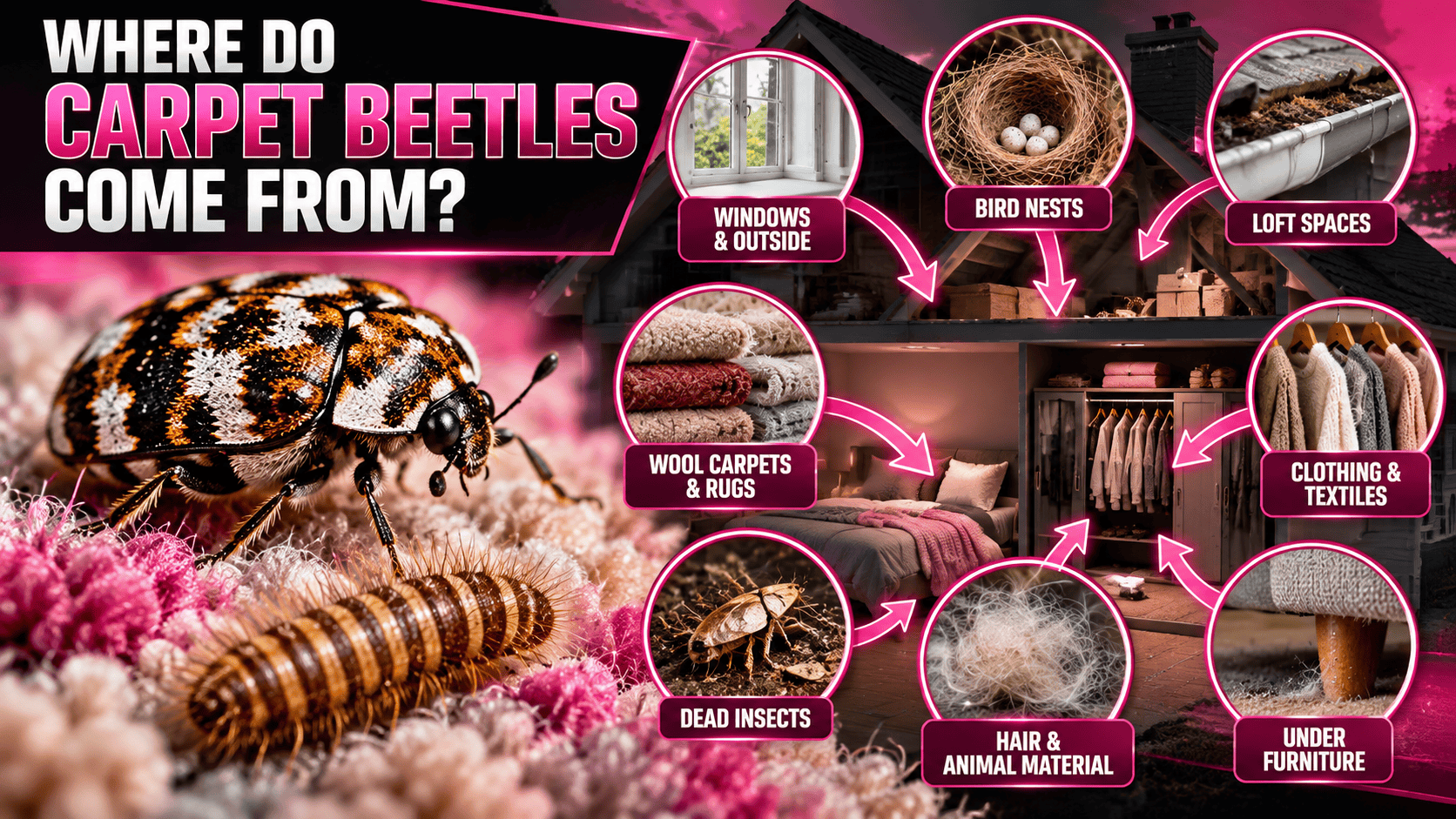
Possible sources include wool and other animal-derived materials, accumulated hair and debris, dead insects and old bird or animal nesting material.
How Do They Become Established Indoors?
Finding an occasional adult inside does not necessarily mean there is a serious infestation.
Adults can enter properties from outdoors through normal openings such as windows and doors. Some species are associated with flowers and pollen outdoors.
The more important question is whether eggs have been laid somewhere that provides suitable food for the developing larvae.
Once the immature stages become established in a protected area, they may remain unnoticed for some time.
Common Sources Around the Home
If the beetles keep appearing, these are some of the main locations and potential sources worth investigating.
How Do They Get Into Your House?
Adult beetles can enter homes from outdoors. Open windows and doors provide obvious routes, although such small insects may also find their way through other openings in a building.
This means that seeing one adult indoors is not automatically evidence of an established infestation.
The situation becomes more significant when you repeatedly find adults, larvae, cast skins or fresh damage to susceptible materials.
Why Can They Become Established Indoors?
The larval stage is particularly important inside the home.
The larvae can feed on various animal-derived materials. A property may therefore contain suitable food sources even when it is regularly cleaned and well maintained.
Potential food materials include wool, fur, feathers, hair and other susceptible natural materials.
They may also exploit less obvious accumulations of organic material in quiet and protected locations.
Do Carpet Beetles Come From Carpets?
Not necessarily. The name carpet beetle can give the impression that the insects originate exclusively from carpets, but that is not the case.
Natural-fibre carpets can provide food for the larvae, particularly in areas that remain undisturbed underneath furniture.
However, the source could instead be clothing, rugs, stored natural materials, upholstered items or another hidden source elsewhere in the property.
Common Hidden Sources to Check
Wool Carpets & Rugs
Natural-fibre carpets and rugs can provide food for larvae. Pay particular attention to edges and areas underneath furniture where disturbance is limited.
Clothing & Stored Textiles
Natural-fibre clothing, blankets and other stored materials may provide suitable food, especially when items remain untouched for long periods.
Old Bird Nests
Old nesting material may contain feathers, hair and other animal-derived material. Roof and loft areas can therefore be worth investigating.
Dead Insects
Accumulations of dead insects in lofts, window voids and other undisturbed locations can provide another potential food source.
Hair & Organic Debris
Protected areas where animal hair, fibres and organic debris accumulate may provide suitable material for developing larvae.
Under Heavy Furniture
Wardrobes, beds and sofas may remain in the same position for years, creating quiet areas that routine vacuuming rarely reaches.
Can Carpet Beetles Come From a Bird Nest?
Yes. Old bird nesting material is one possible source that should not be overlooked.
Feathers and other animal-derived material within old nests may provide food for larvae. This can be particularly relevant when activity appears to originate around a loft, roof space, chimney area or upper floor.
If you suspect an old nest, consider whether insects could move from that area into the living space.
Do not disturb an active bird nest. Wild birds, their eggs and active nests have legal protection in the UK, so any nest issue should be dealt with appropriately.
Could the Source Be in the Loft?
Yes. Loft spaces are easy to overlook during an inspection.
They may contain several potential sources, including old nesting material, feathers, animal hair, dead insects and stored natural-fibre items.
A loft can also remain largely undisturbed for long periods, allowing a small breeding source to go unnoticed.
If adults repeatedly appear upstairs, particularly around windows, it can be sensible to include the loft in your inspection.
Why Do They Appear on Windowsills?
Adult beetles are often noticed around windows because they may move towards light.
This creates an important trap when investigating an infestation. The window may be where you see them, but it may not be where they developed.
The larval source could be underneath furniture, within a carpeted area, amongst stored materials or somewhere above the room.
Keep finding them on a windowsill? Don't simply clean the windowsill and assume the problem has been solved.
Repeated sightings should prompt an inspection of the wider room and nearby hidden areas for larvae, cast skins and potential food sources.
Can They Enter Through Open Windows?
Yes. Adults can enter from outdoors through open windows and doors.
However, there is an important distinction between a beetle that has simply entered the property and an established indoor infestation.
For a population to continue indoors, the developing larvae need access to suitable food and protected areas.
Why Can They Suddenly Appear?
Sometimes an infestation is not as sudden as it seems.
Larvae can remain concealed in undisturbed areas, so the first obvious sign may occur when adults emerge and start appearing around windows or elsewhere in the home.
This means you can seemingly go from seeing no insects at all to finding several adults within a relatively short period.
The immature stages may have been developing unnoticed before those adults became visible.
Why Does the Problem Keep Coming Back?
If activity disappears and then repeatedly returns, a breeding source may still be present somewhere in the property.
Removing visible adults will not necessarily affect larvae developing elsewhere.
This is particularly important when the source is underneath heavy furniture, within stored materials or associated with another location that routine cleaning does not reach.
Read our detailed guide explaining why carpet beetles keep coming back.
How Do You Find the Source?
Work systematically rather than randomly treating different areas of the property.
Start Where You See Activity
Record where adults, larvae, cast skins or textile damage are being found. Treat this as a starting point rather than proof of the source.
Inspect Hidden Areas
Move furniture where practical and inspect carpet edges, wardrobes, cupboards, stored textiles and other quiet locations.
Look Beyond the Room
If the obvious areas are clear, consider lofts, old nesting material, dead insects and other less obvious sources nearby.
What Signs Should You Look For?
Do not rely solely on finding adult insects.
During an inspection, look for:
- brown, hairy or bristly larvae;
- discarded larval skins;
- small adult beetles;
- damage to susceptible natural materials;
- activity around carpet edges;
- evidence beneath furniture; and
- a possible hidden food source.
Our guide to carpet beetle larvae explains the main identification features in more detail.
Could It Be Clothes Moths Instead?
Possibly. Damage to wool carpets, rugs and natural-fibre clothing is not unique to this pest.
Clothes moth larvae can attack many of the same materials, so correct identification is important before deciding how to deal with an infestation.
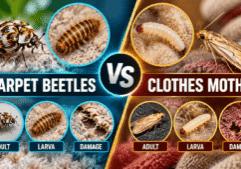
Our guide to carpet beetles vs clothes moths explains the key differences between the two pests.
Can Vacuuming Help?
Thorough vacuuming can be an important part of control because it physically removes some larvae, debris and potential food material from accessible areas.
Concentrate on carpet edges, skirting boards, underneath beds and furniture and other places that routine cleaning may miss.
However, vacuuming only the visible carpet may not solve an established problem if the actual source is somewhere else.
When Professional Treatment May Be Needed
A single adult beetle does not automatically mean that professional pest control is necessary.
Professional treatment may become appropriate when larvae are repeatedly found, fresh textile damage continues, activity occurs in several rooms or you cannot identify the source.
An effective approach should consider the extent of the infestation, likely larval harbourages and potential food sources rather than concentrating solely on visible adults.
MothKill provides professional carpet beetle treatment for established infestations in UK homes.
Frequently Asked Questions
Where do carpet beetles originally come from?
They occur naturally outdoors. Adult beetles can enter buildings, while an indoor infestation can develop if the larvae have access to suitable food and protected areas.
Does having them mean my house is dirty?
No. They can occur in well-maintained homes. However, inaccessible accumulations of hair, fibres, dead insects or other suitable material can provide food for larvae.
Can they come from birds' nests?
Old bird nesting material can be a potential source because it may contain feathers and other animal-derived materials suitable for the larvae.
Can they come through windows?
Adult beetles can enter through open windows and doors. Finding one adult indoors does not by itself prove that an established infestation is present.
Why do I keep finding them on my windowsill?
Adults may move towards light and become noticeable around windows. The larvae may have developed somewhere else in the property.
Can the larvae live underneath furniture?
Yes. Protected areas beneath furniture may provide suitable conditions when an appropriate food source is available and disturbance is limited.
Where Do Carpet Beetles Come From? The Bottom Line
So, where do carpet beetles come from? Adults occur naturally outdoors and can find their way into homes. Persistent indoor activity, however, means it is worth looking for a suitable food source for the larvae.
The source may be relatively obvious, such as a vulnerable wool carpet or stored natural-fibre clothing. But it can also be hidden underneath furniture, amongst stored textiles, in a loft or associated with old nesting material, dead insects or other animal-derived debris.
Don't concentrate solely on the adult insects you can see.
Finding where the larvae are developing and what they are feeding on is often the key to solving the problem.
Keep Finding Carpet Beetles?
If beetles or larvae keep appearing and you cannot locate the source, MothKill can advise on professional treatment and the options available for your property.
🔥 GET A QUOTE ☎ 07366 262835