How Do Clothes Moth Get into Your House
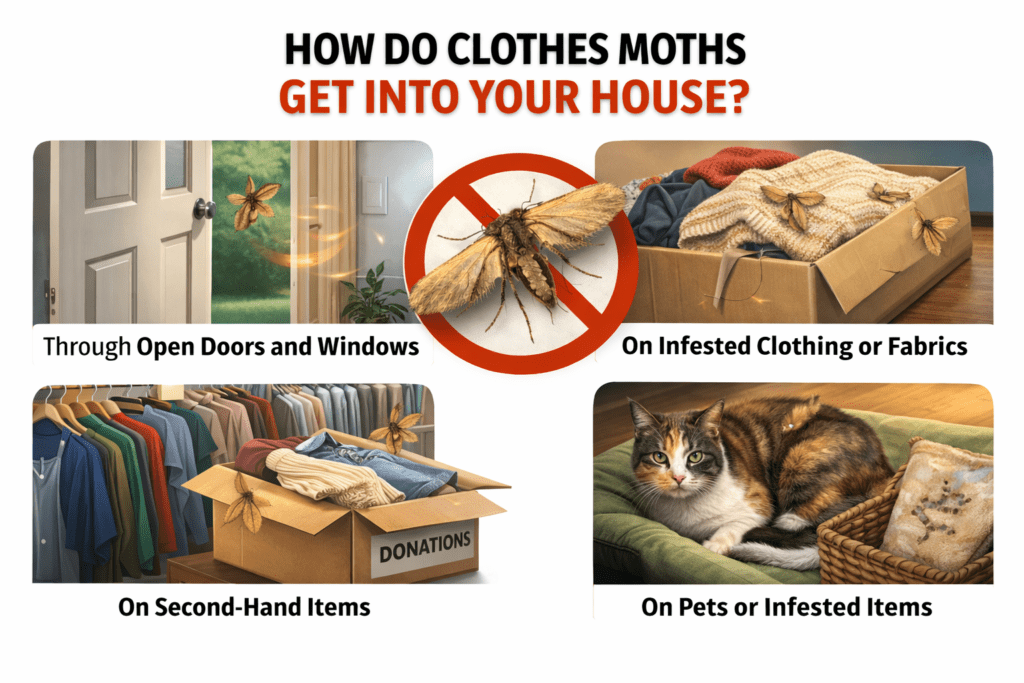
Clothes moths don't simply appear from nowhere. An infestation starts because moths, eggs or larvae have reached a property — or because a small existing population has been hidden there for much longer than anyone realised.
So how do clothes moths get into your house?
There isn't one universal route. They can potentially arrive with clothing, rugs, furniture and other susceptible textiles, while adult moths can also enter buildings from elsewhere.
And sometimes what appears to be a "new" infestation isn't new at all.
🦋 How Do Clothes Moths Get Into a House?
The main possibilities include:
- infested clothing or stored textiles;
- second-hand rugs and soft furnishings;
- upholstered furniture containing susceptible materials;
- items moved from another property or storage area;
- adult moths entering from elsewhere;
- movement within a multi-unit building; or
- an existing infestation that has only just become noticeable.
The original route is not always possible to prove. Once clothes moths are established, finding where the larvae are feeding is normally more useful than trying to determine exactly which moth entered the property first.
First: Make Sure They Really Are Clothes Moths
Not every moth found indoors is a clothes moth.
Outdoor moths can enter properties accidentally, while stored-product moths are associated with food rather than wardrobes and carpets.
Carpet beetles can also cause damage that householders mistake for clothes moth damage.
Before worrying about where the infestation came from, look for:
- the adult moth;
- pale caterpillar-like larvae;
- silken webbing or larval cases;
- damage to susceptible textiles; and
- activity around wardrobes, wool carpets, rugs or furniture.
Use our detailed guide to identify clothes moths correctly .
1. Clothes Moths Can Arrive With Clothing and Textiles
One possible route into a home is through an item that already contains eggs or larvae.
Potential examples include:
- wool clothing;
- cashmere;
- blankets;
- stored textiles;
- vintage clothing;
- rugs; and
- other susceptible natural-fibre items.
The problem is that early infestations can be difficult to see.
Eggs are tiny, and larvae may remain concealed in folds, seams or other protected areas.
2. Second-Hand Furniture Can Bring Textile Pests Into a Home
It's sensible to inspect upholstered furniture before bringing it indoors, particularly if it contains natural materials.
Potentially vulnerable items include:
- upholstered chairs;
- sofas;
- footstools;
- fabric headboards;
- rugs;
- cushions; and
- older furniture containing animal-hair or natural-fibre fillings.
Check seams, folds, undersides and protected areas for larvae, cases, webbing or textile damage.
3. Rugs and Carpets Can Be the Hidden Source
Sometimes the homeowner thinks the moths have recently "entered" the house because adults suddenly start appearing.
But the source may already be beneath their feet.
Where suitable wool or other susceptible fibres are present, larvae can feed in protected areas such as:
- beneath beds;
- under sofas;
- under wardrobes;
- around skirting boards;
- along carpet edges; and
- beneath rugs.
An infestation can therefore develop for some time before visible adult activity draws attention to it.
4. Stored Belongings Can Reintroduce Moths
Items moved between properties, lofts, garages, storage facilities or relatives' homes can potentially carry textile pests if they have been stored in affected conditions.
Particular attention should be paid to:
- bags of old clothes;
- wool blankets;
- stored rugs;
- boxes of natural-fibre textiles;
- costumes;
- old soft furnishings; and
- rarely used seasonal clothing.
Inspecting items before returning them to wardrobes is much easier than dealing with an infestation after they have been distributed around the property.
5. Can Clothes Moths Fly Into Your House?
Adult moths can enter buildings, so an outside or neighbouring source is possible.
However, it is unwise to assume that every small moth entering an open window is a clothes moth.
Many moth species found around windows and lights are unrelated outdoor species.
Common clothes moths are generally associated with relatively dark and protected areas and are less conspicuous than many outdoor moths.
For that reason, repeatedly finding clothes moths around wardrobes or textile-rich areas is more meaningful than seeing a random moth fly through a window.
⚠️ Don't Assume the Open Window Is the Cause
If you find clothes moth larvae in a wool carpet or wardrobe, closing the windows isn't going to solve the infestation.
The priority is finding the larval feeding source.
6. Can Clothes Moths Come From a Neighbouring Flat?
In flats and other connected buildings, movement between areas is possible.
Exactly how easily this happens depends on the building, the infestation and the routes available.
Potential connections can include:
- communal areas;
- shared storage spaces;
- service routes;
- gaps around building features; and
- items being moved between flats.
But finding moths in one flat does not automatically prove that a neighbour is the source.
The affected property should still be inspected for its own breeding sites.
7. Pet Hair Can Support Larvae — But Your Pet Isn't Necessarily Bringing Moths Home
Animal hair contains keratin and can contribute suitable feeding material where it accumulates undisturbed.
That makes locations such as:
- beneath pet beds;
- carpet edges;
- under furniture;
- blankets; and
- other hair-collecting areas
worth checking.
But finding moth activity near a pet bed doesn't mean the moths were carried into the house on the animal.
8. Lofts and Spare Rooms Can Conceal the Source
Low-use rooms and storage areas can provide exactly the conditions that allow an infestation to remain unnoticed.
Check:
- stored wool clothing;
- blankets;
- old rugs;
- boxes of textiles;
- feather-filled items;
- natural-fibre furnishings; and
- accumulated animal hair or other suitable material.
A room doesn't need to contain a wardrobe to support textile moth activity.
9. Sometimes the Moths Never Actually Left
This explains many apparent "reinfestations".
A homeowner may kill adult moths, place traps or spray visible areas and then see very little activity for a while.
Later, adult moths appear again.
That doesn't necessarily mean a new infestation entered the property.
Hidden larvae or another untreated breeding source may have continued developing.
This is particularly likely where the original treatment focused on visible adults rather than the places larvae were feeding.
Do Clothes Moth Eggs Remain Dormant for Months?
It is better not to think of clothes moth infestations as being caused by indefinitely "dormant eggs".
Development depends on environmental conditions, and the larval stage can persist for a considerable period.
This long and relatively hidden larval development is one reason an infestation can appear to disappear and then become noticeable again later.
Read our Clothes Moth Larvae Life Cycle Explained .
Why Does a Clothes Moth Infestation Seem to Appear Suddenly?
Usually because the infestation became visible suddenly — not necessarily because it started suddenly.
You may first notice:
- several adult moths;
- a damaged jumper;
- a bald patch in a wool carpet;
- larval cases;
- webbing; or
- moths caught on monitoring traps.
But larvae may already have been developing out of sight.
What Makes a House Suitable for Clothes Moths?
| Condition | Why It Matters |
|---|---|
| Wool and animal-derived fibres | Can provide suitable food for larvae |
| Undisturbed storage | Allows larvae to develop without being noticed |
| Protected carpet areas | Provide both food and relatively little disturbance |
| Stable indoor conditions | Can support development even when outdoor conditions are colder |
| Hair and organic debris | Can contribute additional feeding material in hidden areas |
Clothes Moths Are Not a Sign of a Dirty House
This is worth repeating.
Clean homes can get clothes moths.
What matters is whether suitable materials and conditions are available.
Regular cleaning helps because it:
- disturbs harbourages;
- removes hair and debris;
- can physically remove some larvae;
- exposes hidden carpet areas; and
- gives you an opportunity to spot activity earlier.
But cleanliness alone cannot guarantee that clothes moths will never be introduced.
How to Stop Clothes Moths Being Introduced
Inspect Vulnerable Textiles
Check wool, cashmere, rugs and other susceptible items before placing them into long-term storage.
Inspect Second-Hand Furniture
Pay attention to seams, undersides, folds and natural-fibre components.
Clean Clothing Before Storage
Follow garment-care instructions and avoid putting heavily worn natural-fibre clothing into long-term storage without cleaning it.
Store Pest-Free Items Properly
Suitable sealed storage can reduce the opportunity for adult moths to reach vulnerable textiles.
Vacuum Hidden Areas
Don't stop at the centre of the room. Vacuum carpet edges and beneath furniture where practical.
Monitor
Appropriate pheromone traps can provide an early warning of target adult moth activity.
Should You Quarantine Second-Hand Clothing?
You don't need to treat every second-hand jumper as though it is infested.
But keeping a newly acquired natural-fibre item separate while you inspect and, where appropriate, clean it is a sensible precaution.
Look particularly closely at:
- seams;
- folds;
- pockets;
- linings;
- cuffs;
- collars; and
- existing textile damage.
Do Pheromone Traps Stop Clothes Moths Entering?
No.
They are primarily useful for detection and monitoring.
A trap can help alert you to adult activity, but it does not protect every garment or kill hidden larvae.
See: What Do Clothes Moth Pheromone Traps Do? .
What Should You Do If Clothes Moths Are Already Inside?
Once an infestation is established, preventing another moth entering through the window is no longer the main problem.
You need to locate the source.
Confirm the Species
Make sure the pest is actually a clothes moth.
Inspect Natural-Fibre Materials
Check clothing, carpets, rugs, stored textiles and suitable furniture.
Move Furniture
Inspect protected carpet areas that aren't normally visible.
Clean and Treat Affected Items
Use appropriate laundering, dry cleaning, controlled freezing or other suitable methods according to the material.
Vacuum Thoroughly
Concentrate on feeding sites and low-disturbance areas.
Monitor for Continuing Activity
Look for fresh damage, larvae and continuing adult moth activity.
Why DIY Clothes Moth Treatment Sometimes Fails
DIY treatment isn't automatically ineffective. A small, localised infestation can sometimes be managed successfully.
Problems arise when the treatment doesn't match the extent of the infestation.
Common failure points include:
- treating adult moths but not larvae;
- missing wool carpet beneath furniture;
- failing to inspect stored textiles;
- relying entirely on pheromone traps;
- treating one room when activity exists elsewhere;
- missing furniture or rugs; and
- stopping as soon as adult moth activity falls.
🔥 When Professional Clothes Moth Heat Treatment May Help
For widespread or persistent infestations, professional heat treatment is one treatment option.
When sufficient thermal exposure reaches the insects, heat can kill eggs, larvae, pupae and adult clothes moths.
MothKill uses professional heating equipment, industrial fans and multiple temperature sensors to manage airflow and treatment conditions.
The important part is not simply making the property hot. The relevant areas need to receive sufficient temperature for adequate exposure.
Heat itself leaves no residual insecticide behind.
Learn more about professional clothes moth heat treatment .
How to Reduce the Risk of Clothes Moths Returning
After an infestation has been controlled:
- clean susceptible clothing before storage;
- store confirmed pest-free items appropriately;
- inspect second-hand textiles and furnishings;
- vacuum beneath furniture and along carpet edges;
- periodically inspect stored woollens;
- monitor vulnerable areas; and
- investigate new moth activity promptly.
Prevention is about making it harder for a small introduction to develop unnoticed into an established infestation.
How Clothes Moths Get Into Houses – FAQs
How do clothes moths get into your house?
They can potentially be introduced with clothing, rugs, furniture and other textiles, while adult moths can also enter buildings from elsewhere. In some cases, an apparently new problem is actually an older infestation that has only recently become noticeable.
Can clothes moths fly in through windows?
Adult moths can enter buildings, but not every moth entering a window is a clothes moth. Outdoor moth species commonly enter homes too, so identification is important.
Can clothes moths come in on second-hand clothes?
Potentially. Susceptible textiles can carry eggs or larvae if they have been stored in an infested environment. Inspecting and appropriately cleaning vulnerable items before storage reduces the risk.
Can new clothes have clothes moths?
Any textile that has been exposed to an infested environment could potentially carry pest activity. The important factor is its storage and exposure history rather than whether it was sold as new or second-hand.
Can clothes moths come from a neighbouring flat?
Movement within connected buildings is possible where suitable routes exist, but finding moths in your flat does not by itself prove a neighbour is the source. Your own property should still be inspected carefully.
Can clothes moths come in on pets?
Pet hair can provide suitable material for larvae where it accumulates, but moth activity near pet bedding doesn't mean the pet itself introduced the infestation.
Why do clothes moths suddenly appear?
The infestation may have been developing unnoticed. Hidden larvae can feed for an extended period before adult moths or obvious textile damage make the problem visible.
Do clothes moths mean my house is dirty?
No. Clean homes can develop clothes moth infestations. Suitable textiles, protected areas and the opportunity for larvae to develop are more important than general household cleanliness.
Can pheromone traps prevent clothes moths?
They are useful monitoring tools but do not prevent every introduction or eliminate hidden eggs and larvae.
The Bottom Line: Where Did Your Clothes Moths Come From?
There may not be a single answer that can be proved.
Clothes moths can potentially reach a home through:
- textiles;
- rugs;
- furniture;
- stored belongings;
- movement within buildings; or
- adult moth entry.
But once an infestation is established, the more useful question becomes:
Where are the larvae feeding now?
Find that source and you are much closer to controlling the infestation than you will be by concentrating solely on how the first moth entered the house.
Found Clothes Moths in Your Home?
If moth activity or textile damage continues despite cleaning and monitoring, MothKill can help with established clothes moth infestations.