
How long after a bed bug bite does a reaction appear
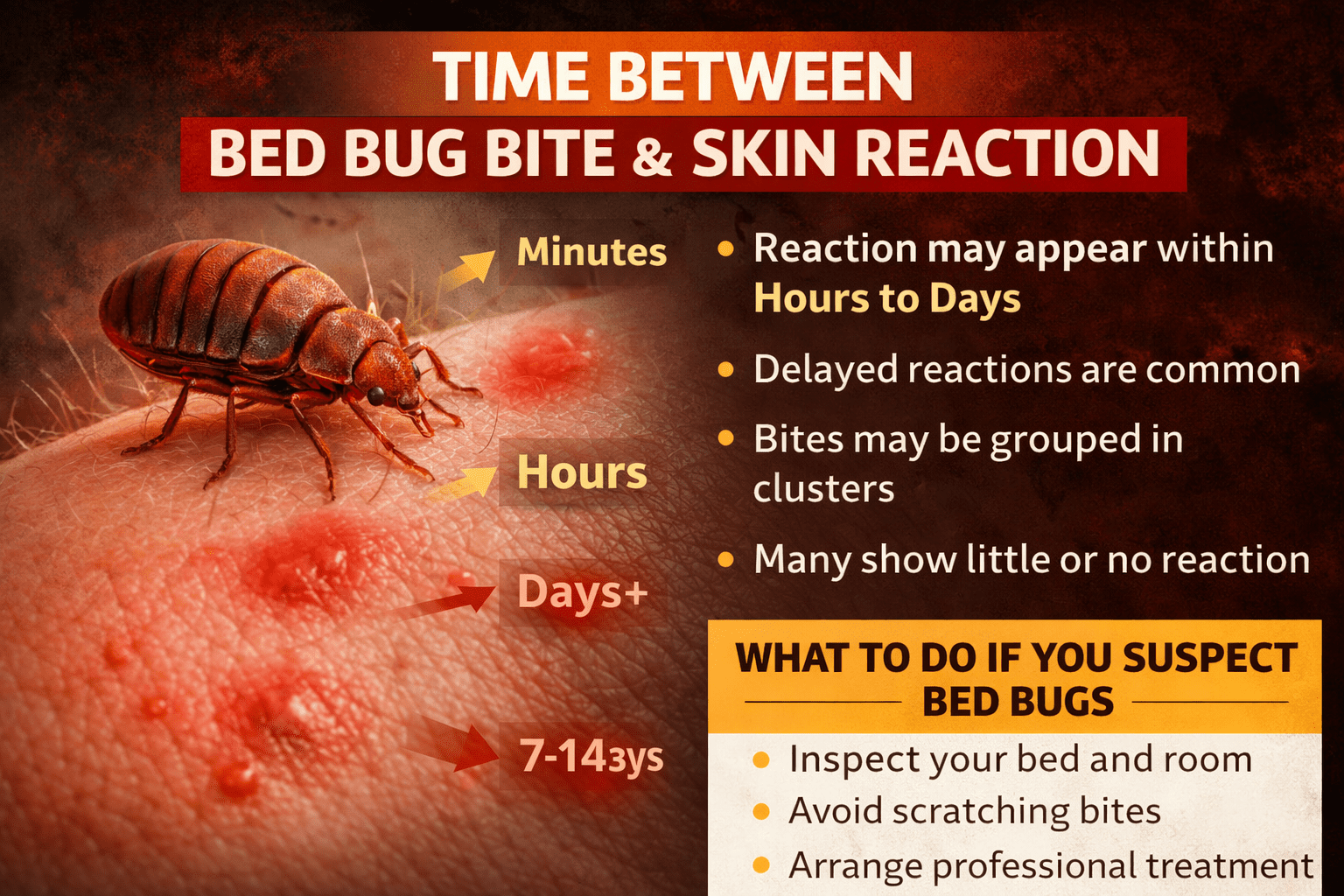

Waking up with itchy red marks and realising they were not there the night before can be unsettling. One of the most confusing things about bed bug bites is that the bite and the visible skin reaction do not necessarily happen at the same time.
Bed bug bites are often not felt while the insect is feeding. Depending on the individual and their previous exposure, a visible reaction may appear relatively quickly, several days later, or sometimes not be obvious at all.
This creates an important problem: you cannot reliably work out exactly when or where you were bitten simply from when a skin reaction appeared.
This UK guide explains the time between a bed bug bite and a reaction, what the marks may look like, why reactions vary and what to do if you suspect bed bugs are responsible.
How Long After a Bed Bug Bite Does a Reaction Appear?
There is no single reaction time that applies to everyone.
Some people notice skin changes relatively soon after exposure. In other people, the reaction can be delayed for days. Previous exposure can also affect how quickly an individual's immune system responds.
Some people may have little or no obvious skin reaction.
This means that marks appearing today do not necessarily prove that you were bitten last night.
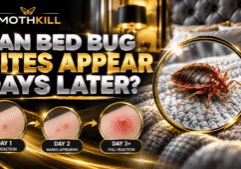
Bed Bug Bite Reaction Timeline
It is better to think of the reaction time as a broad range rather than a precise timetable.
Why Is There a Delay Between a Bed Bug Bite and the Reaction?
What you see on the skin is not simply a puncture mark from the insect.
Bed bugs introduce saliva while feeding. The visible itching, redness, swelling or other skin response can involve your body's reaction to components in that saliva.
Because people's immune responses differ, the appearance and timing of the reaction can differ too.
Does Previous Exposure Change the Reaction Time?
It can.
Published research has shown that sensitivity and reaction time can change with repeated exposure to bed bugs.
Someone with little previous exposure may have a delayed response, while a person who has become sensitised through repeated exposure may respond more quickly.
But this should not be turned into a rigid rule. Human reactions vary, and the appearance of bites cannot tell you precisely how long an infestation has been present.
Can Someone Be Bitten by Bed Bugs and Have No Marks?
Yes. Not everybody develops the same visible skin response.
This is particularly important when two people share the same bed.
One person may develop obvious itchy marks while the other notices little or nothing. That does not prove that only one person is being bitten.
For this reason, the absence of visible bites cannot reliably rule out bed bugs.
Can Bed Bug Bites Appear Days After Leaving a Hotel?
Yes, a delayed reaction means this is possible.
For example, someone might stay in a hotel, return home and notice marks later. The timing of those marks alone cannot prove whether the exposure occurred in the hotel, at home or somewhere else.
This is especially important after travel because it is tempting to use the appearance of a rash as a precise clock.
It isn't.
Can New Bed Bug Bites Appear After Treatment?
Skin reactions that become visible after a treatment do not automatically prove that new bites occurred after the treatment.
A delayed reaction to earlier exposure is one possibility.
However, genuinely continuing bed bug activity is another possibility, so new marks should not simply be dismissed either.
The better approach is to look for physical evidence of continuing bed bug activity and consider the timing alongside the treatment method and other evidence.
We explain this in more detail in How Do I Know If Bed Bugs Are Gone After Treatment?
What Do Bed Bug Bites Look Like?
Bed bug bites do not have one appearance that allows them to be identified with certainty.
Possible features include:
- itchy raised marks;
- red, brown, purple or otherwise discoloured areas depending on skin tone;
- small areas of swelling;
- several marks close together;
- marks that appear in a line or group; and
- reactions on skin exposed while sleeping.
Some people can experience more pronounced swelling or other reactions.
But none of these features proves that bed bugs are responsible.
Can You Diagnose Bed Bugs From Bites?
No — bites alone are not reliable enough to confirm a bed bug infestation.
Bed bug skin reactions can resemble reactions caused by other insects, dermatological conditions and allergies.
The more reliable approach is to inspect the sleeping environment for physical evidence.
Look for:
- live bed bugs;
- dark faecal spotting;
- cast skins;
- eggs or eggshells; and
- other evidence around likely harbourages.
See our complete guide to the signs of bed bugs .
Bed Bug Bites vs Other Possible Causes
Many skin conditions can resemble insect bites, so appearance alone can be misleading.
| Possible Cause | What You Might Notice | Important Point |
|---|---|---|
| Bed bugs | Itchy marks that may be grouped or linear | Physical evidence in the sleeping environment is needed for stronger confirmation |
| Fleas | Small itchy bites, often noticed on the lower legs or ankles | Pets or other animal hosts may provide additional clues |
| Mosquitoes | Itchy raised reactions that may be scattered | Appearance can overlap with other insect bites |
| Scabies | Intense itching and a characteristic distribution can occur | Scabies is caused by mites and requires appropriate medical assessment and treatment |
| Dermatitis / allergy | Itching, redness, irritation or rash | Skin reactions can occur without an insect infestation |
| Other insect bites | Variable | Many bites cannot be confidently identified by appearance alone |
Where Do Bed Bug Bites Usually Appear?
Marks associated with bed bug feeding are often noticed on areas of skin exposed during sleep, such as the arms, shoulders, neck, face or legs.
But distribution alone is not diagnostic.
Bed position, clothing, bedding and individual sleeping habits can all affect which areas of skin are accessible.
Do Bed Bug Bites Always Appear in a Line?
No.
Bed bug bites are often described as appearing in lines or groups, but this pattern is not present in every case and is not unique to bed bugs.
A straight line of itchy marks therefore does not confirm an infestation by itself.
Why You Should Inspect the Bed Instead of Studying the Bites
If you are trying to establish whether you have bed bugs, the bedroom usually provides better evidence than your skin.
Start with the areas closest to where you sleep.
🛏️ Mattress
Check seams, piping, labels and folds, particularly around the head end.
🔎 Bed Frame
Inspect joints, screw holes, cracks, slats and connection points carefully.
🪑 Headboard
Check behind and around the headboard, including fixings and upholstered sections.
🗄️ Bedside Furniture
Inspect drawer joints, undersides, backs and narrow gaps near the bed.
🖼️ Nearby Fixtures
Look around skirting, pictures and other sheltered areas close to the sleeping position.
⚫ Physical Evidence
Look for live insects, dark spotting, cast skins and eggs rather than relying on bites alone.
Our guide to where bed bugs hide during the day shows the main harbourages worth checking.
What Should You Do If You Find a Bed Bug?
If you find an insect you suspect is a bed bug, try not to immediately move furniture or belongings around the property.
If possible, capture the insect securely or take clear photographs for identification.
Then inspect the surrounding sleeping area for additional evidence.
Our step-by-step guide, I Found a Bed Bug in My Bed – What Should I Do? , covers the immediate next steps.
What to Do Immediately If You Have Suspected Bed Bug Bites
If the reaction is mild, uncomplicated bed bug bites often settle without specific medical treatment.
General measures recommended by the NHS include:
- keeping the affected skin clean;
- using something cool, such as a clean damp cloth, to help with itching and swelling; and
- avoiding scratching, which can increase the risk of secondary infection.
A pharmacist can advise whether treatments such as an antihistamine or mild steroid cream are appropriate for you.
For current medical guidance, see NHS guidance on bed bugs .
When Should You Get Medical Help?
Seek medical advice if the reaction is severe, persistent, increasingly painful or swollen, or if you are concerned that the skin has become infected.
Urgent medical help is required for symptoms of a serious allergic reaction, such as difficulty breathing or significant swelling involving the mouth, tongue or throat.
For current guidance on bites, allergic reactions and when to seek urgent help, see NHS insect bites and stings guidance .
What to Do If You Find Evidence of Bed Bugs
If inspection confirms bed bug evidence, avoid panicking and moving infested items unnecessarily from room to room.
Confirm the Identification
Make sure the insect or physical evidence is consistent with bed bugs before starting an expensive treatment.
Inspect the Sleeping Area
Check the mattress, frame, headboard and nearby furniture to establish where activity is present.
Handle Fabrics Carefully
Bag potentially infested bedding or clothing before moving it. Launder or heat-dry suitable items according to their care instructions.
Vacuum Useful Areas
Careful vacuuming can physically remove some bed bugs and debris. Empty the vacuum contents carefully afterwards.
Avoid Moving the Problem
Do not start carrying beds, mattresses and potentially infested belongings through the property unless this forms part of a considered treatment plan.
Choose an Appropriate Treatment
The correct approach depends on the extent of the infestation, property and circumstances.
Does Washing Bedding Get Rid of Bed Bugs?
Laundering and heat-drying suitable bedding and clothing can be useful parts of bed bug management.
But washing the bedding does not necessarily eliminate an infestation from the bed frame, furniture or surrounding room.
Bed bugs spend much of their time hidden away from the host, so treatment needs to address their harbourages rather than just the sheets.
Should You Spray the Bed If You Think You Have Bed Bugs?
Do not randomly apply insecticides simply because you have unexplained skin marks.
First establish whether bed bugs are actually present.
If a pesticide is used, it must be authorised for the intended purpose and used strictly according to its label.
Professional insecticides can have a legitimate role in bed bug control, but successful treatment depends on appropriate product selection, application, coverage and follow-up where required.
When Should You Consider Professional Bed Bug Treatment?
Professional help becomes particularly worthwhile when:
- you have confirmed bed bug evidence;
- activity is present in more than one area;
- the infestation has continued despite DIY measures;
- you live in a flat or other connected accommodation where the extent of activity is uncertain;
- previous treatments have failed; or
- you do not feel confident carrying out treatment yourself.
Different professional methods can include insecticides, steam, heat or an integrated combination depending on the circumstances.
Bed Bug Heat Treatment
Professional heat treatment works differently from insecticide treatment.
Bed bug adults, nymphs and eggs are vulnerable to sufficiently high temperatures when effective thermal conditions reach them for sufficient exposure.
MothKill uses professional heating equipment, industrial air-moving fans and multiple temperature sensors to create and monitor the treatment environment.
Our indirect diesel heating equipment remains outside the property. Combustion gases remain outdoors while clean heated air is ducted into the treatment area.
The important point is not simply how hot the room feels. Effective treatment depends on heat distribution, monitored temperatures and sufficient thermal exposure throughout the relevant treatment environment.
Learn more about professional bed bug heat treatment .
Bed Bug Bites in Rented Homes
If you rent your home, report a suspected or confirmed infestation promptly and keep a written record.
Who is responsible for dealing with the problem can depend on the tenancy, condition of the property and circumstances surrounding the infestation.
Do not assume automatically that responsibility always belongs to either the tenant or landlord.
If there is disagreement, obtain current housing advice relevant to your circumstances.
Frequently Asked Questions
How long after a bed bug bite do marks appear?
Reaction time varies considerably. Some people notice a reaction relatively quickly, while others can have a delayed response lasting days. Some people may show little or no obvious reaction. There is no reliable universal timetable.
Can bed bug bites appear several days later?
Yes. Delayed reactions are possible. This means the day a mark becomes visible does not necessarily tell you the exact day the bite occurred.
Can bed bug bites appear after I have left a hotel?
Yes, because skin reactions can be delayed. However, the timing of a reaction alone cannot prove where the exposure occurred.
Can two people share a bed but only one have bites?
Two people can have very different visible reactions. One may develop obvious itchy marks while another has little or no noticeable reaction. Skin marks therefore do not reliably show who has or has not been exposed.
Do bed bug bites always itch?
No. Reactions vary between individuals. Some people experience significant itching while others may have a mild or barely noticeable reaction.
Do bed bug bites always appear in a line?
No. They can occur in groups or lines, but they may also have other patterns. A line of marks is not sufficient to diagnose bed bugs.
Can you tell when you were bitten from the reaction?
Not reliably. Because reaction times differ and can be delayed, it is usually not possible to determine the exact time or place of exposure from the skin reaction alone.
Do new marks after bed bug treatment mean the treatment failed?
Not necessarily. A delayed skin reaction is one possible explanation, although continuing infestation is another. Look for physical evidence and consider the treatment method and timing rather than using bites alone to judge success.
How can I confirm whether I have bed bugs?
Inspect the bed and nearby furniture for live bed bugs, dark faecal spotting, cast skins, eggs and other physical evidence. Bites alone cannot reliably confirm an infestation.
The Bottom Line
The time between a bed bug bite and a visible reaction varies considerably from person to person.
Some people react relatively quickly. Others can develop marks days later, and some people may show little or no obvious skin reaction.
That means you cannot reliably use the appearance of a bite to work out exactly when or where you encountered bed bugs.
If you suspect bed bugs, look beyond the skin.
Inspect the mattress, bed frame, headboard and nearby furniture for physical evidence. If you find a suspected bed bug, capture or photograph it where possible and confirm the identification before deciding on treatment.
If bed bugs are confirmed, the appropriate treatment will depend on the extent of the infestation and the property.
Found Evidence of Bed Bugs?
If you've found bed bugs or physical signs of an infestation, MothKill can advise on professional treatment options, including monitored bed bug heat treatment.