
Bed Bugs in a Divan Bed: Why They’re So Difficult to Eliminate
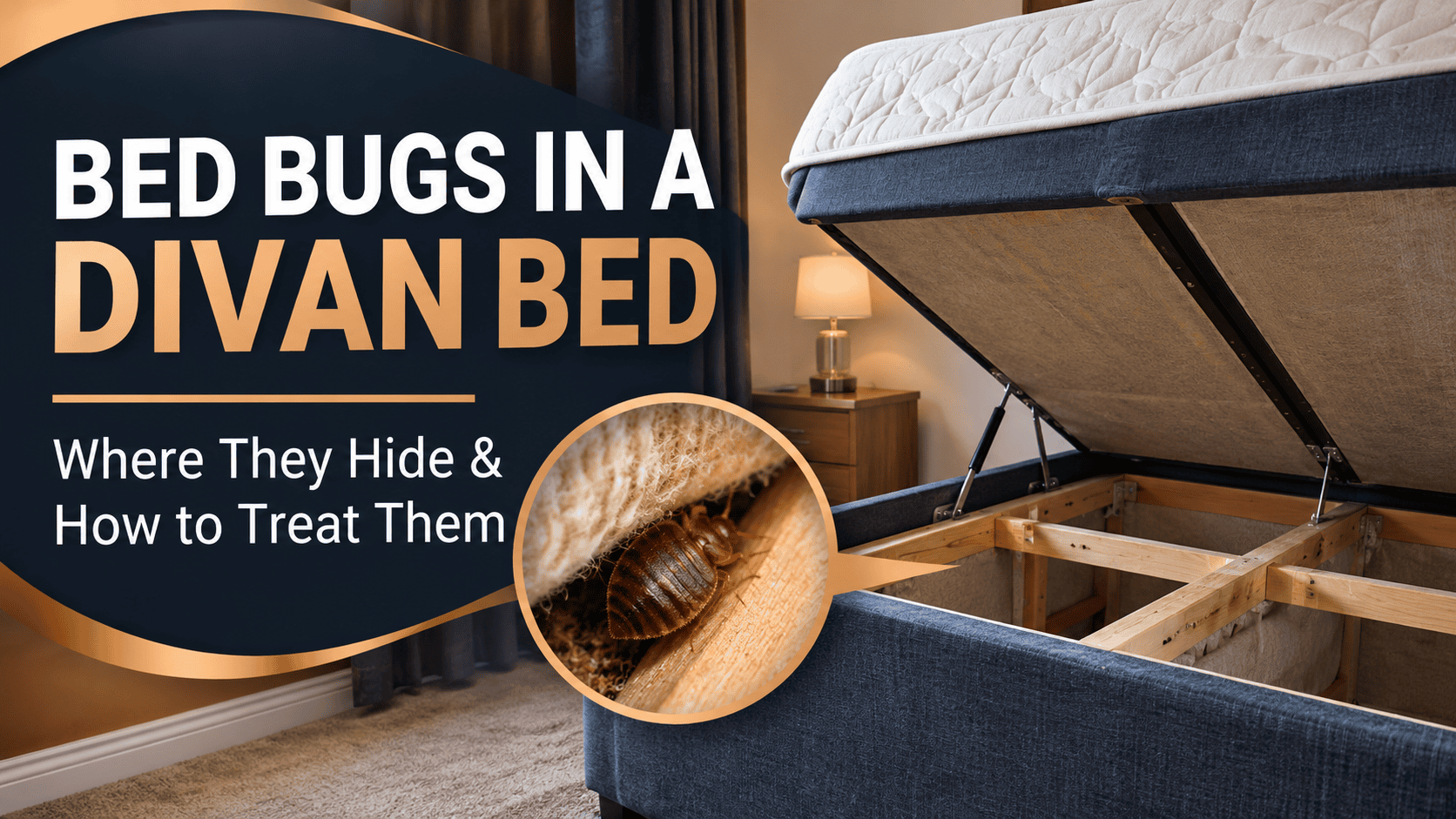
Bed Bugs in a Divan Bed: Where They Hide and How to Get Rid of Them
Discover why divan bed bases are particularly challenging to inspect, where bed bugs conceal themselves, and how professional treatment can help eliminate an infestation without automatically replacing your bed.
Divan beds are popular throughout the UK. They are comfortable, practical and often provide useful storage beneath the mattress.
Unfortunately, their construction can also create numerous concealed spaces where bed bugs may hide.
Unlike a simple metal bed frame, a divan base may contain wooden supports, fabric coverings, internal cavities, storage drawers and small gaps around fixings.
These features can make an infestation difficult to identify during a casual inspection.
People sometimes replace their mattress, wash their bedding and apply insecticide around the bed, only to discover that bed bugs are still present.
One possible explanation is that insects remain concealed within the divan base or surrounding furniture.
Understanding the construction of your bed is therefore an important part of deciding how to tackle an infestation.
Why Do Bed Bugs Hide in Divan Beds?
Bed bugs generally prefer concealed locations close to where people rest or sleep.
They do not need to remain on the mattress itself. During periods when they are not feeding, they often shelter in narrow cracks, joints and protected surfaces around the bed.
A divan base may provide several suitable harbourages within a relatively small area.
Its fabric covering can conceal wooden construction details, while internal compartments may be difficult to inspect without opening the base.
Bed bugs are attracted to suitable harbourages rather than to a particular brand or style of bed.
However, a divan bed can offer more inaccessible hiding places than a simple open-frame bed.
For a broader explanation, read our guide to where bed bugs hide during the day.
Seven Places Bed Bugs Can Hide in a Divan Bed
Underneath the Fabric Covering
The fabric attached to the underside of a divan can conceal gaps, staples and internal framework. Bed bugs may shelter behind loose sections or around seams.
Inside Wooden Frame Joints
Internal wooden supports, corner joints and screw holes provide narrow spaces where insects may remain concealed.
Behind the Headboard
Headboard fixing brackets, mounting holes and upholstered panels are common inspection points, especially close to the sleeping area.
Inside Storage Drawers
Divan drawers create additional spaces around runners, handles, backs and undersides. Stored clothing and bedding may also require inspection.
Along the Upper Bed Base Edge
The junction between the mattress and the divan base may contain piping, seams, folds and protected edges suitable for harbourage.
Around Feet and Castors
Fixing points, plastic feet and supporting brackets can create small gaps. These areas may be overlooked when only the mattress is inspected.
Inside Ottoman Lift-Up Mechanisms
Some storage beds contain hinges, lift mechanisms, panels and enclosed compartments. These should be inspected according to the manufacturer's safety instructions.
Not every divan bed will contain bed bugs in all these places.
The actual distribution depends on the infestation, the bed's construction and how long insects have been present.
How Can You Tell If Your Divan Bed Has Bed Bugs?
Bed bugs may remain hidden even when an infestation is active.
Nevertheless, there are several signs worth checking.
Signs to Look For
- Live insects: Look for small, flattened, reddish-brown bugs around accessible seams and joints.
- Dark spotting: Bed bug faecal marks may appear around fabric seams, wooden joints and concealed edges.
- Shed skins: Growing bed bugs shed their outer skins, which may accumulate near harbourages.
- Eggs: Small pale eggs may be attached to protected surfaces.
- Repeated sightings: Insects appearing near the bed may indicate an infestation requiring closer inspection.
Bites alone are not sufficient to confirm that bed bugs are present.
Other insects and skin conditions can produce similar symptoms.
Read our detailed article covering the signs of bed bugs for more help identifying an infestation.
How to Inspect a Divan Bed for Bed Bugs
A careful inspection should concentrate on places where insects can remain protected and undisturbed.
Start by checking accessible areas without unnecessarily moving the bed into another room.
- Inspect the mattress: Examine seams, piping, labels and accessible edges.
- Check the headboard: Look around fixing brackets, joints and upholstery.
- Examine the divan perimeter: Inspect fabric edges, corners and visible joints.
- Inspect storage drawers: Check their backs, undersides, runners and contents.
- Look beneath the bed: Examine accessible underside fabric, feet and attachment points.
- Inspect nearby furniture: Bedside cabinets and surrounding cracks may also contain insects.
- Record evidence: Photograph suspected insects or signs before cleaning or disturbing them.
If inspection requires opening or dismantling a divan base, speak to your pest controller before proceeding.
Some beds contain sharp fixings, heavy components or mechanical lifting systems that can cause injury if handled incorrectly.
Unnecessary dismantling may also dislodge insects or spread infested belongings.
Can Bed Bugs Live Inside a Divan Drawer?
Yes. Storage drawers can provide additional hiding places, particularly around their runners, internal corners and fixing points.
Bed bugs may also be found among stored belongings if those items provide suitable sheltered spaces.
However, finding bed bugs in a drawer does not necessarily mean every stored item is infested.
Each item needs to be assessed according to its construction, material and level of exposure.
If you discover bed bugs inside a storage drawer, avoid transferring its contents into another bedroom.
Ask your treatment provider how to contain, inspect or treat the contents safely.
Can Bed Bugs Live Under the Fabric Beneath a Divan Bed?
Yes. The thin fabric covering beneath some divan beds can conceal structural woodwork and other protected areas.
Bed bugs may shelter around staples, folds, corners and gaps between the fabric and internal framework.
This creates an inspection challenge because the visible exterior may look completely clean.
In some circumstances, professional access to the internal framework may be necessary.
Whether that involves removing sections of fabric or dismantling part of the bed depends on the model and the proposed treatment.
Do not assume that spraying the exterior fabric will reach insects concealed behind it.
Why Can Divan Bed Bugs Survive DIY Treatments?
Home treatments frequently concentrate on the surfaces that are easiest to reach.
Unfortunately, accessible surfaces are not always where the majority of insects are hiding.
Inaccessible Harbourages
Sprays or surface treatments may not penetrate deep joints, enclosed compartments or spaces behind fabric coverings.
Missed Eggs
Eggs attached to concealed surfaces may escape treatments that cannot reach those areas.
Untreated Furniture
Insects may be present in headboards, bedside cabinets or surrounding gaps as well as inside the divan.
Incomplete Treatment
Even where a product kills exposed bed bugs, that does not mean the complete infestation has been eliminated.
The NHS advises that bed bugs are difficult to eliminate without professional help because they can be hard to find and some are resistant to insecticides.
Learn more in our article Why Are Bed Bugs Still Alive After Spraying?.
Should You Throw Away a Divan Bed That Has Bed Bugs?
Not automatically.
Although divan beds can be difficult to treat, many suitable beds may be retained following an appropriately designed professional treatment.
Whether a particular bed can be treated effectively depends on several factors.
- The severity and distribution of the infestation.
- Whether internal harbourages can be reached or adequately heated.
- The construction and condition of the bed.
- The suitability of the chosen treatment method.
- Whether the mattress and surrounding furniture can also be treated.
Some heavily infested or inaccessible divan bases may be unsuitable for the available treatment method.
In these circumstances, responsible disposal may be recommended.
However, replacing an infested divan without treating the surrounding property can leave the original infestation unresolved.
New furniture may subsequently become infested.
Read Should You Throw Away Your Mattress If You Have Bed Bugs? for related advice.
Important: Do Not Move an Infested Divan Bed Into Another Room
Moving a bed base containing live bed bugs or viable eggs can introduce insects into other areas of your property.
Bed bugs may remain concealed inside the bed while it is being carried through hallways or placed into storage.
Unnecessary movement also makes it harder to establish the original extent of the infestation.
If you suspect bed bugs inside your divan, ask for professional advice before moving, dismantling or disposing of it.
Our existing guide explains how moving furniture can spread bed bugs around your home.
Can Professional Heat Treatment Kill Bed Bugs Inside a Divan Bed?
Professional heat treatment can be effective against bed bugs inside suitable divan beds, provided lethal temperatures reach the actual harbourages for sufficient time.
This distinction is important.
The temperature measured in the room is not necessarily the same as the temperature inside a densely constructed piece of furniture.
Enclosed compartments, upholstery, wooden framing and stored contents can slow heat penetration.
That is why simply heating a room for a short period does not guarantee that every insect and egg inside a divan base has been exposed to a lethal temperature.
Professional treatment should consider the bed's construction, airflow, accessibility and temperature exposure.
Depending on the treatment plan, drawers may need to be emptied and parts of the bed may need to be opened or repositioned.
Where appropriate, temperature monitoring can help determine whether difficult areas have received adequate exposure.
Heat-sensitive materials and lifting mechanisms may require additional precautions.
Learn more about how professional bed bug heat treatment works.
Does Heat Need to Reach the Inside of the Divan?
Yes. Effective thermal control depends on the temperature experienced by the insects themselves, rather than merely the air temperature displayed by a heater.
A divan bed can create protected areas that warm more slowly than exposed surfaces.
Air circulation may be restricted by enclosed cavities, stored belongings and dense construction materials.
Consequently, bed preparation and treatment design are important.
Professional technicians may use appropriate monitoring and extended heating periods to address difficult-to-reach locations.
There is no universal room-air temperature reading or fixed operating time that guarantees every divan construction has been treated successfully.
How Should You Prepare a Divan Bed for Professional Treatment?
Preparation requirements vary between pest control companies and treatment methods.
Always follow the instructions supplied for your specific appointment.
Divan Bed Preparation Checklist
- Confirm the bed type: Tell your pest controller whether you have a standard divan, drawer divan or ottoman storage bed.
- Identify storage: Explain what is stored beneath or inside the bed.
- Follow drawer instructions: Empty storage compartments if instructed and manage their contents using the recommended containment procedure.
- Prepare bedding: Follow the provider's laundering, drying and containment advice.
- Avoid moving the bed: Keep the base in the affected area unless the provider tells you otherwise.
- Discuss dismantling: Do not cut fabric or dismantle lifting mechanisms without suitable advice.
- Identify sensitive materials: Mention delicate finishes, electronic components or mechanisms that could be affected by heat.
- Provide access: Make sure the technician can inspect and access the bed as required.
Our bed bug heat treatment preparation checklist covers general preparation requirements.
Is a Divan Bed More Difficult to Treat Than a Metal Bed Frame?
It can be, depending on its design.
A simple open metal frame may expose more of its joints and surfaces during inspection.
A divan base often contains upholstered sections and concealed internal components.
However, metal bed frames can also harbour insects around hollow sections, joints and fixing points.
The effectiveness of treatment ultimately depends on identifying and reaching the infested harbourages.
| Bed type | Potential hiding places | Inspection considerations |
|---|---|---|
| Standard divan base | Fabric coverings, framework, corners and underside | Internal access may be difficult |
| Drawer divan | Base structure, drawer runners, contents and joints | Drawers and stored belongings need assessment |
| Ottoman storage bed | Internal cavity, hinges, frame and upholstered panels | Lift mechanisms require safe handling |
| Wooden bed frame | Screw holes, slat supports, joints and headboard | Some joints may require dismantling |
| Metal bed frame | Fixings, joins and potentially hollow sections | Accessible surfaces may be easier to inspect |
Can Bed Bugs Come Back After Treating a Divan Bed?
Bed bugs may be discovered after treatment for several reasons.
Some insects may have survived in untreated or inadequately heated harbourages.
Others may have remained in nearby furniture or other areas outside the treatment zone.
Reintroduction from luggage, visitors, neighbouring accommodation or untreated belongings is another possibility.
Finding a bed bug after treatment does not by itself establish why activity is continuing.
A follow-up inspection and consideration of the original treatment method may be necessary.
For detailed guidance, see Bed Bug Heat Treatment Failed: What Should You Do Next?.
How Professional Bed Bug Treatment Should Address the Whole Room
Even when a divan appears to be the main source of activity, it should not be considered in isolation.
Bed bugs may occupy several separate harbourages around the sleeping area.
These can include the headboard, bedside cabinets, skirting boards, nearby upholstery and wall fittings.
Professional assessment should therefore consider the extent of the infestation rather than focusing exclusively on the bed base.
Depending on the findings, treatment of additional furniture, rooms or adjoining areas may be appropriate.
Read our article Bed Bugs in One Bedroom: Do You Need to Treat the Whole House? for further guidance.
Frequently Asked Questions
Can bed bugs hide inside a divan base?
Yes. Fabric coverings, joints, wooden supports, drawer runners and other concealed spaces can provide harbourages.
Do bed bugs prefer divan beds?
There is no need for bed bugs to prefer divans specifically. However, their enclosed construction can offer numerous protected hiding places near a sleeping person.
Can bed bugs live in divan storage drawers?
Yes. They may shelter in joints, runners, drawer backs and nearby crevices. Stored belongings may also require inspection.
Will replacing my mattress eliminate bed bugs in a divan?
Not necessarily. Insects may remain inside the bed base, headboard and surrounding furniture even after the mattress has been replaced.
Should I cut open the fabric beneath my divan?
Not without appropriate advice. Altering the base may damage the bed, create handling hazards or disturb insects. Ask your treatment provider whether internal access is needed.
Does bed bug spray work inside a divan?
Appropriately authorised products can play a role in professional control, but sprays applied only to exposed surfaces may not reach concealed harbourages. Always follow product labels and professional guidance.
Can professional heat treatment save my divan bed?
Many suitable divan beds can potentially be treated, provided lethal exposure reaches the insects and eggs. Construction, accessibility and heat sensitivity must be assessed.
Is an ottoman bed harder to treat than a normal divan?
It may be. Ottoman beds can contain enclosed storage compartments, hinges and lifting mechanisms that require careful inspection and preparation.
Can I keep sleeping in my divan while waiting for treatment?
Ask your pest controller for advice based on the infestation and treatment plan. Moving to another bedroom can encourage dispersal in some circumstances, so avoid changing sleeping arrangements without considering the risks.
Will bed bugs disappear if I leave the divan unused?
No reliable elimination can be expected simply by leaving the bed unused. Bed bugs can survive for extended periods without feeding, depending on environmental conditions.
Final Advice: Do Not Overlook the Divan Base
When bed bugs are found around a bed, the mattress is often the first item people inspect.
However, a divan base can contain numerous concealed spaces that are not visible during a quick examination.
Ignoring these areas may result in insects remaining after an otherwise substantial cleaning or treatment effort.
The most effective approach is to establish where bed bugs are actually hiding, assess the complete sleeping area and select a treatment strategy capable of reaching the relevant harbourages.
Professional heat treatment may help preserve suitable infested furniture, but successful results depend on correct preparation, heat penetration and suitable management of the whole infestation.
The important question is not simply whether the divan gets hot, but whether the insects and eggs hidden inside it receive an effective treatment.
Found Bed Bugs in Your Divan Bed?
MothKill provides professional bed bug heat treatment for suitable properties and furniture. If you have discovered bed bugs in a divan base, mattress or bedroom furniture, contact us to discuss the infestation and the most appropriate treatment options.
Request Professional Advice & a Quote Explore Professional Heat Treatment