
Can Bed Bugs Live in Ventilation Systems and Air Ducts?
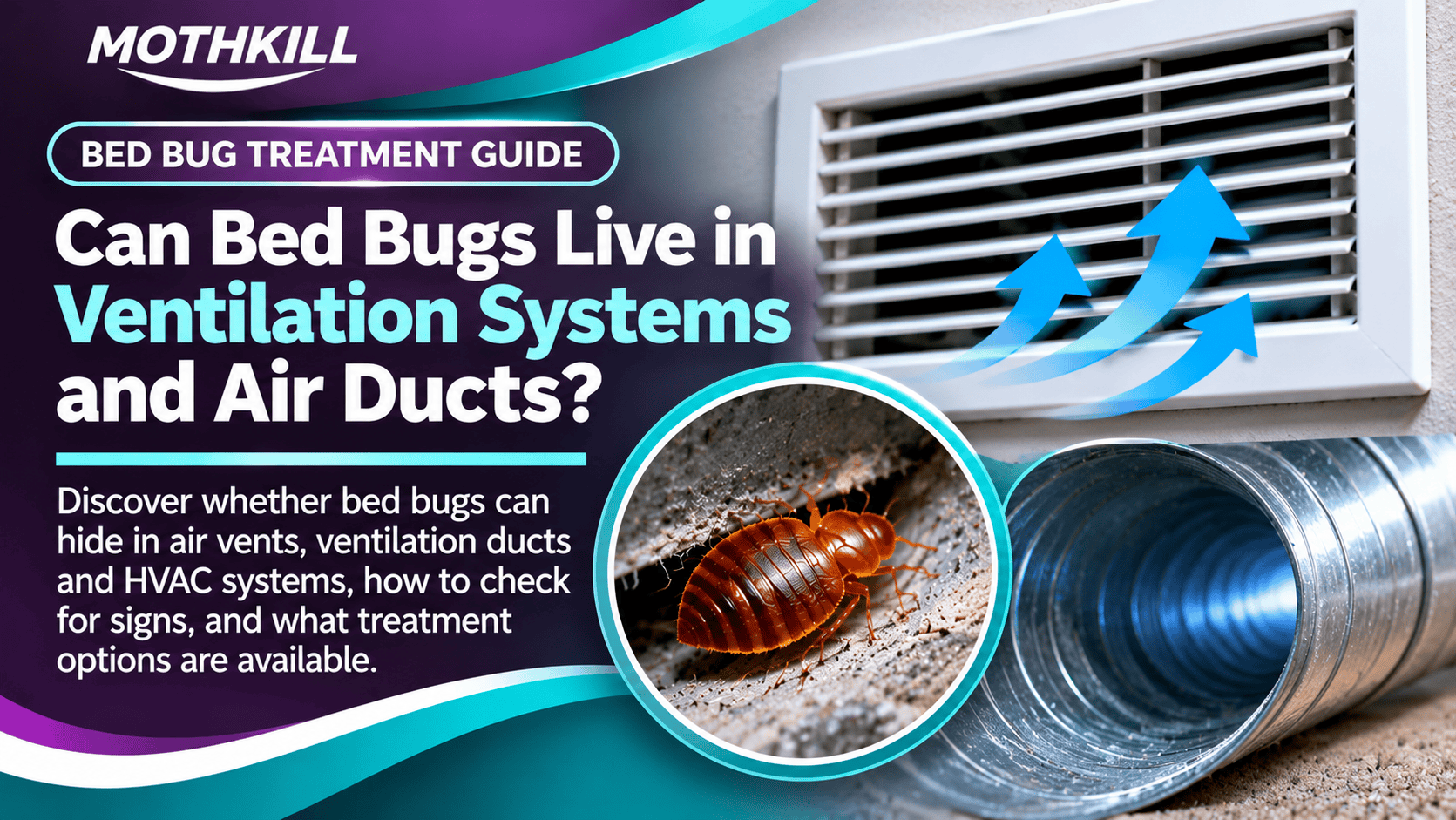
Can Bed Bugs Live in Ventilation Systems and Air Ducts?
Discover whether bed bugs can shelter around air vents, travel through ductwork and survive inside ventilation systems — plus what to do if you suspect activity.
When bed bugs keep appearing in a bedroom, homeowners sometimes begin investigating less obvious hiding places.
Mattresses, headboards and bed frames are familiar harbourages. But what about air vents, ventilation grilles and ductwork hidden behind walls?
Can bed bugs enter these spaces, and could a ventilation system allow them to move between rooms?
The answer is that bed bugs may occasionally enter accessible ventilation openings and sheltered gaps around ductwork. However, ventilation systems are not generally their preferred habitat.
Understanding the difference between a possible hiding place and a likely source of infestation is important before attempting treatment.
Do Bed Bugs Normally Live Inside Air Ducts?
Bed bugs generally prefer protected harbourages close to sleeping or resting people.
They feed on blood and commonly emerge from hiding to find a host.
For this reason, the most frequently encountered harbourages include mattress seams, bed frames, headboards and nearby furniture.
Air ducts may be less attractive because they can be distant from hosts, exposed to moving air and difficult to navigate.
However, not every ventilation system is the same.
A short, accessible duct or an unsealed gap around a grille could provide shelter under suitable circumstances.
It would be incorrect to assume that every ventilation system is infested simply because bed bugs are present in the building.
Where Might Bed Bugs Hide Around Ventilation Systems?
Behind Ventilation Grilles
Narrow gaps between a grille and the surrounding wall may provide protected spaces.
Around Duct Penetrations
Small openings where ductwork passes through walls or floors may offer sheltered routes.
Wall Voids Near Vents
Structural cavities adjacent to ventilation openings may provide harbourages independently of the duct itself.
Behind Decorative Covers
Loose trim, covers and fixing points can create small cracks suitable for insects.
Unused Vent Openings
Disused or poorly sealed ventilation openings may contain sheltered gaps.
Service Voids
Shared spaces carrying pipes, cables and ventilation components can connect different parts of a building.
Can Bed Bugs Travel Through Air Vents Between Rooms?
Potentially, if there is a continuous accessible route.
Bed bugs are crawling insects and do not fly or jump.
They may disperse through cracks, wall openings and connected structural spaces.
In buildings containing multiple flats or bedrooms, shared service penetrations can sometimes provide routes for movement.
However, a ventilation system should not automatically be blamed when bed bugs appear in more than one room.
Movement of furniture, luggage and belongings may also spread infestations.
Professional inspection should consider all plausible routes rather than assuming that insects are travelling through ductwork.
Read how bed bugs spread between properties.
Can Bed Bugs Survive Moving Air?
Bed bugs are small crawling insects that can shelter within narrow gaps.
Air movement may make some exposed duct surfaces unsuitable as resting places.
Nevertheless, airflow is not a reliable method of killing bed bugs.
Insects protected behind grille edges or within adjacent cracks may experience very different conditions from those in the centre of a duct.
Therefore, running an extractor fan or ventilation system should not be considered an infestation treatment.
What About Bed Bugs in Bathroom Extractor Fans?
Bathroom extractor fans are not typical bed bug harbourages because bathrooms generally provide fewer opportunities for insects to feed on sleeping occupants.
However, where a bathroom adjoins an infested bedroom, gaps around wall penetrations or fixtures may warrant inspection if there is evidence of activity.
Electrical and mechanical components must be treated as potential safety hazards.
Homeowners should not dismantle powered extractor fans or apply insecticides inside them.
Could Bed Bugs Hide in Air Conditioning Units?
Bed bugs could potentially shelter in accessible gaps around an air-conditioning unit, particularly where it is installed near an infested sleeping area.
However, this does not establish that the internal mechanical components are infested.
Any inspection should distinguish between the surrounding wall, mounting gaps and the appliance itself.
Air-conditioning equipment contains electrical components and may require specialist access.
Do not spray insecticides into an air-conditioning unit or attempt to heat its internal components without an appropriate professional assessment.
How Can You Check for Bed Bugs Around Air Vents?
Start by confirming that bed bugs are actually present.
Where possible, preserve a suspected insect for identification.
Then inspect the most likely harbourages around beds and nearby furniture before moving to less common locations.
Practical Inspection Checklist
- Inspect mattress seams, headboards and bed-frame joints.
- Look for live insects, shed skins, eggs and characteristic dark spotting.
- Record the location of sightings and any evidence near ventilation openings.
- Visually examine accessible grille edges without dismantling electrical or mechanical equipment.
- Check whether visible gaps exist around the vent or surrounding wall.
- Ask a professional to assess concealed openings where evidence suggests activity.
- Avoid disturbing suspected harbourages unnecessarily.
Our guide to the signs of bed bugs explains the evidence to look for.
Can Professional Heat Treatment Kill Bed Bugs Near Air Vents?
Professional heat treatment can kill bed bugs and eggs when they receive sufficient lethal thermal exposure.
However, concealed spaces around ducts and ventilation openings may heat differently from the surrounding room.
Air temperature in the bedroom is not necessarily the same as the temperature inside a wall cavity or enclosed service void.
Some cavities may remain cooler because of building construction, insulation or connections to untreated areas.
A competent treatment provider should assess relevant harbourages and consider whether supplementary measures are necessary.
Professional heat treatment should not be assumed to sterilise every hidden cavity throughout a building.
Learn more about how professional bed bug heat treatment works.
Important: Never Spray Insecticide Into Electrical or Ventilation Equipment
Ventilation systems may contain fans, electrical connections, filters and other components that are unsuitable for pesticide application.
Spraying chemicals into ducts may also distribute residues to other occupied areas.
Do not apply insecticides, powders or flammable products inside electrical fittings, fans or ductwork unless the specific product is authorised for that use and the work is undertaken safely by a competent professional.
Likewise, do not obstruct essential ventilation openings in an attempt to prevent bed bug movement.
Should You Remove Ventilation Grilles to Look for Bed Bugs?
Not routinely.
Removing grilles without a clear reason can damage finishes or disturb concealed insects.
Some grilles are connected to powered equipment or form part of fire-safety or building ventilation arrangements.
Where evidence suggests activity around a vent, a qualified professional can determine whether access is justified.
Any necessary electrical isolation, specialist removal or reinstatement should be handled appropriately.
Do Bed Bugs Spread Through Shared Ventilation in Flats?
Bed bugs can spread between flats through several mechanisms, including movement of infested belongings and dispersal through suitable structural connections.
Shared ventilation or service spaces may provide a possible route in certain buildings, but this should not be assumed without evidence.
Where infestations recur in neighbouring flats, coordinated inspection may be more useful than repeatedly treating one room in isolation.
Building management and adjoining occupants may need to be involved where connected areas are suspected.
See our guide to bed bug heat treatment for flats and apartments.
Should Ventilation Ducts Be Professionally Cleaned for Bed Bugs?
Not as a routine bed bug treatment.
There is no good reason to commission extensive duct cleaning solely because bed bugs have been discovered in a bedroom.
Conventional duct cleaning is not designed to guarantee elimination of bed bugs or their eggs from every connected harbourage.
If insects are confirmed inside accessible ductwork, the treatment provider should assess the extent of the problem and determine a suitable response.
That may involve specialist inspection, access to particular sections or targeted measures appropriate to the installation.
Ventilation-Related Treatment Options Compared
| Approach | Possible benefit | Important limitation |
|---|---|---|
| Professional inspection | Identifies whether there is evidence near ventilation openings. | Concealed areas may require additional access. |
| Professional room heat treatment | Can control bed bugs in suitable heated spaces and accessible harbourages. | Does not guarantee lethal temperatures in remote or insulated ducts. |
| Targeted professional treatment | May address confirmed harbourages where an authorised method is suitable. | Must account for electrical, ventilation and product restrictions. |
| Sealing appropriate gaps | May help reduce access through identified non-essential cracks after assessment. | Must not block essential ventilation or compromise building safety. |
| Routine duct cleaning | May remove ordinary dust and debris. | Not a proven stand-alone solution for a bed bug infestation. |
How Do You Prevent Bed Bugs Returning Through Structural Gaps?
Where a confirmed infestation involves structural openings, treatment should address the insects as well as the relevant access routes.
Appropriate sealing of non-essential gaps may be considered after inspection and treatment.
However, it is important not to seal insects into inaccessible spaces prematurely or interfere with ventilation, fire protection or electrical safety.
In flats and shared buildings, the treatment provider may recommend inspecting neighbouring areas if evidence suggests a connected infestation.
Frequently Asked Questions
Can bed bugs crawl through air vents?
Potentially, where the vent and connected spaces provide a suitable continuous route. It is not their most typical method of spread.
Do bed bugs live inside heating ducts?
They may occasionally enter accessible spaces, but heating ducts are not generally regarded as common primary harbourages.
Can an extractor fan spread bed bugs?
There is no reason to assume that normal fan operation routinely spreads bed bugs. Movement through connected openings is a separate possibility that requires evidence.
Can heat treatment reach bed bugs behind vents?
It may reach some accessible harbourages, but concealed cavities can heat differently. Treatment planning and monitoring are important.
Should I spray bed bug insecticide into an air vent?
No. Do not apply insecticides inside ventilation or electrical equipment without professional assessment and a product specifically authorised for that application.
Can bed bugs travel between flats through ductwork?
Potentially in certain connected installations, but this is not proof that ductwork is the route. Other means of spread should also be investigated.
Should I block my air vents?
No. Blocking required ventilation can create health, moisture and building-safety problems.
Does duct cleaning eliminate bed bugs?
Routine duct cleaning is not a dependable stand-alone bed bug eradication method.
Final Advice: Bed Bugs and Ventilation Systems
Bed bugs can potentially shelter around air vents, duct penetrations and adjacent structural gaps.
However, their usual harbourages remain much closer to beds and other places where people rest.
Homeowners should not assume that ductwork is infested without physical evidence.
Where bed bugs are confirmed, professional inspection should establish the extent of activity and identify appropriate treatment options.
Heat treatment can be effective in suitable areas, but concealed ventilation spaces must not automatically be assumed to reach lethal temperatures.
The best approach is to investigate the evidence, treat confirmed harbourages and avoid unsafe DIY applications inside ventilation or electrical systems.
Concerned About Bed Bugs in Your Property?
MothKill provides professional bed bug heat treatment for suitable homes and properties. If you are finding bed bugs in unusual locations or experiencing recurring activity, contact us to discuss the infestation and an appropriate treatment plan.
Request a Bed Bug Treatment Quote Explore Our Heat Treatment Service