Why Do Bed Bugs Exist

Few household pests generate quite as much frustration as bed bugs. After discovering them in a bed or bedroom, it is understandable to wonder: why do bed bugs even exist?
Bed bugs did not suddenly appear because humans invented beds, and they do not exist because a home is dirty. They belong to an ancient group of blood-feeding insects whose evolutionary history stretches far beyond modern houses, hotels and mattresses.
Their biology happens to make human sleeping environments particularly suitable for them.
Understanding how bed bugs evolved, why they feed on blood and how they survive also helps explain why infestations can be so difficult to control.
Why Do Bed Bugs Exist?
Bed bugs exist for the same basic reason any other successful organism exists: their ancestors evolved characteristics that allowed them to survive and reproduce.
They are specialised blood-feeding insects. Over evolutionary time, members of the bed bug family became associated with warm-blooded hosts, including bats, birds and humans.
The bed bug that most commonly infests human homes, Cimex lectularius, has become particularly successful at living close to people.
Our beds provide something extremely useful to a bed bug: a predictable host returning to roughly the same location for hours at a time.
Did Bed Bugs Evolve to Live in Beds?
No.
Bed bugs existed long before modern beds, bedrooms and houses.
The evolutionary history of the wider bed bug family involves associations with animals including bats and birds. Research into bed bug evolution also indicates that their history is considerably older and more complicated than the simple idea that bed bugs appeared when humans began sleeping in caves.
What is clear is that certain bed bug lineages became closely associated with humans and proved extremely successful at exploiting us as hosts.
Beds simply provide an excellent modern environment for an insect already adapted to feeding on a host that remains relatively still for long periods.
Where Did Bed Bugs Originally Come From?
The precise evolutionary history is complex, but bed bugs belong to the family Cimicidae — a group of blood-feeding insects associated with vertebrate hosts.
Different cimicid species are associated with different animals, including bats and birds.
Humans have had a very long association with bed bugs, and this relationship continued as people moved from caves and simple shelters into increasingly complex buildings.
Modern houses did not eliminate the ecological opportunity. In many ways, they created enormous numbers of stable sleeping sites where a human host returns every night.
Why Do Bed Bugs Feed on Blood?
Blood feeding is not a lifestyle bed bugs choose. It is a highly specialised feeding strategy produced through evolution.
Bed bugs require blood meals to develop and reproduce.
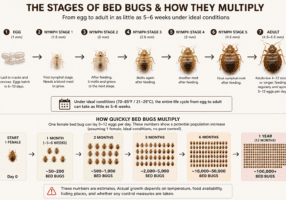
Young bed bugs, known as nymphs, pass through a series of developmental stages before reaching adulthood. Blood meals are required as they progress through these stages.
Adult females also require blood meals for continued egg production.
Humans are therefore not simply somewhere for bed bugs to live. We are their food source.
Do Bed Bugs Have a Purpose?
People often ask whether bed bugs have any useful purpose in nature.
Evolution does not assign organisms a purpose in the human sense. A species does not need to be useful to people in order to exist.
Bed bugs survive because they have been successful enough at feeding, reproducing and avoiding threats to persist from one generation to the next.
Like other organisms, they form part of biological systems and evolutionary relationships, but there is no household benefit to maintaining a bed bug infestation.
Why Are Humans Such Good Hosts for Bed Bugs?
Think about what happens every night.
A person enters the same room, lies in approximately the same location and remains relatively still for several hours.
Meanwhile, the bed and surrounding furniture provide numerous narrow, sheltered harbourages.
A bed bug can remain concealed close to the host and emerge when conditions are suitable for feeding.
From the bed bug's perspective, a bedroom combines food, shelter and predictability in one small area.
How Are Bed Bugs Adapted to Survive Around People?
Flat Bodies
Bed bugs have flattened bodies that allow them to occupy narrow spaces in bed frames, furniture joints and other protected harbourages.
Blood Feeding
Their mouthparts and feeding behaviour are specialised for obtaining blood from a host.
Host Detection
Bed bugs respond to environmental cues associated with potential hosts, including carbon dioxide, warmth and other signals.
Sheltered Harbourages
They spend much of their time concealed rather than openly moving around a room, helping them avoid disturbance.
Reproduction
When suitable hosts and conditions are available, a population can increase over time as females lay eggs and nymphs develop.
Survival Between Meals
Bed bugs can tolerate substantial periods without feeding, although survival time varies with life stage, temperature and other conditions.
Are Bed Bugs Nocturnal?
Bed bugs are commonly most active when their host is resting, which for many people means activity occurs during the night.
But describing them simply as nocturnal can be misleading.
Bed bugs can adjust their activity according to host availability and can feed during daylight if circumstances favour it.
The important factor is access to a suitable host rather than an absolute rule that they only emerge in darkness.
Why Do Bed Bugs Live Near Beds?
A bed is a logical place for bed bugs because their host remains there for hours at a time.
But despite their name, bed bugs are not restricted to mattresses.
They may harbour in:
- bed-frame joints;
- headboards;
- divan bases;
- mattress seams;
- bedside furniture;
- upholstered furniture;
- skirting areas;
- cracks and crevices; and
- other sheltered locations close to resting hosts.
As an infestation becomes more established, harbourages may be found farther from the bed.
See our detailed guide to where bed bugs hide during the day .
Why Don't Bed Bugs Have Wings?
Modern bed bugs are wingless insects.
They do not need to fly to obtain food because their survival strategy is based on living close to a predictable host.
Instead, they crawl between harbourages and feeding locations and can be transported much greater distances when they hitchhike with human belongings.
This ability to be transported accidentally is a major reason bed bugs can spread between buildings, towns and countries without being able to fly.
How Do Bed Bugs Spread Between Homes?
Bed bugs are excellent hitchhikers.
They can be transported with:
- luggage;
- bags;
- clothing;
- second-hand furniture;
- bedding; and
- other belongings.
In some multi-occupancy buildings, movement between neighbouring rooms or properties can also occur.
Travel therefore gives bed bugs opportunities to move far beyond the distance they could crawl themselves.
Why Does Modern Life Help Bed Bugs Spread?
International Travel
People and their belongings move rapidly between cities and countries, providing opportunities for bed bugs to hitchhike to new locations.
Hotels and Short-Stay Accommodation
Frequent turnover means large numbers of people and bags pass through the same sleeping environments.
Second-Hand Furniture
Infested beds, sofas and other furniture can transport bed bugs when moved between properties.
High-Density Housing
Flats, HMOs and other connected buildings can make investigation and control more complicated when activity involves more than one area.
Insecticide Resistance
Resistance to some insecticides has developed in bed bug populations, complicating control where products or strategies are poorly matched to the infestation.
Are Bed Bugs Becoming More Common in the UK?
Bed bugs remain an important pest in the UK, as they do in many countries.
Changes in travel, movement of belongings, insecticide resistance, treatment practices and other factors have all been investigated as contributors to the modern resurgence of bed bugs.
However, reports of increased bed bug activity should be interpreted carefully. Local reports or short-term increases do not necessarily establish a single national trend or one simple cause.
What has not changed is their ability to be transported between locations and to establish themselves when they gain access to a suitable host and harbourage.
Do Bed Bugs Mean Your House Is Dirty?
No.
Bed bugs feed on blood rather than household dirt or food waste.
A very clean home can develop an infestation just as a cluttered home can.
Housekeeping can affect how easy an infestation is to inspect and treat — particularly where large amounts of clutter provide additional hiding places — but cleanliness does not prevent a bed bug from being introduced.
What they need most is access to a suitable host and somewhere protected to hide between feeds.
Why Are Bed Bugs So Difficult to Get Rid Of?
Bed bug control is difficult because several characteristics work in their favour.
Hidden Harbourages
Bed bugs can occupy narrow cracks, joints and folds that are easily missed during inspection or treatment.
Small Eggs and Nymphs
Early life stages can be difficult to see and may remain protected inside harbourages.
Incomplete Coverage
A treatment can fail when important harbourages or affected areas are not adequately treated.
Insecticide Resistance
Some bed bug populations show resistance to particular insecticides, which can reduce the effectiveness of poorly chosen chemical treatments.
Reintroduction
A successful treatment cannot prevent a bed bug from being introduced again later on luggage, furniture or other belongings.
Connected Properties
In some flats and multi-occupancy buildings, activity outside the treated area can complicate long-term control.
Why Do Some Bed Bug Treatments Fail?
Treatment failure does not always have one cause.
Possible reasons include:
- incorrect identification;
- missed harbourages;
- incomplete treatment coverage;
- inadequate preparation;
- insecticide resistance;
- poorly selected products or methods;
- insufficient follow-up where follow-up is required;
- untreated neighbouring areas; and
- reintroduction after treatment.
If you have already received treatment but are still concerned about activity, read our guide to still having bed bugs after treatment .
Do Bed Bug Sprays Work?
Authorised insecticides can have a legitimate role in bed bug control when products are selected appropriately and used according to their labels.
However, simply spraying exposed surfaces does not guarantee that insects hidden inside protected harbourages have been reached.
Resistance to particular active ingredients can also vary between bed bug populations.
This is why professional insecticide programmes may involve careful inspection, targeted application, residual treatment where appropriate and planned follow-up rather than one indiscriminate spray.
What About Steam?
Steam can be useful as a direct treatment for suitable accessible bed bug harbourages.
Bed bugs and eggs receiving sufficient thermal exposure can be killed, but steam remains a local treatment.
Correct equipment and application are important, and steam does not automatically treat every hidden location in a room.
How Does Professional Bed Bug Heat Treatment Work?
Professional heat treatment takes a different approach by attempting to establish controlled thermal conditions throughout the treatment area.
At MothKill, indirect diesel heating equipment remains outside the property. Combustion gases remain outdoors while clean heated air is ducted into the treatment area.
Industrial fans help circulate the heated air, while temperature sensors are used to monitor different locations.
Bed bugs at different life stages, including eggs, can be killed when sufficient thermal conditions reach them for sufficient time.
Heat treatment is therefore about temperature distribution, airflow, exposure and monitoring — not simply making a room feel hot.
Read more about how bed bug heat treatment works .
Is Heat Treatment Always the Best Bed Bug Treatment?
Not necessarily.
The appropriate treatment depends on factors such as the extent of the infestation, property layout, harbourages, previous treatments, access, occupancy and other practical considerations.
Possible control methods include:
| Method | Potential Role | Important Limitation |
|---|---|---|
| Professional Heat | Controlled thermal treatment capable of targeting different life stages. | Preparation, airflow, exposure and temperature monitoring are critical. |
| Insecticides | Targeted and residual control where appropriate. | Coverage, product choice and resistance can affect results. |
| Steam | Direct heat treatment of suitable accessible harbourages. | Local treatment with limited reach beyond the treated surface. |
| Vacuuming | Physical removal of accessible insects and debris. | Cannot reliably reach the whole infestation by itself. |
| Integrated Treatment | Combines appropriate methods according to the infestation. | Requires a strategy based on inspection rather than random product use. |
Can Bed Bugs Be Completely Eliminated?
Bed bug infestations can be successfully controlled and eliminated, but no responsible treatment should be described as incapable of failure.
Success depends on correctly identifying the pest, understanding the extent of the infestation and using methods capable of reaching the relevant harbourages.
Preparation, treatment coverage, monitoring and follow-up can all matter.
There is also an important distinction between treatment failure and reintroduction. A property can be cleared and later acquire bed bugs again from a new source.
How Can You Reduce the Risk of Bed Bugs?
It is impossible to guarantee that a bed bug will never be introduced, but sensible precautions can reduce risk or help detect a problem earlier.
- Inspect second-hand beds and upholstered furniture carefully before bringing them indoors.
- Be aware of bed bug signs when travelling.
- Check luggage after staying somewhere where bed bugs are suspected.
- Avoid moving potentially infested belongings between rooms.
- Learn the physical signs of bed bugs rather than relying on bites alone.
- Investigate suspicious activity before an infestation becomes heavily established.
Frequently Asked Questions
Why do bed bugs exist?
Bed bugs exist because their ancestors evolved a successful blood-feeding lifestyle. Certain bed bug lineages became closely associated with humans, taking advantage of predictable access to a host and sheltered harbourages near sleeping areas.
Did bed bugs evolve from bats?
The relationship between bed bugs, humans and bat-associated cimicids is an important part of research into their evolutionary history. However, the evolution of the bed bug family is complex, so the simple statement that modern human bed bugs directly “came from bats” can overstate what the evidence shows.
What purpose do bed bugs serve?
Species do not need a human-defined purpose in order to exist. Bed bugs have persisted because their biology allows them to obtain food, reproduce and survive successfully. There is no benefit to keeping a bed bug infestation in a home.
Why do bed bugs need human blood?
Bed bugs are specialised blood feeders. Blood meals provide the nutrients needed for development and reproduction. Humans are important hosts for Cimex lectularius, although the wider bed bug family includes species associated with other animals.
Why do bed bugs come out at night?
Their activity commonly corresponds with periods when a host is resting, which for humans is usually at night. They are not restricted to feeding in darkness, however, and can adjust their activity according to host availability.
Are bed bugs caused by poor hygiene?
No. Bed bugs feed on blood and can be introduced into clean or untidy properties. Clutter can make inspection and treatment more difficult, but poor personal hygiene does not cause bed bugs.
Why are bed bugs so hard to kill?
They hide in narrow protected harbourages, their eggs and young nymphs can be difficult to locate, and some populations have resistance to particular insecticides. Successful control therefore depends on inspection, treatment coverage and choosing methods appropriate to the infestation.
Can bed bugs survive without feeding?
Bed bugs can survive substantial periods between blood meals. The length of time varies with factors including temperature, life stage and physiological condition, so a single fixed starvation period should not be applied to every infestation.
Can bed bugs fly?
No. Bed bugs are wingless and cannot fly. They crawl locally and can travel much greater distances by being transported accidentally with luggage, furniture, clothing and other belongings.
Can professional treatment get rid of bed bugs?
Yes, established bed bug infestations can be successfully treated. The appropriate method depends on the infestation and property and may involve heat, insecticides, steam, physical removal or an integrated combination of methods.
Why Do Bed Bugs Exist? Final Thoughts
Bed bugs are not a modern invention, they are not created by dirty homes, and they do not exist simply because humans invented beds.
They are the product of a long evolutionary history of specialised blood-feeding insects.
Human sleeping behaviour happens to provide them with an excellent opportunity: a predictable source of blood surrounded by beds, furniture, cracks and other places where they can remain concealed.
Modern travel and the movement of belongings then give them opportunities to reach new hosts and new properties.
Understanding this biology also explains why successful bed bug control is based on finding and treating harbourages rather than simply killing the insects that happen to be visible.
Bed Bugs in Your Home?
If you've moved beyond wondering why bed bugs exist and have discovered them in your property, MothKill provides professional bed bug heat treatment using controlled heating, industrial air circulation and temperature monitoring.