Bed Bug Treatment After a Failed Pest Control Visit
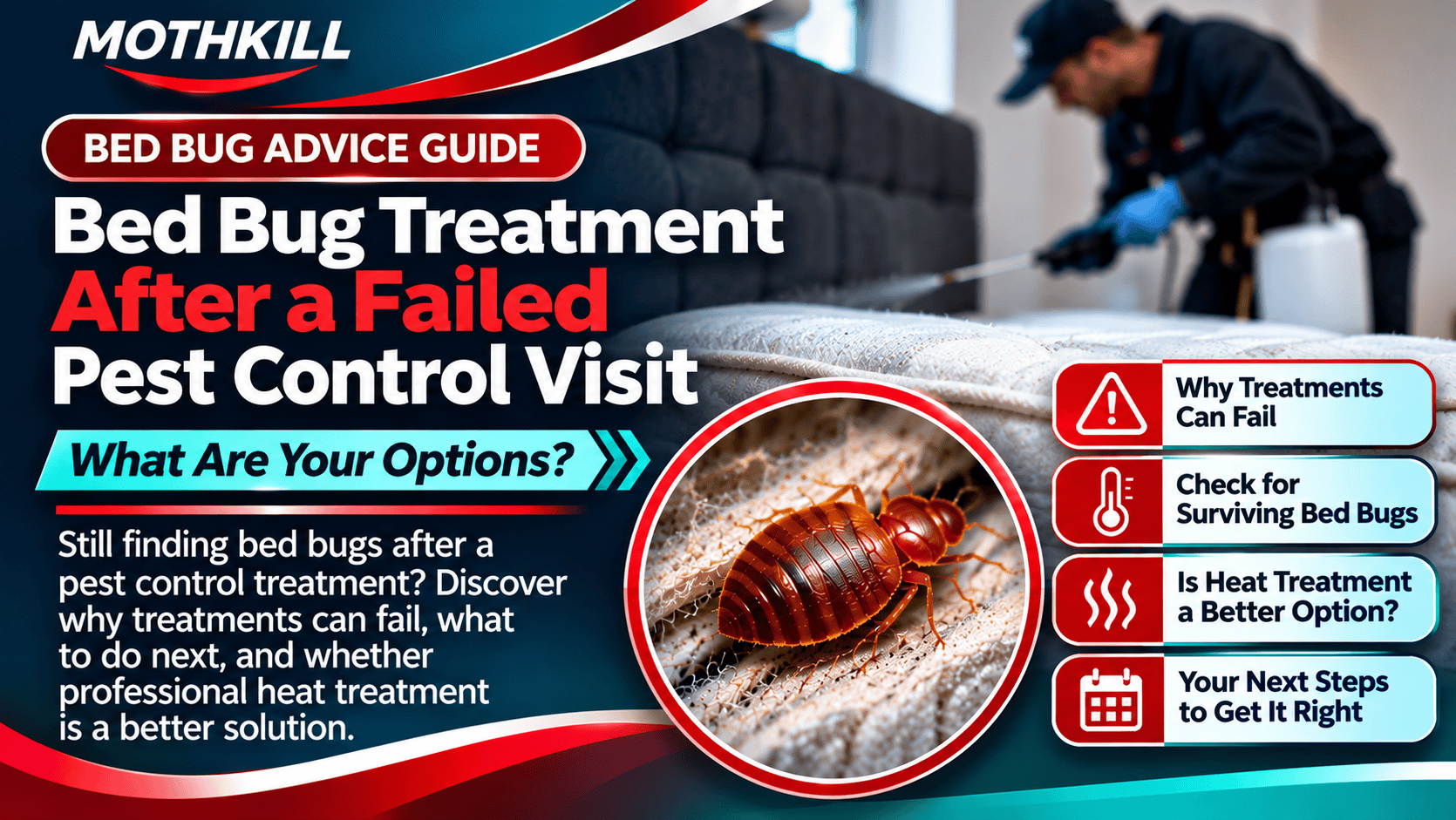
Bed Bug Treatment After a Failed Pest Control Visit – What Are Your Options?
Still finding bed bugs after paying a professional pest control company? Discover why treatment may not have worked, what to do next and whether switching to heat treatment could help.
Paying a pest control company to eliminate bed bugs is a significant expense, particularly when the infestation has already affected your sleep and peace of mind.
Unfortunately, some homeowners continue finding live bed bugs after treatment.
Perhaps the technician sprayed the bedrooms, advised you to wait several weeks and promised that the insects would gradually disappear.
Yet you are still being bitten, discovering insects around your bed or finding fresh signs of activity.
At this point, it is understandable to question whether the treatment has worked and whether you should pay the same company for another visit.
However, finding a bed bug after treatment does not always mean the original treatment has failed.
Some professional insecticide programmes are designed around multiple visits, while other situations involve surviving insects, untreated harbourages or new introductions.
The first step is to establish what treatment was carried out and whether the ongoing activity is consistent with the agreed treatment plan.
Does Finding Live Bed Bugs Mean the Treatment Failed?
Not necessarily.
The answer depends on the treatment method, the time elapsed and the evidence of continuing infestation.
Some insecticides have residual activity, meaning bed bugs may encounter treated surfaces after the technician has left.
Other treatment programmes require repeat applications to address insects emerging from protected harbourages or newly hatched eggs.
Therefore, finding a live insect shortly after an initial chemical treatment does not automatically prove failure.
However, repeated sightings, fresh evidence and continued activity after the agreed treatment programme should be investigated.
In particular, a substantial number of live insects remaining in untreated furniture or concealed harbourages may indicate that the infestation has not been adequately controlled.
Eight Reasons Professional Bed Bug Treatments May Fail
Insecticide Resistance
Some bed bug populations have developed resistance to certain insecticide active ingredients, reducing the effectiveness of treatments that rely on them.
Missed Harbourages
Bed bugs may remain hidden inside divan beds, headboards, furniture joints and other spaces that were not adequately inspected or treated.
Incomplete Property Coverage
Treating only one bed or bedroom may be insufficient where insects have already spread into adjoining rooms or other parts of the property.
Inadequate Preparation
Clutter, inaccessible furniture and failure to follow preparation instructions can prevent technicians reaching important harbourages.
Insufficient Follow-Up
Some chemical treatment programmes require further visits. Missing these appointments can reduce the likelihood of successful control.
Untreated Belongings
Infested luggage, bags, furniture or other possessions may continue harbouring bed bugs after surrounding areas have been treated.
Reintroduction
Bed bugs may be brought back into the property through travel, second-hand belongings or movement from other infested locations.
Unsuitable Treatment Strategy
A severe or widespread infestation may require a more comprehensive programme than a limited application to accessible surfaces.
Why Do Bed Bug Insecticide Treatments Sometimes Struggle?
Bed bugs are particularly challenging insects to control with insecticides alone.
They spend much of their time concealed in narrow harbourages, often avoiding exposed surfaces.
Even where an insecticide is effective against susceptible insects, the product must be applied appropriately and bed bugs must receive sufficient exposure.
Resistance can complicate matters further.
Some populations have developed mechanisms that reduce susceptibility to particular active ingredients, especially certain pyrethroids.
This does not mean every insecticide is ineffective or that professional chemical treatments cannot succeed.
It means the choice of product, application method, infestation extent and follow-up programme all matter.
Read Why Are Bed Bugs Still Alive After Spraying?.
What Should You Do Immediately After Suspecting Treatment Failure?
Your First Seven Steps
- Check the treatment paperwork: Establish which rooms were treated, which products or methods were used and whether further visits were included.
- Record live sightings: Note dates, locations and the number of insects found.
- Preserve evidence: Take clear photographs or retain specimens safely for identification.
- Contact the original company: Explain what you have found and request an assessment.
- Follow existing instructions: Avoid disrupting residual treatments unless advised by the contractor.
- Do not add random DIY sprays: Mixing products or applying additional chemicals may create risks and complicate treatment.
- Consider a second opinion: If activity continues or the original contractor cannot explain the situation, arrange an independent assessment.
Should You Give the Original Pest Control Company Another Chance?
Often, yes — at least initially.
If the treatment was part of a planned multi-visit programme, the original contractor should have an opportunity to assess progress and complete the agreed work.
Ask whether the findings are expected at this stage and what the next treatment step involves.
A reputable contractor should be able to explain the method used, the expected treatment period and any limitations.
However, if repeated visits have produced little improvement, or the contractor cannot identify why activity continues, it may be reasonable to seek another professional opinion.
Keep copies of quotations, invoices, preparation instructions and correspondence.
Questions to Ask Your Original Pest Control Company
Before Agreeing to Another Visit
- Which rooms and furniture were treated?
- What insecticides or treatment methods were used?
- Was the visit intended to be a complete treatment or the first stage of a programme?
- Are follow-up visits included in the original price?
- What evidence would indicate that the treatment has not worked?
- Could insects be surviving in untreated furniture or structural gaps?
- Does the treatment include a warranty or service guarantee?
- What changes will be made if the same approach has not produced sufficient control?
When Should You Consider Changing Treatment Methods?
Changing methods may be appropriate when the existing programme has not achieved satisfactory control and the reason for continued activity has been assessed.
For example, an infestation involving numerous concealed harbourages may require a different strategy from a limited, recently introduced infestation.
Where insecticide resistance is suspected, using the same product repeatedly without reassessment may not be the best approach.
A revised programme might involve alternative authorised insecticides, physical control measures, steam, professional heat treatment or a combination of methods.
The most appropriate option depends on the property, infestation and previous treatment history.
Could Professional Heat Treatment Be a Better Option?
Professional heat treatment can be a valuable alternative for suitable properties, particularly where previous insecticide treatments have not achieved adequate control.
Unlike chemical treatments, heat does not depend on bed bugs being susceptible to a particular insecticide active ingredient.
When bed bugs and their eggs receive sufficiently high temperatures for an adequate duration, the exposure is lethal.
However, effective heat treatment involves more than simply heating the air in a room.
Bed bugs can remain concealed inside furniture, thick materials and protected structural spaces.
These areas may heat more slowly than exposed surfaces.
Professional heat treatment therefore requires suitable equipment, preparation, airflow and temperature monitoring.
Read How Does Bed Bug Heat Treatment Work?.
Important: Heat Treatment Is Not Automatically Guaranteed to Succeed
Heat treatment can be highly effective, but it still depends on correct planning and execution.
Overcrowded rooms, untreated belongings, inaccessible voids and inadequate temperature exposure may compromise the outcome.
The important factor is whether lethal temperatures reach the insects and eggs in their actual harbourages.
Before booking, ask the contractor how temperatures will be monitored, what preparation is required and how any inaccessible areas will be managed.
Professional Heat Treatment Versus Another Chemical Treatment
| Consideration | Further chemical treatment | Professional heat treatment |
|---|---|---|
| How it works | Uses authorised insecticides applied according to the product label and treatment plan. | Uses controlled high temperatures to kill insects and eggs where lethal exposure is achieved. |
| Resistance | Resistance to certain active ingredients can reduce effectiveness. | Does not rely on susceptibility to chemical insecticides. |
| Follow-up | May require multiple visits, depending on the programme. | May be completed in one planned treatment, but further action can still be necessary. |
| Concealed harbourages | Effectiveness depends on suitable application and insect exposure. | Effectiveness depends on heat reaching protected locations. |
| Property risks | Requires compliance with product restrictions and safety instructions. | Heat-sensitive furniture, electronics and finishes require assessment. |
| Residual effect | Some authorised products provide residual activity. | Heat itself leaves no residual insecticidal protection. |
What About Combining Heat Treatment With Insecticides?
In some circumstances, a professional treatment programme may combine heat with suitable insecticidal or desiccant-based measures.
This is sometimes described as a hybrid approach.
However, products must be selected and applied according to their authorisations, labels and the conditions in which they will be used.
Heat can affect the performance or safety of some products, so chemical applications must be planned appropriately.
A combined approach should be based on a clear treatment rationale rather than assuming that adding more chemicals automatically improves the outcome.
Why Is Preparation So Important After Previous Treatment Failure?
Preparation can make a significant difference to treatment access and effectiveness.
Rooms containing large quantities of clothing, boxes, bags and furniture may contain numerous protected harbourages.
When belongings are tightly packed together, they can restrict access during chemical treatment and slow temperature penetration during heat treatment.
However, moving potentially infested belongings without a plan may spread bed bugs into other rooms.
Always follow the new treatment provider's preparation instructions rather than assuming that the instructions from the previous contractor will be identical.
See our Bed Bug Heat Treatment Preparation Checklist.
Could Bed Bugs Be Surviving Inside Your Bed?
Yes. Bed frames, divan bases and headboards can contain numerous concealed harbourages.
Divan beds may be particularly challenging because insects can shelter behind fabric coverings and within internal timber joints.
A limited surface spray may not reach every protected location.
Professional inspection should consider the construction of the bed rather than examining only the mattress.
Read Bed Bugs in Divan Beds for more information.
What If the Bed Bugs Have Spread Into Other Rooms?
Where an infestation has become established, insects may be found beyond the original bedroom.
Other sleeping areas, sofas, upholstered chairs and nearby furniture may contain harbourages.
In flats or connected buildings, movement between properties may also need to be considered.
Repeatedly treating one room while ignoring confirmed activity elsewhere may allow the infestation to continue.
A new treatment plan should assess the extent of the infestation before deciding which areas require attention.
Should You Throw Away Your Mattress After Failed Treatment?
Not automatically.
Discarding a mattress does not guarantee elimination because bed bugs may remain in the bed frame, headboard, furniture or structural gaps.
It may also create an unnecessary expense if the mattress is suitable for professional treatment.
However, some heavily damaged or inaccessible furniture may be unsuitable for practical treatment.
Any decision to dispose of furniture should follow a proper assessment.
Read Should You Throw Away Your Mattress If You Have Bed Bugs?.
How Can You Tell Whether the Second Treatment Has Worked?
The absence of new sightings, fresh spotting and other evidence over an appropriate monitoring period can provide reassurance.
However, no single observation guarantees complete eradication.
Skin reactions are not a reliable measure on their own because people respond differently to bites, and reactions may be delayed or caused by other factors.
Monitoring should consider physical evidence and the treatment provider's recommendations.
Read How Do I Know If Bed Bugs Are Gone After Treatment?.
Can You Claim a Refund for Failed Bed Bug Treatment?
Possibly, depending on the agreement, the service delivered and the circumstances.
In the UK, consumer services are generally subject to legal requirements concerning reasonable care and skill.
However, a continuing infestation does not automatically prove that a contractor breached those obligations.
Some treatments are explicitly sold as multi-visit programmes, and the outcome may depend on preparation, access and other factors.
Review the quotation, terms, warranty conditions and treatment records.
If you believe the service was not delivered as agreed, raise the issue with the contractor in writing.
For advice about consumer rights, contact an appropriate consumer advice service such as Citizens Advice.
How Much Does It Cost to Switch to Professional Heat Treatment?
The price depends on the property, number of rooms, infestation extent, access, preparation requirements and treatment method.
A heavily furnished property with widespread activity may require more work than a small, lightly furnished flat.
Previous unsuccessful treatment can also affect the assessment, particularly if large quantities of insecticide have been applied or belongings have been moved.
When requesting a quotation, provide details of the previous treatment and the current evidence of activity.
This helps the new contractor understand the situation before recommending a suitable approach.
For further guidance, read our UK Bed Bug Heat Treatment Cost Guide.
How to Choose a New Pest Control Company After Treatment Failure
What to Look For
- A willingness to review previous treatment records.
- Clear explanations of why activity may be continuing.
- A realistic assessment of the infestation's extent.
- Written preparation instructions.
- Details of the proposed treatment method.
- Appropriate temperature monitoring where heat treatment is used.
- Clear information about property and furniture risks.
- Transparent pricing and any follow-up arrangements.
- Written terms explaining warranty conditions and exclusions.
- No unrealistic promises that every infestation can be resolved without preparation or limitations.
Frequently Asked Questions
Why am I still finding bed bugs after professional spraying?
Possible explanations include residual activity during a planned treatment programme, missed harbourages, insecticide resistance, incomplete coverage or reintroduction.
Does seeing one bed bug mean the treatment failed?
Not necessarily. The timing, treatment method and other evidence should be considered before concluding that the programme has failed.
Should I pay for another pest control visit?
First check whether follow-up visits were included and ask the original contractor to assess the ongoing activity. Seek a second opinion if necessary.
Can bed bugs become resistant to professional insecticides?
Yes. Resistance to certain insecticide active ingredients is documented in bed bug populations.
Is heat treatment better after chemical treatment has failed?
It may be a suitable alternative because heat does not rely on insecticide susceptibility. However, successful heat treatment still requires adequate exposure at relevant harbourages.
Can heat treatment kill insecticide-resistant bed bugs?
Yes. Insecticide resistance does not make bed bugs immune to sufficiently lethal heat exposure.
Do I need to treat the whole house?
That depends on the extent of the infestation. A professional inspection should determine whether activity is limited or has spread into other rooms.
Should I use more DIY bed bug spray between visits?
Not without professional advice. Additional products may create safety risks or interfere with the existing treatment programme.
Can I get a refund if bed bug treatment did not work?
It depends on the contract and whether the service was delivered with reasonable care and skill. Continuing activity alone does not automatically establish entitlement to a refund.
Can bed bugs return after successful heat treatment?
Yes. New introductions are possible, and activity may continue if relevant harbourages or belongings were not adequately treated.
Final Advice: What to Do When Professional Bed Bug Treatment Has Not Worked
Discovering live bed bugs after paying for pest control can be extremely frustrating.
However, the most useful response is to establish why activity continues rather than immediately applying more chemicals or throwing away furniture.
Review the previous treatment, document the evidence and ask the original contractor to explain the expected results.
If the treatment programme has not achieved adequate control, an independent assessment may identify missed harbourages, incomplete coverage or the need for a different method.
Professional heat treatment can be a valuable alternative for suitable properties, particularly where previous insecticide treatments have been unsuccessful.
However, effective preparation, temperature monitoring and appropriate property coverage remain essential.
A failed treatment does not mean that bed bugs cannot be eliminated. It means the next treatment plan should be based on a careful assessment of what happened and why.
Still Finding Bed Bugs After Pest Control?
If previous treatment has not resolved your infestation, MothKill can discuss your situation and assess whether professional bed bug heat treatment is suitable. Tell us what treatment has already been carried out, which rooms are affected and where live bed bugs are still being found.
Request a Bed Bug Treatment Quote Explore Professional Heat Treatment